
SMS Conversion Rate: How to Calculate and Improve It in 2026
Explore eight strategic ways to boost your SMS conversion rate and see how TextUs can help create more meaningful interactions!

Written by
Adam Hamdan
Published
September 4, 2026

Every text message you send costs money and attention. The SMS conversion rate tells you whether those messages actually produce results. It shows whether your SMS marketing messages contribute to replies, bookings, sign-ups, purchases, or other defined outcomes.
This guide explains what SMS conversion rate means, how to calculate it, and which factors affect it the most. You will also find practical ways to lift the number without sending more messages.
TL;DR
- SMS conversion rate is the percentage of people who complete a desired action after receiving your text message, such as replying, booking, signing up, or purchasing.
- You calculate the conversion rate by dividing conversions by delivered messages and multiplying by 100.
- Benchmarks vary by industry and campaign type, so compare your results against your own historical data first, and industry benchmarks second.
- Timing, targeting, message length, and frequency are the factors that move the number the most.
- TextUs helps revenue teams track delivery and response data, while supported integrations can connect SMS activity with conversion data stored in a CRM
What Is the SMS Conversion Rate?
Short Message Service (SMS) conversion rate is the percentage of users who take a desired action after getting one of your SMS messages. It measures the end result of a campaign, not just engagement along the way.
What counts as a conversion depends on the goal of the campaign. Common examples include:
- Replying to a message from your sales team.
- Booking a demo or an appointment.
- Completing a sign-up form.
- Making a purchase.
- Confirming a shift, interview, or reservation.
This flexibility matters because SMS is not a single-purpose channel. A recruiting team counts a candidate reply as a conversion. A sales team counts a booked meeting. A customer success team might count a completed survey.
The metric adapts to the outcome you care about, which is exactly why it belongs at the center of your SMS marketing strategy, whether you run sales outreach or broader text message marketing.
Conversion rate also sits at the bottom of the funnel. Delivery tells you the message arrived. Opens and clicks tell you it earned attention. Conversion tells you it produced a business result.
That is the difference between measuring activity and measuring outcomes, and it is why teams that treat SMS as a serious revenue channel track it first.
How to Calculate SMS Conversion Rate
To calculate the conversion rate, the formula is simple:
- SMS conversion rate = (number of conversions ÷ number of delivered messages) × 100
Say you send 2,000 SMS marketing messages promoting a webinar. Carriers deliver 1,950 of them, and 156 recipients register. Your conversion rate is 156 ÷ 1,950 × 100 = 8%.
Two details keep this number honest.
Use Delivered Messages, Not Sent Messages
Sending SMS messages to invalid numbers, landlines, or carrier-filtered contacts means some texts never arrive.
Dividing by sent messages punishes you for delivery problems and hides the real performance of your copy and targeting. Track your delivery rate separately so each metric tells its own story.
Define the Conversion Before the Campaign Goes Out
If you decide afterward what counts, the number stops being comparable between campaigns. Pick one action per campaign, whether that is a reply, a booking, or a purchase, and measure how many recipients completed it within a set attribution window, such as 24 or 72 hours.
Tracked this way, the conversion rate becomes a reliable baseline. You can compare campaigns against each other, spot which segments respond best, and build future campaigns on real conversion data instead of guesswork.
What Is a Good SMS Conversion Rate?
SMS marketing benchmarks vary by industry, campaign type, and how you define a conversion, so no single number fits every business. The honest answer is a range, and the ranges differ by measurement method.
TextUs benchmark data for information services puts average SMS conversion rates at 15 to 25%, with delivery rates of 98 to 99%. These figures reflect conversions defined broadly, such as clicking a link or replying to move a process forward.
Parts of the wider SMS marketing market measure conversions more narrowly.
E-commerce brands often count only purchases, since they build SMS offers around events like Cyber Week, loyalty rewards programs, and messages that reference past purchases to drive repeat purchases.
A purchase-only conversion rate will always look lower than one that counts replies and clicks, even when both programs perform well.
Messages triggered by recipient behavior also outperform bulk sends by a wide margin, which is why automated follow-ups deserve their own baseline.
So before comparing yourself to industry SMS benchmarks, check what the latest SMS marketing statistics actually count. A 5% purchase rate can represent stronger performance than a 20% reply rate, depending on the value of each action.
The most useful benchmark is your own history. Track your average conversion rate per campaign type, then work on beating it. External figures set context, but your trend line sets the target.
SMS Conversion Rate vs Other Key Metrics
Conversion rate only makes sense alongside the other key metrics in your SMS reporting. Each one describes a different stage of the journey, and confusing them leads to bad decisions.
- Delivery rate is the percentage of sent messages that reach a device. It reflects list quality and sender reputation, not message quality. A low delivery rate means you have a data problem, not a copy problem.
- Click-through rate is the percentage of delivered messages that get at least one tap on a tracked link. It tells you whether the offer and the copy created interest.
- Response rate is the percentage of delivered messages that get a reply. For sales and recruiting teams running two-way conversations, this is often the metric that predicts the pipeline.
Read together, these metrics tell you where the funnel leaks. Conversion rate tells you the outcome. The others tell you why.
How SMS Complements Other Marketing Channels
SMS earns its place next to email marketing and paid ads for one structural reason: it reaches people on the device they check most.
Texts land on a mobile phone, get read quickly, and invite a reply in the same thread. Email competes with crowded inboxes and spam filtering. SMS competes with almost nothing.
The conversion impact shows up in TextUs's own funnel data. Cold emails top out around a 5% reply rate, while SMS campaigns generate an 8% reply rate.
Further down the funnel, opportunities that included SMS in the sales process saw a 10% conversion lift from lead to sales qualified lead, and a 23% lift from opportunity to closed won, with SMS-assisted deals closing at a 31% win rate.
The full breakdown is in our guide to the SMS sales funnel.
There is a compliance layer to respect. Business texting in the United States falls under the Telephone Consumer Protection Act (TCPA), which requires prior consent and clear opt-out instructions.
Far from a burden, this keeps your SMS list limited to people who agreed to hear from you, which is a big part of why the channel converts.
Consent plus immediacy is the whole formula. Other channels rarely have both.
Factors That Affect SMS Conversion Rates
Most conversion problems trace back to a handful of variables. These are the ones worth testing first.
- Message timing: Timely messages convert because they match intent. A reminder an hour before an appointment or a follow-up minutes after a form fill performs differently than the same message sent at random. Study your audience's response patterns and schedule around them.
- Message length: Concise messages win. A text is not an email, so make one point, use line breaks for readability, and end with a single clear ask.
- Targeting and personalization: Personalized messages that use a name, a role, or relevant context outperform generic blasts. Segment your list so existing customers, new leads, and inactive contacts each get the right message rather than the same message.
- Frequency: Sending too many messages is the fastest way to train people to ignore you or opt out. Respect the cadence your audience signed up for.
- Consistency of voice: A recognizable brand voice builds trust from one send to the next, and trust is what turns a click into an action.
None of these require more budget. They require discipline and a platform that makes segmentation and scheduling easy to repeat.
How to Improve Your SMS Conversion Rate
Improvement comes from small, repeatable changes, not a bigger send list. Start with these.
Lead With High-Intent Campaigns
Appointment reminders, SMS reminders for renewals, and transactional messages like confirmations and transactional alerts often address an action the recipient already expects to complete.
Build the program around these, then layer promotional sends on top.
Automate the Follow-Up
Automated SMS triggered by behavior, such as a reply, a missed call, or an abandoned form, reaches people at the moment of interest. That is where high-performing SMS campaigns are usually won.
Test One Variable At a Time
Change the send time, the call to action, or the offer, then compare against your baseline. Testing two things at once tells you nothing.
Combine SMS With Other Channels
SMS works best as part of a wider mix. Use email for depth, then combine SMS for urgency and replies. Coordinated sequences outperform either channel alone.
Clean the List Quarterly
Remove invalid numbers and re-permission inactive subscribers. A smaller, engaged list converts better than a large, cold one.
A performance SMS platform makes each of these repeatable instead of manual, which is where sustained gains come from.
How to Track SMS Conversion Data Accurately
A conversion rate is only as trustworthy as the tracking behind it. Before comparing numbers or planning changes, confirm that campaign, analytics, and CRM data use consistent definitions.
Use Tracked Links
Send messages with a click goal to a relevant landing page and add UTM parameters or a supported tracked link.
Without them, SMS-driven visits show up as direct traffic in your analytics, and the channel gets no credit for the conversions it produced.
Set the Attribution Window in Advance
Decide how long after delivery a conversion still counts, whether that is 24 hours for a flash sale or 72 hours for a demo booking. A consistent window keeps campaigns comparable.
Sync Conversions to Your CRM
When SMS activity flows into the systems your revenue team already uses, every reply, meeting, and closed deal ties back to the message that started it. This is where SMS performance becomes visible to leadership, not just to the person sending texts.
Report Campaign Types Separately
Broadcast promotions and automated follow-ups produce very different results. Blending them creates an average that describes neither, so track each stream against its own baseline.
Get the tracking right once, and every SMS strategy decision afterward rests on real numbers instead of impressions.
Boost Your SMS Performance with TextUs
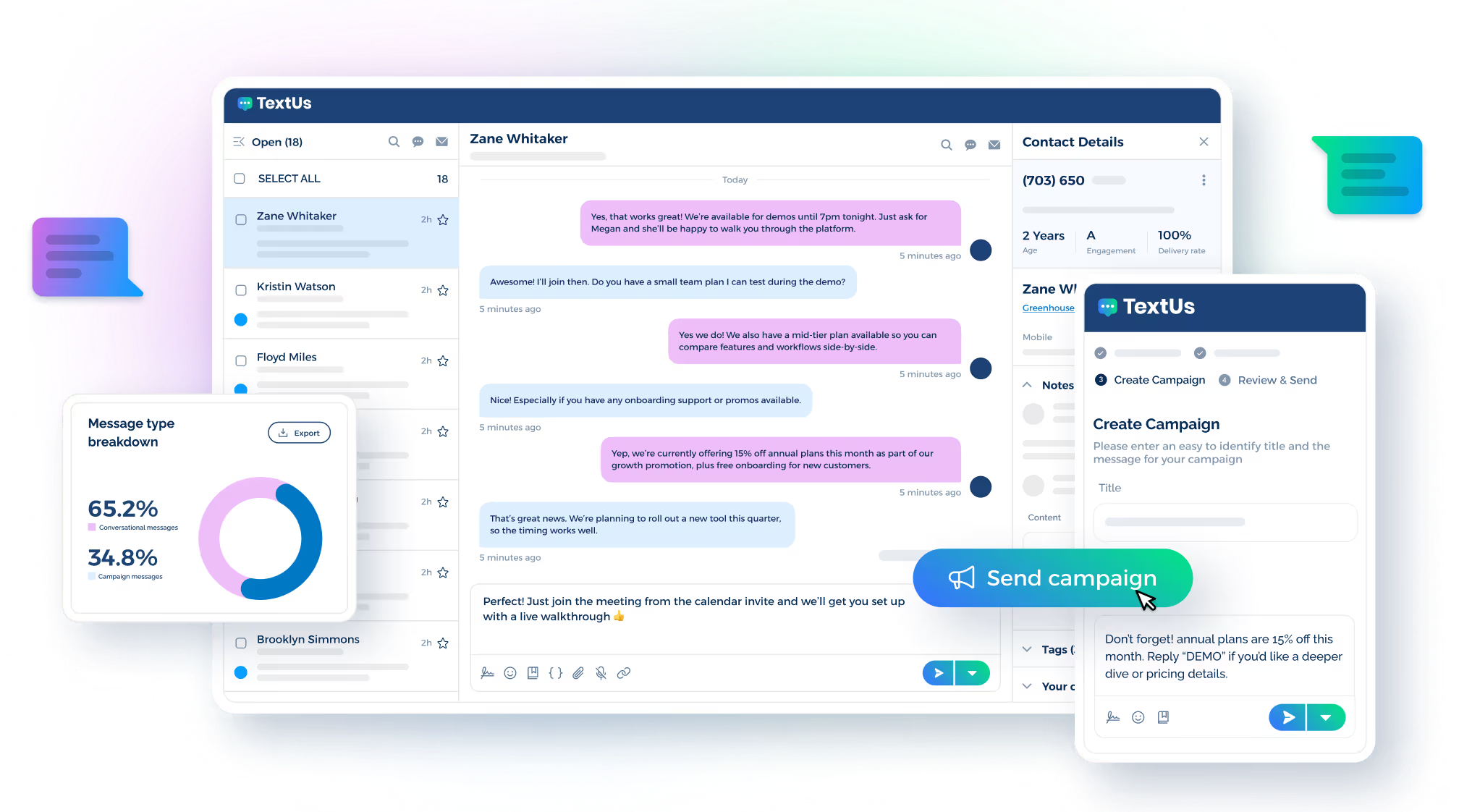
Tracking conversion rate is only useful if your platform gives you something to act on. TextUs is built for exactly that. It is a business texting platform designed for revenue teams, and it treats every campaign as something to measure and optimize, not just send.
The conversion levers covered in this guide are built into the product. Campaigns support segmented and personalized sends with built-in A/B testing on copy and calls to action, so you can test one variable at a time and keep what wins.
The shared Inbox routes every reply to the right teammate in real time, which protects the fast response windows where conversions actually happen.
Automation handles drip sequences, scheduled sends, and behavior-triggered follow-ups. Campaign analytics reports delivery, response, and failure data, while supported links and CRM integrations can provide additional click and outcome data.
TextUs also protects the number before you ever hit send. The Message Quality Indicator scores each message for spam risk in real time, and Smart Delivery monitors opt-out rates and pauses campaigns that put your sender reputation in danger.
Native integrations with Salesforce, HubSpot, and Bullhorn keep conversion data synced with the systems your team already uses.
Ready to turn SMS into a measurable pipeline? Book a demo with TextUs today!
Continue Reading



Frequently Asked Questions
How much does SMS marketing cost per message?
It depends on how you define a conversion. TextUs benchmark data for information services shows average conversion rates of 15 to 25% when conversions include replies and link clicks. E-commerce purchase-only benchmarks run much lower.
Compare against your own campaign history first, and use a platform like TextUs to track the trend accurately.
What is a standard SMS rate?
In the United States, sending a marketing text typically costs between $0.01 and $0.05 per message, with rates dropping at higher volumes. TextUs pricing is based on team size and message volume, so you pay for what fits your program.
What is a good SMS click rate?
Click-through rates in the 14 to 22% range are typical for information-focused texting programs. Clear calls to action, tracked links, and good timing push you toward the top of that range, and TextUs analytics show you exactly which messages earn the clicks.
Business Texting
Built for Results
Create and convert pipeline at scale through industry leading SMS software