Should you Build or Buy your SMS?
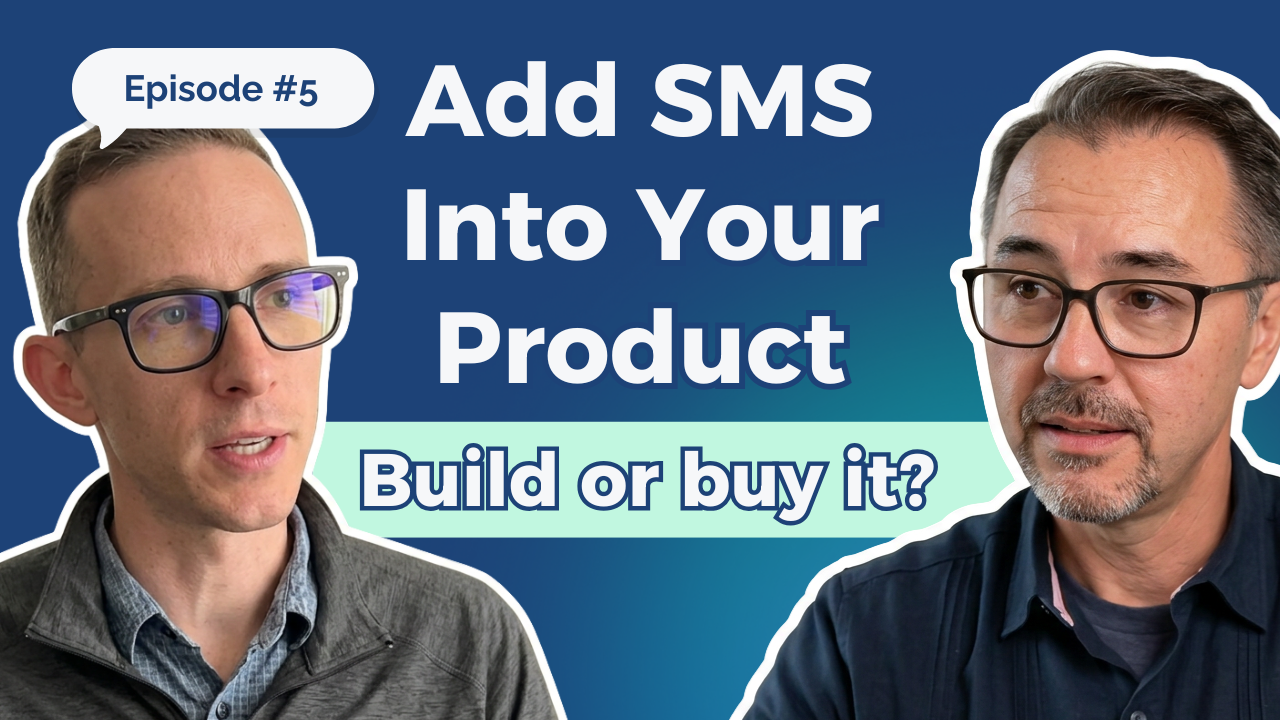
In this episode, TextUs CEO Martin Payne joins Andrew Davis to break down the real costs of building SMS features, the compliance and deliverability challenges most teams underestimate, and why more software companies are choosing embedded or white-label messaging solutions instead.
You'll walk away learning:
✅ When it makes sense to build SMS yourself
✅ The hidden engineering and maintenance costs of messaging infrastructure
✅ How SMS compliance, carrier regulations, and 10DLC impact your product roadmap
✅ Why SMS can improve retention, stickiness, and customer engagement
✅ The difference between API-based, embedded, and white-label SMS solutions
✅ How SaaS companies are generating additional revenue through messaging
Where to Dig Deeper
Tools + Content
Read the full episode transcript
Andrew Davis: All right, let's get started. Welcome to our viewers and listeners exploring white label and other SMS capabilities. This is "The Hidden Costs of Building SMS — and What You Should Do Instead." I'm Andrew, here with the TextUs team, and I'm joined again by Martin, CEO of TextUs, who's become one of the foremost experts in this space — including white label and feature building. Martin, welcome back.
Martin Payne: Thanks for having me, Andrew. Good to see you again.
Andrew: Likewise. Today we're tackling a question I think you and I are both very familiar with. We hear it from product leaders almost daily: should you build SMS into your product, or should you buy it? A lot of people don't even know that second option exists. It sounds like a simple back-and-forth — build it in-house, or buy it — but one path can be extremely expensive, and the other can be an easy button. Martin and I are going to walk through exactly how to think about this for your product, your business, and your customers.
Before we get into it — give me your 30-second take on why this conversation matters right now, in 2026.
Martin: If you're a CEO or a chief product officer at a software company, you're looking for ways to improve stickiness, drive retention, increase deal sizes, and — in this day and age — find more variable sources of revenue, not just seat-based revenue. Texting gives you all three. It's a great complement to whatever functionality you've already built.
Andrew: Couldn't agree more. And I think what gets lost for a lot of product people is that you're not just adding a feature for stickiness — there's an entirely new revenue stream there too, and that gets forgotten.
Let's start with the "why now." Five or ten years ago, it didn't feel like many products had SMS in their feature set — mostly the massive companies were doing it. It felt like an afterthought, maybe transactional at best. Today, it's showing up across small, mid-market, and enterprise SaaS. It feels like you're getting left behind if you don't have it. What's actually changed?
Martin: A couple of things. Email has been the workhorse for marketing, HR, and most async communication for so long that the inbox has gotten cluttered — it's hard to break through. That's one: the commoditization of email. The second is the rise of mobile. Everyone's used to having a phone, and people are willing to give their number to brands they trust, as long as those brands are careful about how they use it.
There's also a usability piece — nobody wants to download a separate app just to talk to a vendor. It's nicer to consolidate everything into one inbox. That's SMS.
Andrew: You mentioned people being attached to their phones — is that generational, or is it broader adoption across the board?
Martin: It's not generational at all, which is counterintuitive. Our State of Texting report breaks this down by age, and even Gen X and boomers are surprisingly receptive to being contacted over text.
Andrew: I've noticed that too. I used to assume it was a millennial/Gen Z thing — but I call my parents and they barely pick up the phone. They text constantly.
Martin: Honestly, we can thank the younger generation for that. If grandparents want to stay in touch with their grandkids, they need a phone and they need to message — it's nearly impossible to get a grandkid on a call. But texting keeps the frequency of communication high.
Andrew: So we've covered mobile-first adoption. But there's also the business side — degrading performance in traditional channels. Email and phone connect rates are trending down, especially with carriers now flagging spam calls before they even reach the phone. Do you think there's a revenue angle here too — bigger deal sizes — or is it more about retention?
Martin: Both, absolutely. We have white label customers at real scale, and we can see the usage and retention dynamics clearly. Cohorts with texting retain significantly better. And separately — texting is often sold and priced as its own package, so when it's bundled with the core product, there's a real lift in ACV.
Over time, the engagement lift is dramatic — we typically see 5x to 10x over email. And interestingly, seat growth has slowed industry-wide, probably due to AI-driven productivity gains, but messages per user keep growing because messaging itself is a productivity lift. More engagement drives more pipeline, more candidates, more deals.
Andrew: The case for SMS itself seems airtight. Which leads to the real question this episode is about: once a team decides they want SMS, the next question is — do we build it ourselves? "How hard can it be?" Walk me through what people don't see when they ask that.
Martin: It really comes down to use case. If you're doing two-factor authentication, that's simple — you send a notification, there's no back-and-forth, no real conversation. End of story.
Andrew: Like a transactional email.
Martin: Exactly. But for the use cases we're talking about — usually a system of record, or a key workflow tool inside an organization — it's far more complex. Performance matters: when you send a campaign, you need to maximize response and engagement. That could be candidate sourcing, consumer acquisition, B2B outreach. Once there's engagement, there's often an ongoing conversation, increasingly handled by AI, and often a human gets looped in too. At that point it becomes a one-to-one conversation, and that's where compliance becomes a serious consideration.
You have to register for 10DLC — that process alone takes time and gets heavily scrutinized. Once registered, every message you send gets monitored. The upside is that monitoring filters out a lot of junk; without it, SMS would look a lot like email. But the downside is you have to know the rules. Send too many spam messages, or have too high an opt-out rate, and you can get your wrist slapped — or shut down entirely.
There's also the data layer: conversation history, opt-out history, all of which has to be stored and managed properly. Add AI on top of that, and the gap between an average message and a well-crafted one is 2 to 3x in response rate. There are real layers of expertise required to maximize ROI on this channel.
Andrew: Why do you think there's so much more regulation around SMS than email?
Martin: It starts with the FCC. Telecom is governed by the Telephone Consumer Protection Act — TCPA. Email doesn't fall under that, but anything related to phone — voice and SMS — does, and that regulation is strict. There are specific words you legally can't use in certain contexts. On top of the legal layer, every mobile carrier adds its own acceptable use policy, usually stricter than the law itself, because carriers want a buffer between "acceptable" and "illegal." And every carrier does this differently, so filtering varies. It's a lot to track — fortunately, the data that fuels our AI helps customers stay in the safe zone and steer toward higher engagement.
Andrew: Right — and most product teams don't even know these regulations exist until they're already building. So there's a knowledge barrier. The other barrier — and I think every SMS provider quietly smirks at this — is the ongoing engineering and maintenance cost. I've heard numbers like $2,000–$3,000 a month just in support. Is that accurate, and can you give more context?
Martin: That number is really just the support person — setting up phone numbers, helping customers through 10DLC registration, getting people unblocked when they've sent too much spam, training teams on how to write compliant messages. If you want anything remotely interesting functionally, you're looking at a couple of full-time engineers at minimum, because the technology moves fast — RCS is coming, which is essentially WhatsApp-style functionality over SMS rails. Then there's analytics to prove ROI against email, plus the machine learning layer on top. To stay competitive, you need all of these layers running. Even being highly productive, two to three engineers puts you at $300,000–$500,000 a year. Add WhatsApp at scale, and you could be in six figures per quarter.
Andrew: We've both seen customers attempt this and either fail outright or massively underestimate the cost. So that's the build side. What does buying — or really, partnering — actually save you?
Martin: You're typically looking at 9 to 12 months just to reach v1 if you build it yourself. With us, the app already exists — send, receive, deliverability, compliance, the AI that powers it, plus the full application layer: campaigns, contact import from your own database, multiple apps for one-to-one conversations across web, mobile, and a Chrome extension, all white-labeled. You can get to market in three months or less if you're an AI-enabled team. That's a massive time advantage. If your message volume is small to medium, we can usually offer a competitive price relative to building your own. And over the long run, the quality difference shows — you're not shipping an MVP, you're shipping something we've spent years refining.
Andrew: And even after you ship an MVP, you're still years away from a truly polished SMS experience. We've had integration partners tell us directly — "our SMS isn't good enough, we'd rather put our users on yours" — because building it themselves was too big a lift relative to what they actually wanted to focus on. Quality is something people underestimate.
Martin: For sure. The analogy I keep coming back to is Stripe. Nobody builds their own payment gateway anymore — they integrate Stripe because it's high quality, reliable, and easy. You're dropping a script tag onto a page, with some setup, but it's an order of magnitude faster than building your own.
Andrew: Simplicity, quality, cost savings — it all adds up. And there's a real competitive angle here too: founders building SMS as a side feature are competing against companies whose entire engineering org wakes up thinking about deliverability and message quality. That's a hidden cost with no dollar figure attached — but it's real.
Let's say someone watching is convinced — they want to buy, not build. What does buying actually look like in practice? Is it API? Embedded messenger? Full white label? Walk me through the paths.
Martin: Some customers just integrate with our API to get carrier operations efficiency, 10DLC registration handled, and access to more advanced features — that's the lightest touch. But most customers actually white label our software so it looks and feels like theirs. They package it — usually into a "good, better, best" tier, often the middle or top package. The common approach is using an iframe: a snippet of code that drops our interface directly into your product, so it looks native — like a modal or window inside your own software. Single sign-on means there's no separate login required, so the whole experience feels seamless.
Andrew: The embedded messenger is genuinely a great feature — we use it internally in our CRM, and it removes a ton of back-and-forth. How does a team know which path — API, embedded, or full white label — is the right one for them?
Martin: It depends on the use case. If campaigns are core to what your users want — creating and executing them — our web app experience is going to be easier to deliver, along with related automations like sequences and keywords. But if your users are mostly having one-to-one conversations, the embedded iframe feels better, because it sits right on a contact page, pulls context in the background, and any messages sent through it get logged back to that contact record automatically. It's a more native experience — no separate windows to manage.
Andrew: You mentioned contact pages — that's making me think of insurance agencies, CRMs, marketing automation platforms — anything with a "contact" object where people want to message in the same window. If you were a CPO trying to figure this out, what two or three questions should you be asking yourself?
Martin: First: you probably already know your ICP and your core differentiator. The question is whether messaging — specifically SMS — is part of that core, or adjacent to it. If it's core, you should probably build. If it's adjacent — important, but not where your team's expertise should be invested — that's where buying makes a lot of sense.
Second: how realistic is it for your team to actually build this well? What's the real risk? SMS is more complicated than it looks, for all the reasons we've covered. And third: look honestly at the time and cost tradeoffs — especially the engineering budget you'd otherwise spend elsewhere.
Andrew: Other questions I'd add: speed to market — how fast can you actually move? And compliance ownership — who in the org is going to own that, or do you want a partner who already does? Those are the kinds of things a good CPO weighs.
For anyone who wants to go deeper on this framework, we built a Build vs. Buy SMS Buyer's Guide that walks through these questions in more detail, including cost modeling — we'll link it at the end.
Quick recap before we wrap: if there's one thing to take from this conversation, it's that SMS doesn't feel optional anymore. If you're running a software company in 2026 or 2027, and any kind of communication is expected between your users and their contacts, you need an SMS component. For SaaS companies that want engagement, retention, and bigger deals — without the headache — building it yourself is more expensive than it looks, with hidden costs around every corner: ongoing compliance, engineering load, maintenance. And you may still end up shipping something that isn't best-in-class, while pulling your team's focus away from what should be a side feature, not a second core product.
If you decide to buy, you've got clean paths: go API if that control matters most, or go embedded or full white label if you want a seamless, ready-made revenue stream you can start selling right away.
Martin, anything else worth calling out before we close?
Martin: I'd end where we started — the big "why." Companies want larger deal sizes through easy, adjacent sells to their core product. Messaging drives that. Once people are messaging inside your product, stickiness and retention improve, and expansion opportunities grow with it. On top of that, in a time when seat-based revenue is under pressure, this gives you a volume-based revenue stream — wrapped in a faster time to market and lower operating expense. The economics are compelling, and in an era where so many applications are embedding things like Stripe, this is really the same play for messaging.
Andrew: Couldn't agree more. If you're sitting with this decision, head to the link on screen and grab the Build vs. Buy SMS Buyer's Guide — it's the fastest way to go from "I think we need SMS" to "here's exactly what we should do about it." And if you want to talk through your specific situation, request a demo for White Label at textus.com, and we'll get one of our experts on the phone with you. Martin, thanks for the time — really appreciate it.
Martin: Thanks, Andrew. Good to see you again.
Want the full framework? Get the Build vs. Buy SMS Buyer's Guide or book time with Andrew to talk through your specific situation.