
Twilio Pricing: What's Driving the Cost Behind Every Text?
Explore Twilio pricing plans and learn how their pay-as-you-go works. Discover why TextUs's flat-rate pricing may be a better fit for your business.

Written by
Adam Hamdan
Published
January 15, 2026
Twilio is a flexible communications platform built for businesses that want full control and are comfortable piecing together multiple APIs.
But if you’re running a growing business and relying on Twilio for SMS, voice, or WhatsApp, keeping track of costs can become a full-time job.
What starts as a simple per-message or per-minute rate can turn into a mix of carrier fees, regulatory charges, and usage-based add-ons you didn’t plan for.
In this article, we’ll break down what drives up Twilio's cost and look at what the real numbers can mean for your budget. We’ll also explore an alternative SMS marketing platform built to deliver powerful business texting without the technical headaches or surprise fees.
TL;DR
- Twilio offers flexible, usage-based pricing across SMS, MMS, voice, email, WhatsApp, and video APIs, but each service is billed separately and includes extra fees.
- Twilio’s SMS rate starts at $0.0083 per segment, with higher rates for MMS, RCS, WhatsApp, and monthly phone number rentals.
- Additional services like Voice, Conversations API, and Video include per-minute or per-user pricing, plus storage, transcription, and media fees.
- Carrier surcharges and regulatory fees make billing more complex and harder to predict.
- TextUs is a better fit for business texting teams looking for a white-label marketing tool with flat-rate pricing, automation, built-in compliance support, and no technical setup.
Twilio's Pricing Plans: A Detailed Breakdown
Twilio offers pay-as-you-go APIs for SMS, voice calls, email, video, and more. Its pricing can be complex, with different rates for each service and additional fees for carriers and compliance.
Below, we break down Twilio’s costs across key services to give you a better picture of what you’d pay.
SMS/MMS Messaging
Twilio charges on a per-message segment basis for SMS. In the United States, the base rate is $0.0083 per SMS sent or received. This applies to messages sent via local ten-digit numbers, toll-free numbers, and short codes alike.
Twilio charges a monthly rental for each phone number type you use on the platform. A standard local number is $1.15 per month, and a toll-free number costs $2.15 per month.
Multimedia messaging service (MMS) messages cost more than SMS on Twilio. In the U.S., sending an MMS is about $0.0220 per message, and receiving an MMS via a local or short-code number is $0.0165.
These MMS fees are per message, but keep in mind MMS size limits. If a message is large and gets split by the carrier, it could count as multiple messages. It can impact payment tracking for high-volume customers.
RCS Messaging
Rich Communication Services (RCS) messages cost the same as SMS at $0.0083 per message sent or received. If you're sending richer media, the price goes up to $0.0220 to send and $0.0165 to receive.
RCS is a good use case if you want a more engaging experience than traditional texting. Using first-party data can enhance message personalization and interaction rates in these campaigns.
WhatsApp Business API via Twilio
Twilio is an official provider of the WhatsApp Business API, and the pricing model is different from SMS.
WhatsApp uses conversation-based pricing where you're charged per 24-hour conversation session, initiated either by a template message from the business or by a user message. Twilio’s role is to pass through WhatsApp (Meta) fees and add a small markup.
Twilio charges a flat $0.005 per message sent or received over WhatsApp. These charges often vary by country and message type and may require reviewing Meta’s documentation to stay compliant and informed.
Voice API Pricing
Twilio’s voice API enables both inbound and outbound phone calls. Outbound calls from your Twilio number to a U.S. phone cost about $0.0140 per minute for standard local calls. Inbound calls are a bit cheaper on a local number, which costs $0.0085 per minute.
However, if the inbound call is to a toll-free number, it costs about $0.0220 per minute for the business receiving the call.
Conversations API Pricing
Twilio’s Conversations API lets you manage two-way messaging across channels like SMS, WhatsApp, and chat in one place.
With the pay-per-active-user model, you’re only charged for people who actually use the system in a given month. An “active user” is anyone who sends or receives messages, based on their phone number, email, or other ID. It starts at $0.05 per active user per month.
For the pay-for-media-storage plan, you can send images, videos, or files in their conversations. Twilio then stores that media, and you’re billed based on how much is stored. Cost starts at $0.25 per GB of media per month.
This is useful if you’re managing large volumes of customer data, rich content, or compliance logs across teams. The API offers flexible access to build internal workflows, but may require a request for support or additional information to optimize storage tiers.
Call Recording and Transcription
Twilio allows you to record calls and even transcribe them, but these features incur additional fees.
If you enable call recording in Twilio, the audio recording is stored and billed per minute recorded. Twilio charges about $0.0025 per recorded minute for recording processing.
Storing the recordings on Twilio’s cloud is free for the first 10,000 minutes of recordings each month, after which storage costs $0.0005 per minute per month.
Twilio can also transcribe recorded voice calls. This is a premium service at about $0.05 per audio minute. Twilio’s transcription uses automated speech recognition, which is convenient but relatively expensive if you have high call volume.
Twilio SendGrid Email API
Twilio SendGrid provides email delivery services with a mix of free and paid tiers.
The free trial allows you to send up to 100 emails per day for 60 days in some promotions to try out the service. There are three main paid plan levels: Essentials, Pro, and Premier.
- Essentials plan (Starts at $19.95 per month) - This entry-tier is for lower volume senders. The base Essentials plan includes around 50,000 emails per month of sending capacity.
- Pro plan (Starts at $89.95 per month) - This is geared toward higher volume and comes with more features. The base Pro includes 100,000 - 2,500,000 emails per month of sending volume.
- Premier plan (Custom pricing) - This is a customized plan for large enterprises, with pricing negotiated on a case-by-case basis. Premier plans can include multiple dedicated IPs, priority support, and a dedicated account manager or deliverability consulting.
Twilio Video API Pricing
Twilio’s Video API enables multiparty video calls, think of building your own Zoom-like service. The pricing is usage-based at $0.004 per participant per minute in a Group Room. If one person drops off early, you stop paying for that person’s minutes.
It also offers some features that incur cost if used, such as recording a video session. It costs another $0.004 per participant-minute because they record each participant’s stream. Composing a merged recording also costs $0.01 per minute of video.
Carrier Passthrough Fees
U.S. carrier surcharges are applied on A2P (application-to-person) SMS/MMS. Twilio automatically adds these fees on top of the base price.
For example, the major mobile carriers charge roughly $0.003 to $0.0025 per SMS/MMS on their networks (AT&T and T-Mobile) and around $0.004 to $0.0065 for Verizon.
Some smaller/regional carriers impose surcharges up to ~$0.01 per message. For MMS, the carrier fees are higher (e.g., T-Mobile adds ~$0.01 per MMS).
Regulatory and Compliance Fees
If you're using long codes for A2P messaging in the U.S., you must register your brand and campaigns due to carrier requirements.
Twilio charges a one-time $4 brand registration fee and monthly campaign fees as mandated by carriers. They also recently introduced a $0.001 fee for each failed message.
While only a fraction of a cent, this “failed message processing fee” can add up if you have large volumes of messages that don’t go through.
Is Twilio the Right Fit for Your Business?
Twilio's pay‑for‑what‑you‑use pricing model works well at low volumes and scales as your usage grows. But with that flexibility comes complexity.
You’ll need to monitor multiple charges on carrier fees, regulatory add-ons, media storage, and API usage, especially if you have teams operating across the world.
The platform itself is built for developers. To use Twilio beyond simple messaging, you’ll need strong engineering support and an understanding of how to manage security and system dependencies.
There’s also no built-in dashboard for contact management and shared inboxes unless you build them yourself or rely on third-party tools. That makes it harder to maintain data quality and a consistent communication flow.
If you need a complete messaging workflow, you’ll likely end up stitching together multiple APIs, building custom interfaces, and managing integration across several product categories.
While Twilio offers volume discounts, its pricing model can become expensive as usage increases. Per‑message rates are higher than those of alternative providers, and carrier fees are added on top. Paid support plans are also required if you need faster or round‑the‑clock assistance.
Overall, Twilio is a good choice if you need to build something custom, have developer support, and want complete control. But if you're looking for an easier way to send and manage text messaging, Twilio may be more complicated and expensive than expected.
Why TextUs Is a Better Option for Business Text Messaging
If your main goal is to use SMS marketing for business communications, TextUs is a great alternative to Twilio. It’s a dedicated business texting platform, and it emphasizes ease of use and a full feature set out of the box, rather than a build-your-own approach.
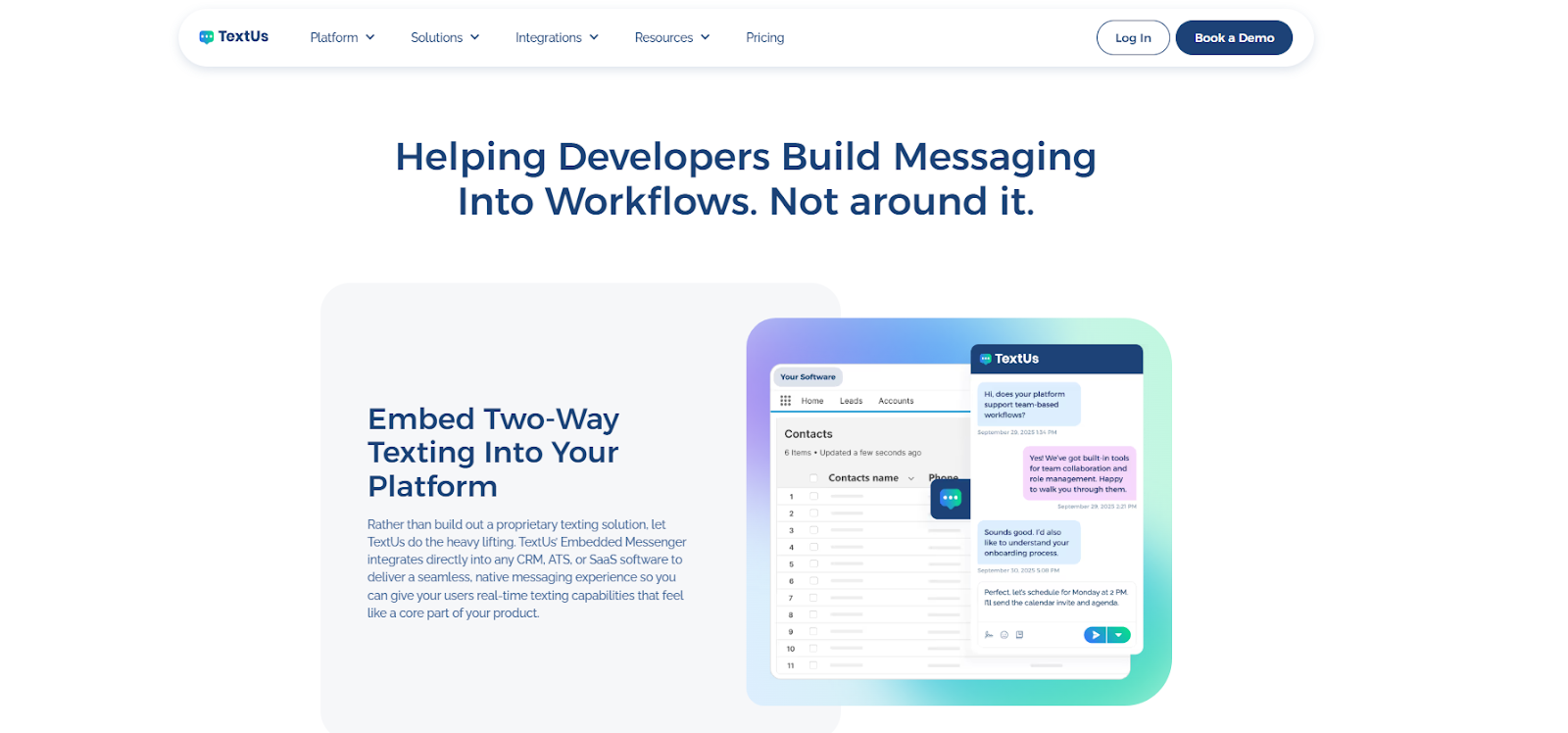
TextUs offers a predictable, business-friendly subscription model. The base subscription is $299 per month for Pro and includes 5,000 messages and 5 phone numbers.
As your team or message volume grows, you can easily add users or purchase more credits without worrying about fluctuating costs or hidden fees. This gives you a more stable estimate of your monthly spend.
TextUs also comes with all the SMS marketing features that you would otherwise have to build or bolt on with Twilio.
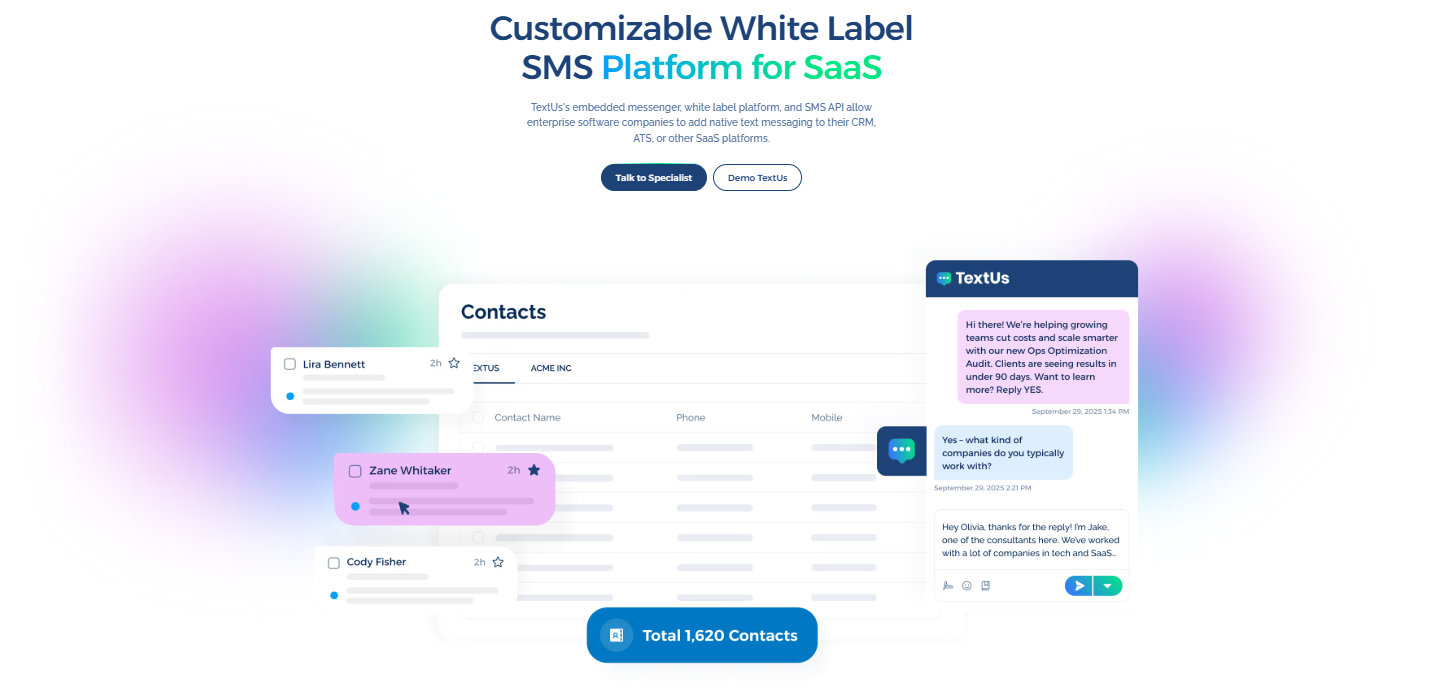
SMS marketing automation and drip campaigns are built into the TextUs platform. Shared team inboxes and collaborative tools allow multiple team members to manage incoming texts together.
Features like SMS templates, opt-out management, link-click tracking, and contact management are all first-class features of TextUs. Many of those would require separate implementation or third-party services compared to Twilio.
Finally, TextUs also offers SMS integrations with other business systems that would take a huge effort to replicate on Twilio’s raw APIs.
Skip the Coding—Switch to TextUs for Simpler Business Texting!
If you’ve found Twilio too hands-on or have outgrown simplistic texting tools, TextUs offers a balanced middle ground with sophisticated features and predictable costs.
Since TextUs is a hosted solution with a web interface and mobile apps, it’s immediately usable by non-technical staff. Your sales reps or support agents can log in to TextUs and start texting from a professional number via a user-friendly inbox interface, similar to email.
This SMS platform also offers tools and guidance to support compliance with texting regulations, making the onboarding process smoother if you're still unfamiliar with messaging rules.
TextUs is optimized for real-time, two-way conversations as it notifies you of incoming texts, supports emojis, and MMS messaging. This enhances team efficiency and responsiveness, which can help you connect faster and close more deals through texting.
FAQs About Twilio Pricing
Is Twilio free for SMS?
Twilio isn’t free for SMS, but it does offer a small amount of free trial credit when you first create an account. After that, every message you send or receive is billed per Twilio segment.
In the U.S., the base SMS rate is about $0.0083 per segment, with additional carrier fees on top, usually ranging from $0.003 to $0.0065 per message. These small charges add up quickly for Twilio users with high message volume.
Smaller teams looking for responsive phone support may also find Twilio's options limited unless they upgrade to paid support tiers.
How much does Twilio charge per phone number?
Phone number pricing depends on the type of number. In the U.S., a local number typically costs $1.15 per month, while a toll-free number costs $2.15 per month.
Short codes also incur much higher monthly costs plus setup fees, depending on availability and provisioning requirements.
How much does Twilio charge per WhatsApp message?
Twilio charges a $0.005 fee per WhatsApp message sent or received. On top of that, Meta’s WhatsApp Business API pricing applies additional per‑template message fees based on the type of template and destination country. Twilio passes those fees through to you.
Is Twilio good for small businesses?
Twilio is a cloud communications platform that works best for companies with developers who can build and manage messaging systems from the ground up. If you lack an internal engineering team or a dedicated account executive to manage integrations, Twilio can be difficult to maintain.
If you're interested in getting started with business texting without building from scratch, TextUs is a better choice. It’s built for sales teams that want to start texting right away, with marketing campaign tools, shared inboxes, automation, and fixed monthly pricing.
Continue Reading



Frequently Asked Questions
How much does Twilio cost for business SMS?
Twilio charges per message sent, typically $0.0079 per SMS domestically plus carrier surcharges and regulatory fees. But the true cost of Twilio includes developer time to build, configure, and maintain the SMS application — which often exceeds the per-message cost significantly.
What hidden costs should businesses know about with Twilio?
Beyond per-message fees, Twilio costs include developer setup and maintenance time, carrier surcharges, regulatory fees, number provisioning, and the cost of building custom features that managed platforms include out of the box.
Is Twilio cost-effective for small and mid-sized businesses?
Twilio can be cost-effective for businesses with development resources and highly custom requirements. For most small and mid-sized businesses without engineering teams, a managed SMS platform provides better value — delivering the features you need without the developer overhead Twilio requires.
Business Texting
Built for Results
Create and convert pipeline at scale through industry leading SMS software