
25 Best Recruitment Automation Software Tools for 2026
Find the best recruitment automation software for your team. Compare TextUs and 24 other tools for outreach, sourcing, screening, ATS workflows, and AI.

Written by
Adam Hamdan
Published
August 31, 2026

Recruitment slows down when administrative work grows faster than your candidate pipeline.
Applications pile up, follow-ups take longer, interviews become harder to coordinate, and strong candidates may accept another offer before your team responds.
The right recruitment automation software reduces repetitive work while keeping your recruiters involved in decisions that require judgment and personal interaction.
In this guide, we will compare different recruitment automation software across five major use cases. You will learn how to find software that fits your existing systems, hiring needs, and plans for growth.
TL;DR
Here are 25 recruitment automation platforms organized around different hiring priorities:
- Candidate engagement: TextUs, Paradox, Sense, Emissary, XOR
- Workflow and ATS: Greenhouse, Workable, Zoho Recruit, Lever, Manatal
- Sourcing and CRM: Gem, hireEZ, SeekOut, Beamery, Phenom
- Screening and interviews: HackerEarth, TestGorilla, HireVue, Codility, Harver
- Enterprise intelligence: Eightfold AI, Workday Recruiting, Avature, iCIMS, SmartRecruiters
Why Choosing the Best Recruiting Software Matters
Some recruitment automation tools offer broad feature sets, but lack the integrations or communication functions your hiring team needs.
A platform that matches your recruiting workflows helps you organize candidate records, send updates, coordinate interviews, and track decisions from one connected system.
The right software also gives you better visibility into candidate progress and outstanding tasks. On top of that, candidates receive more consistent updates, which helps reduce delays and drop-off between recruitment stages.
Your company size, hiring goals, existing interview process, existing systems, and future growth should shape your final choice.
25 Best Recruitment Automation Software by Use Case
A platform that fits your workflows can make the hiring process more organized for your company and more responsive for every applicant.
Here are 25 automated recruitment tools grouped by use case, so you can compare the options that fit your priorities.
Candidate Communication and Engagement
Strong communication keeps applicants informed and helps prevent delays between hiring stages. These platforms are designed to support faster outreach and conversations throughout the candidate experience.
1. TextUs
Candidate communication loses value when replies sit in personal phones, email threads, or separate systems.
TextUs brings outreach, responses, and follow-ups into a shared texting platform that connects with the Applicant Tracking System (ATS) your recruiters already use.
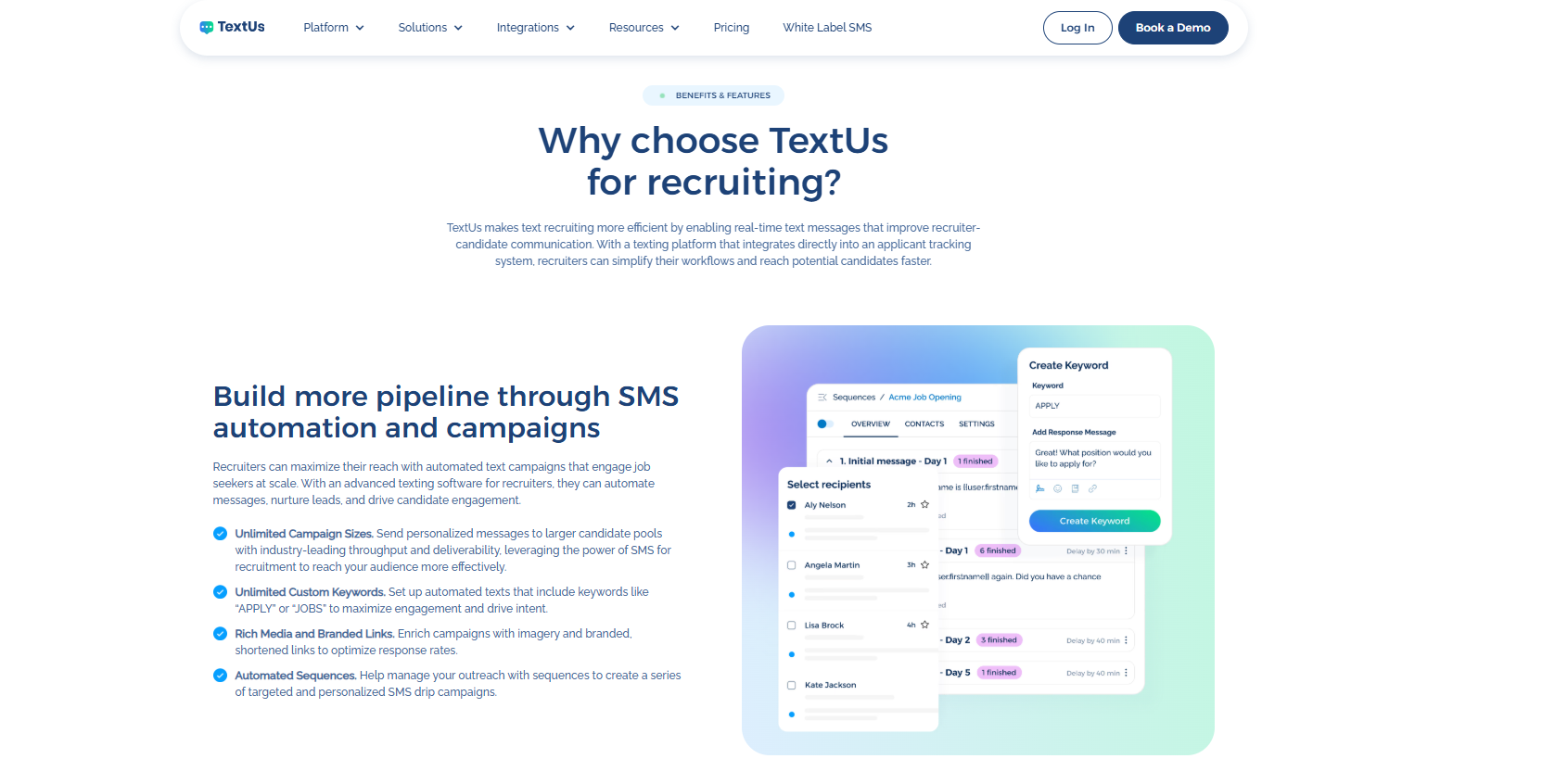
Personalized SMS campaigns support outreach to large candidate groups without turning every message into a generic blast.
You may add merge fields, images, short links, and calls to action, while unlimited campaign sizes give staffing firms room to contact broader talent pools.
SMS keywords will trigger prepared responses and capture interest from candidates who want a faster way to take the next step.
Two-way texting also keeps the conversation open after the first outreach. Shared inboxes give you access to incoming replies, while assignment controls show who owns each conversation.
Templates, scheduled messages, and automated drip campaigns support interview reminders, availability checks, application updates, and follow-ups without needing you to send every text by hand.
Finally, TextUs connects candidate messages with platforms such as Bullhorn, Greenhouse, Workday, and Oracle Taleo. Contact syncing and message logging keep communication history attached to the correct candidate record.
Book a demo with TextUs today to see how this SMS platform can support your candidate communication strategy!
2. Paradox
Paradox is a conversational hiring platform that uses an AI assistant called Olivia to communicate with candidates through text and chat.
Workday completed its acquisition of Paradox on October 1, 2025, and the product is now presented as the Workday Paradox Candidate Experience Agent.
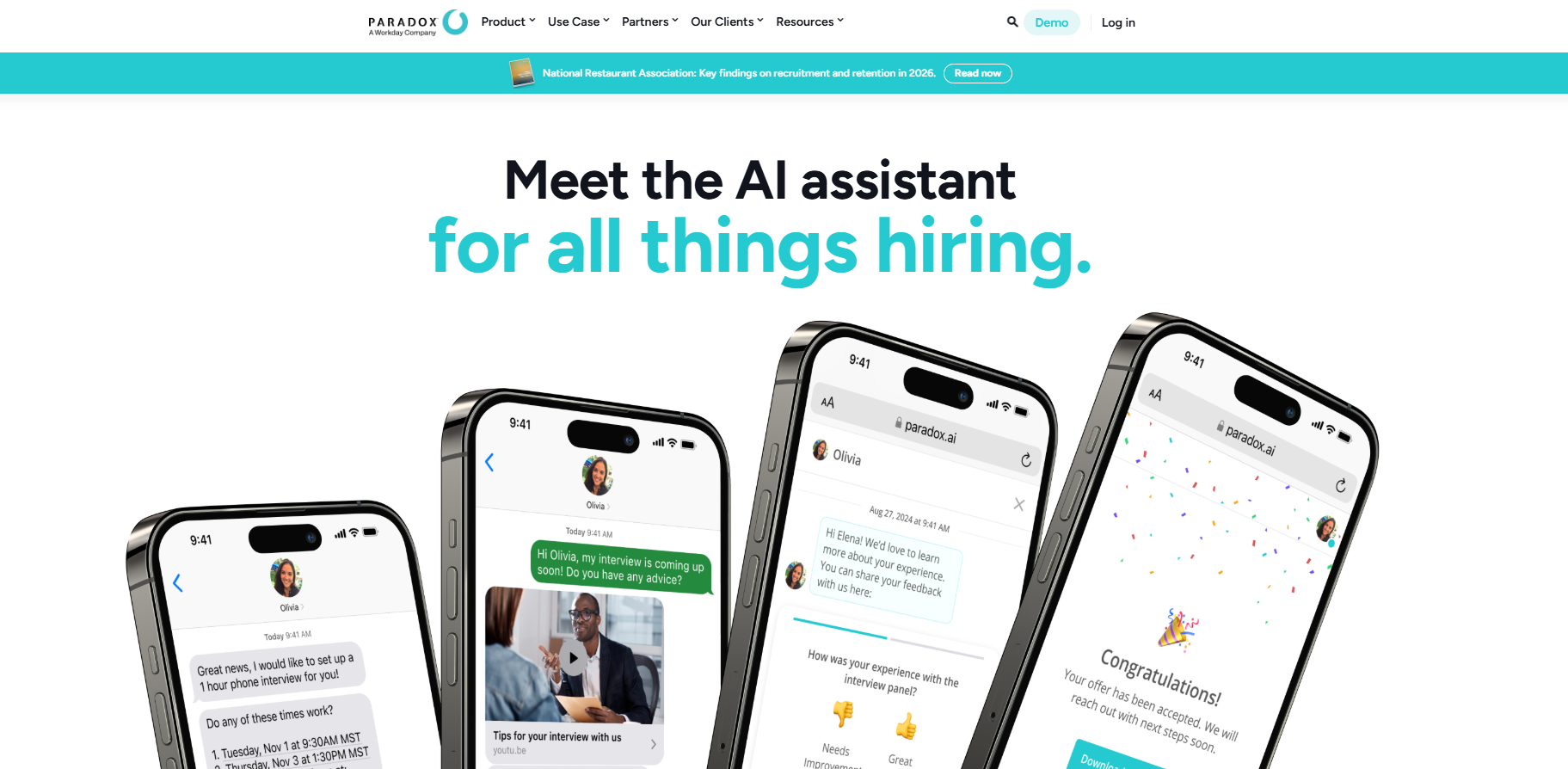
Candidates use the assistant to search for roles, receive job recommendations, ask questions, and complete applications through a conversation.
Its career-site product shares role information, videos, documents, and links based on what a candidate asks about.
Paradox supports candidate engagement after an applicant expresses interest. Olivia asks qualification questions through chat or text and directs the candidate to an interview or a different outcome based on configured rules.
3. Sense
Sense is a talent engagement platform that supports communication through SMS, WhatsApp, email, web chat, and voice.
Its AI Recruiter handles outreach, follow-ups, candidate questions, and job openings across different stages of hiring.
The platform sends trigger-based messages based on candidate activity or changes recorded in the connected ATS.
It also provides an AI chatbot that answers common questions, explains company benefits, shares application updates, and collects screening information.
Its automated workflows use synchronized ATS data to support follow-ups, nurture campaigns, and database reactivation.
You may use these functions to nurture passive candidates, update older records, and reconnect with people whose experience matches current roles.
4. Emissary
Emissary is a text recruiting platform for candidate and employee communication. It supports individual conversations, group campaigns, and chatbot workflows through SMS.
It lets you send one-to-one messages from Emissary’s inbox or through its Chrome extension, which recognizes phone numbers on web pages.
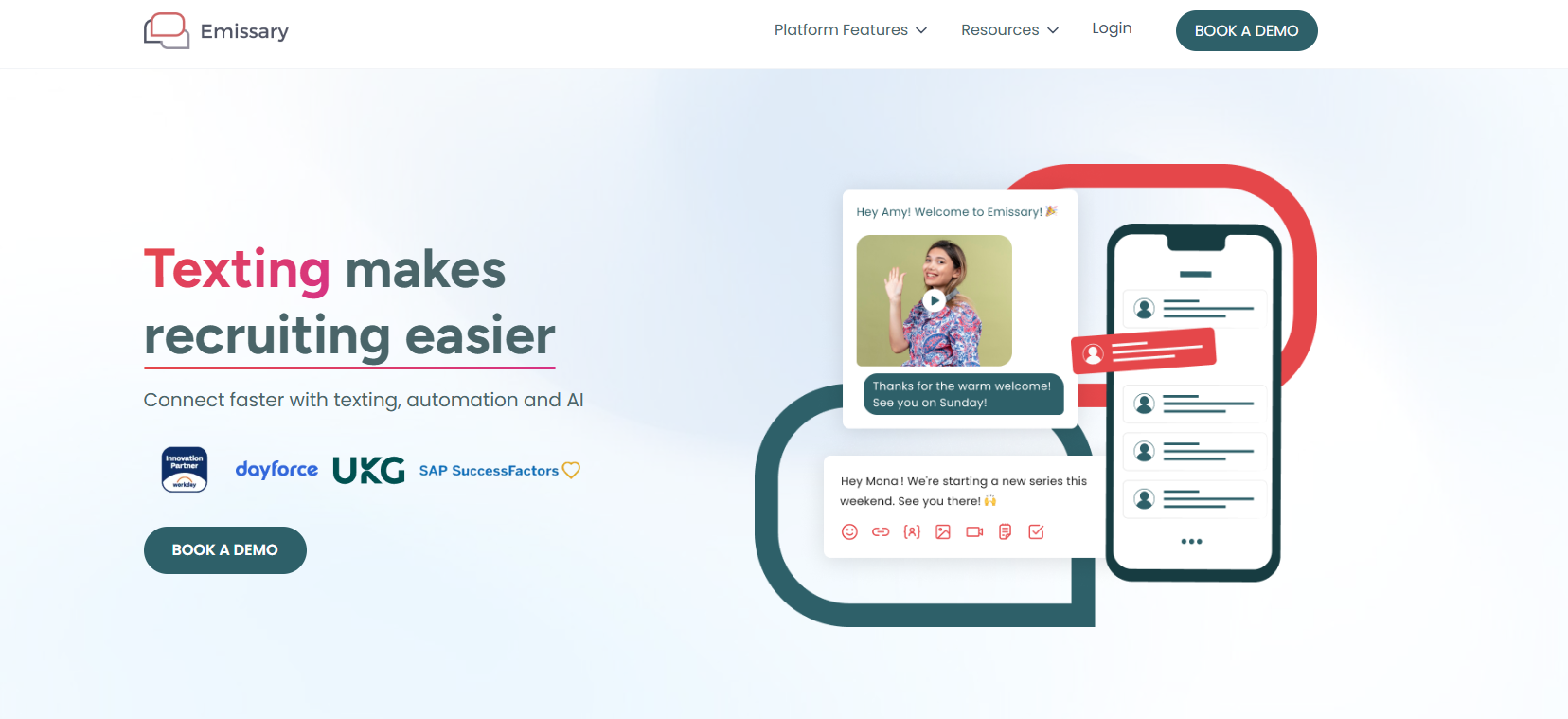
The inbox brings conversations from direct outreach, campaigns, and short codes into one view, with options to flag, tag, search, and share messages across recruiting teams.
Text campaigns support personalized messages for groups ranging from a small candidate list to thousands of recipients.
You may use them for applicant follow-ups, hiring updates, interview reminders, new-hire communication, or reconnecting with past applicants.
5. XOR
XOR is an AI recruiting platform that supports candidate communication through text messaging, WhatsApp, chat, and virtual hiring events.
Its chatbots handle inbound conversations from career sites, job postings, and recruitment campaigns. Outbound messaging helps you contact prospective applicants through text or WhatsApp.
Candidates complete applications through a guided conversation. The chatbot collects contact and work information, creates candidate profiles, and shares relevant roles based on the responses provided.
XOR also supports automated screening through configurable questions and answer scoring. Candidates who meet the configured requirements can be routed to interview booking or recruiter review.
Tracking and Recruitment Workflow Automation
Applicant tracking software brings candidate records, approvals, interviews, and internal tasks into a connected system.
6. Greenhouse
Greenhouse is an applicant tracking and hiring platform that keeps candidate, application, job, and interview information within a central system.
Its structured hiring framework helps teams define role requirements, create interview plans, and evaluate applicants through prepared interview kits and candidate scorecards.
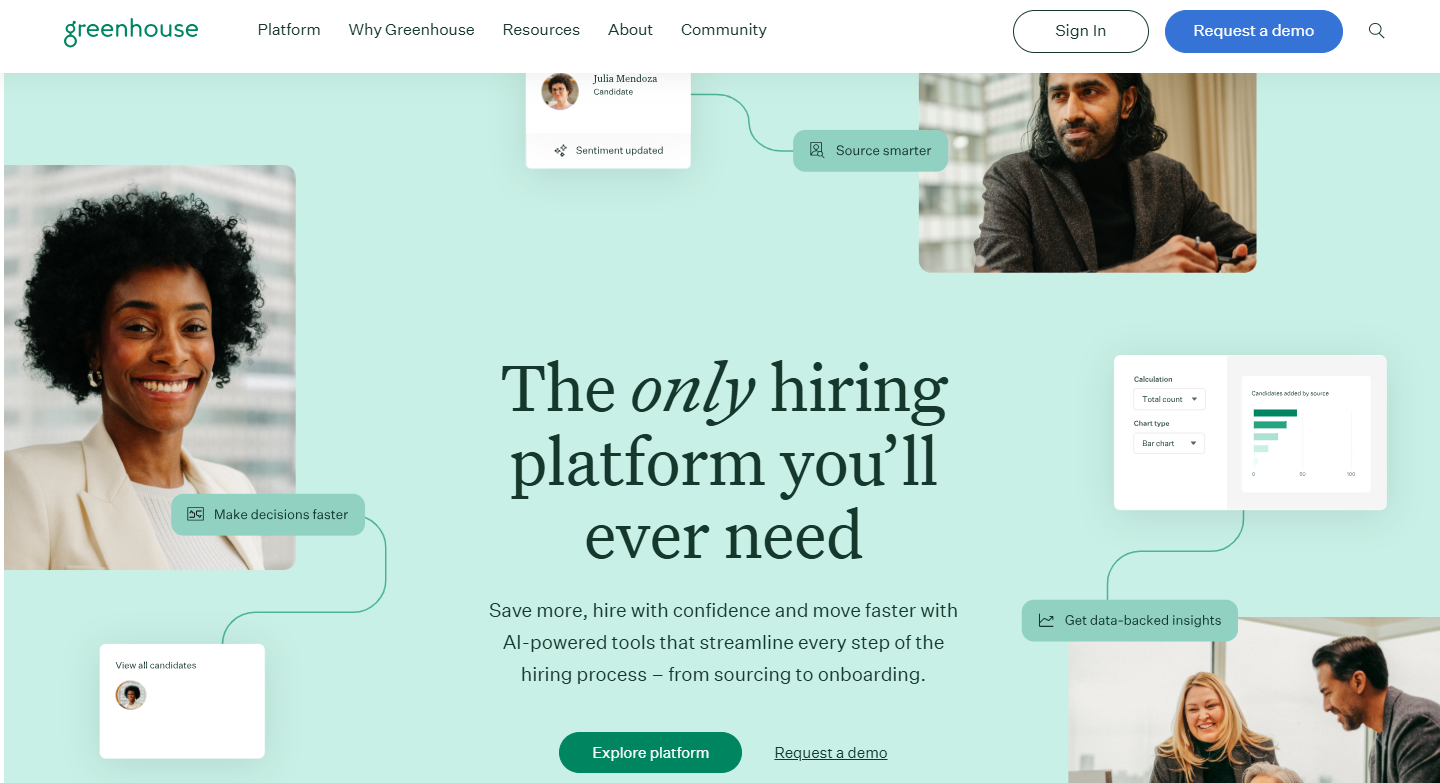
The platform supports job kickoff forms, approval controls, automated reminders, task notifications, and @mentions. Slack integration also sends updates about approvals and outstanding tasks.
Greenhouse provides advanced data configurations, customizable permissions, and custom workflows for different departments, roles, and regions.
Its tracking features support candidates with multiple applications, repeat applicants, bulk actions, and approval workflows.
7. Workable
Workable is an ATS that stores applications, candidate profiles, interview notes, messages, and hiring activity in a searchable database.
Its pipeline management features let you create separate hiring stages for different roles, departments, or seniority levels while keeping those stages connected to a shared reporting pipeline.
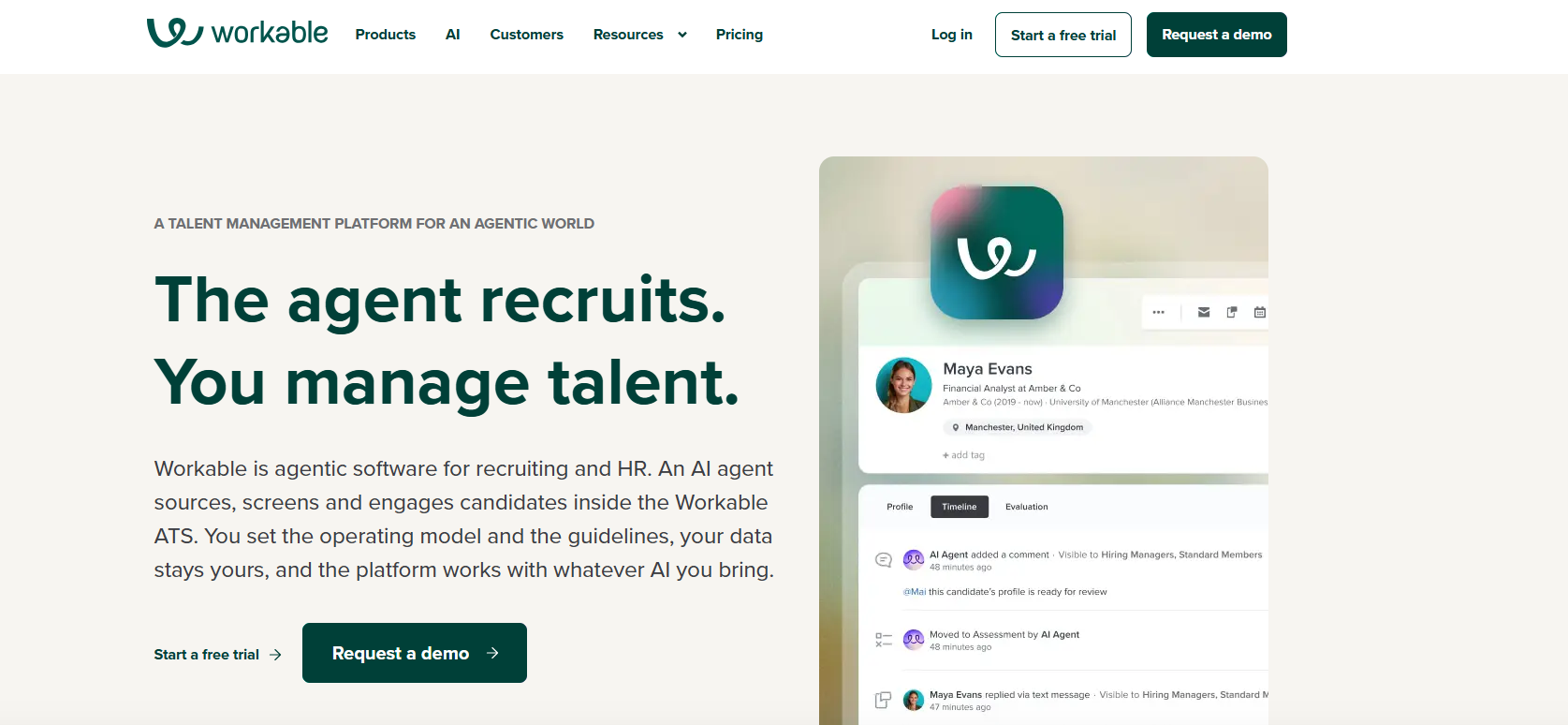
You can move applicants between stages such as phone screening, assessment, interview, offer, and hired. Each stage may include interview kits, scorecards, assessments, video interviews, or other evaluation steps.
Workable’s automation features trigger actions when a candidate enters a selected pipeline stage. Available actions include sending an email or text message and providing a self-scheduling link connected to a recruiter’s Gmail or Outlook calendar.
8. Zoho Recruit
Zoho Recruit combines an ATS with candidate management features for internal HR departments and staffing agencies.
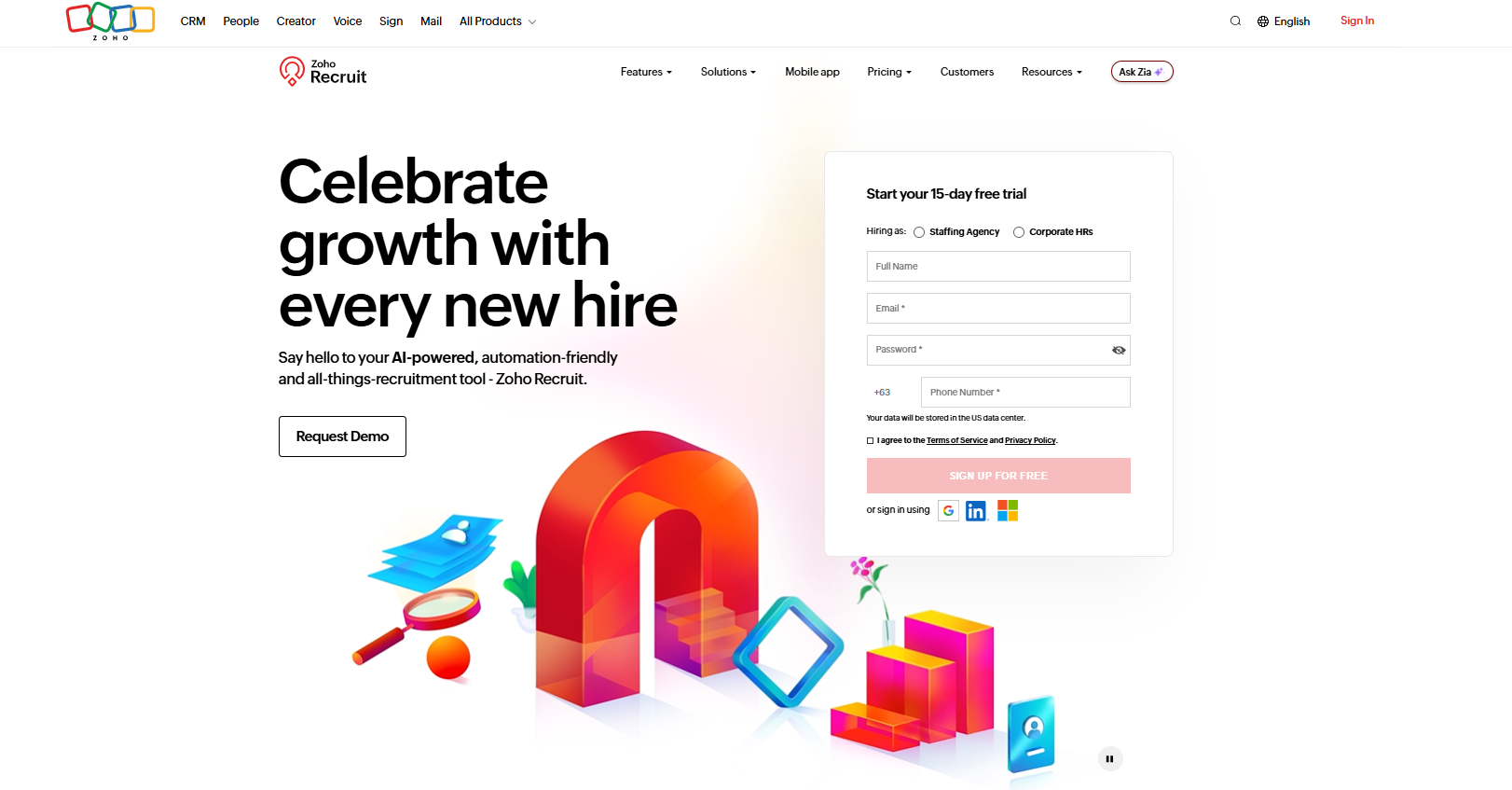
Workflow rules start when a record is created, updated, or reaches a specified time or status.
Based on the conditions set by the administrator, Zoho Recruit sends email or SMS alerts, assigns records to recruiters, creates tasks, updates fields, and schedules actions for a later date.
Its Blueprint feature maps the recruitment process into defined stages and specifies which actions, information, and approvals are required before a record moves forward.
The platform also supports approval workflows for requisitions, offers, and hiring decisions, with separate permissions for users, roles, groups, or management levels.
9. Lever
LeverTRM brings applicant tracking and candidate relationship management into one system.
Candidate profiles, applications, interview activity, communication history, and talent pipeline information remain connected within the same record, including people considered for several roles.
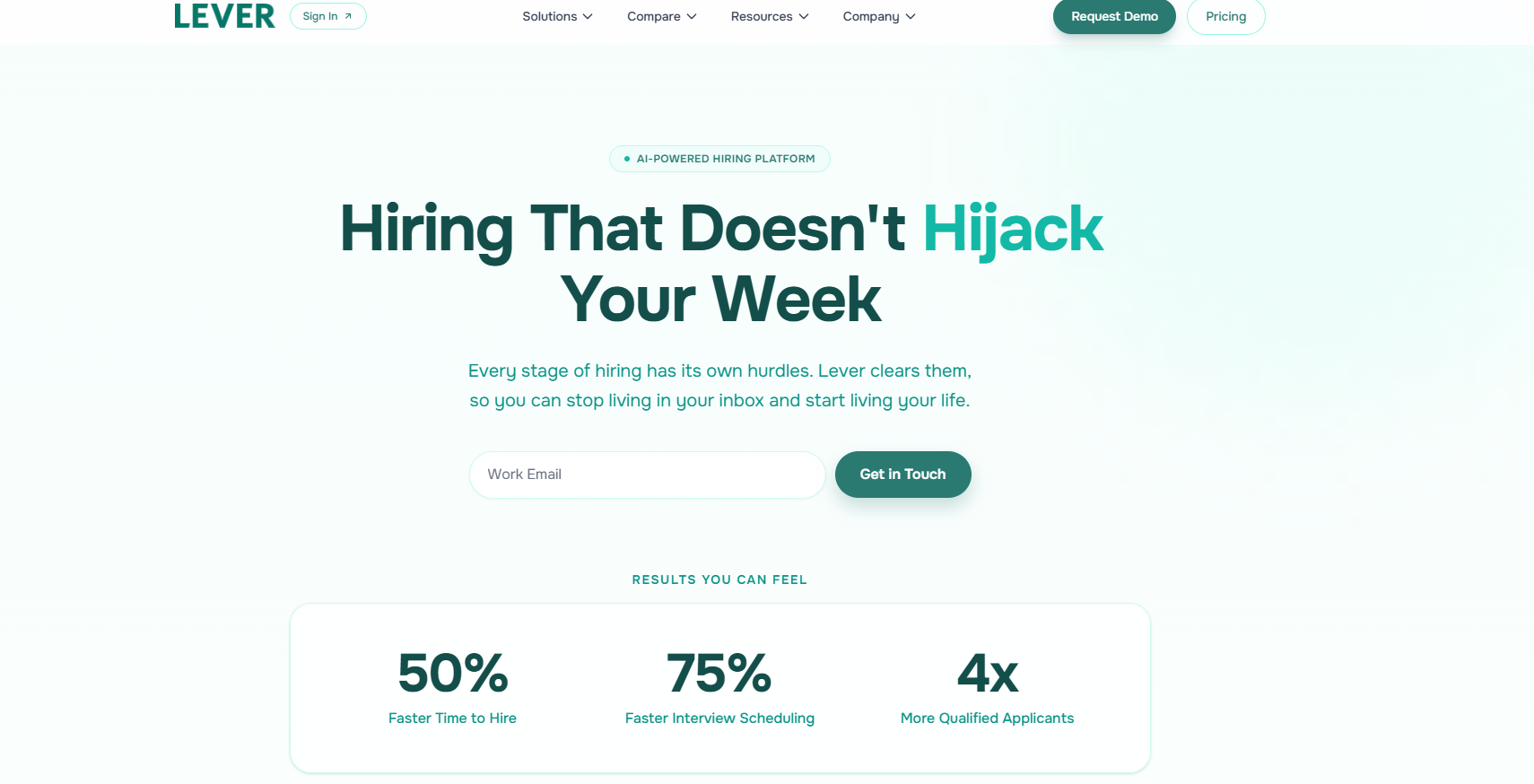
You can move applicants through configurable stages and use interview plans, feedback forms, tasks, and approval steps to coordinate the recruiting process.
Easy Book links let candidates choose an available interview time, while calendar synchronization shows interviewer availability and responses to scheduled invitations.
Lever’s workflow builder uses triggers and actions to handle repetitive tasks. Advanced workflow functions are available through LeverTRM for Enterprise or the Advanced Automation add-on.
10. Manatal
Manatal is cloud-based applicant tracking and recruiting software for internal HR departments and recruitment agencies.
The platform stores candidate profiles, resumes, applications, notes, jobs, and interview activity in a central database. Each vacancy has a Kanban or list view that shows where applicants sit within the recruitment pipeline.
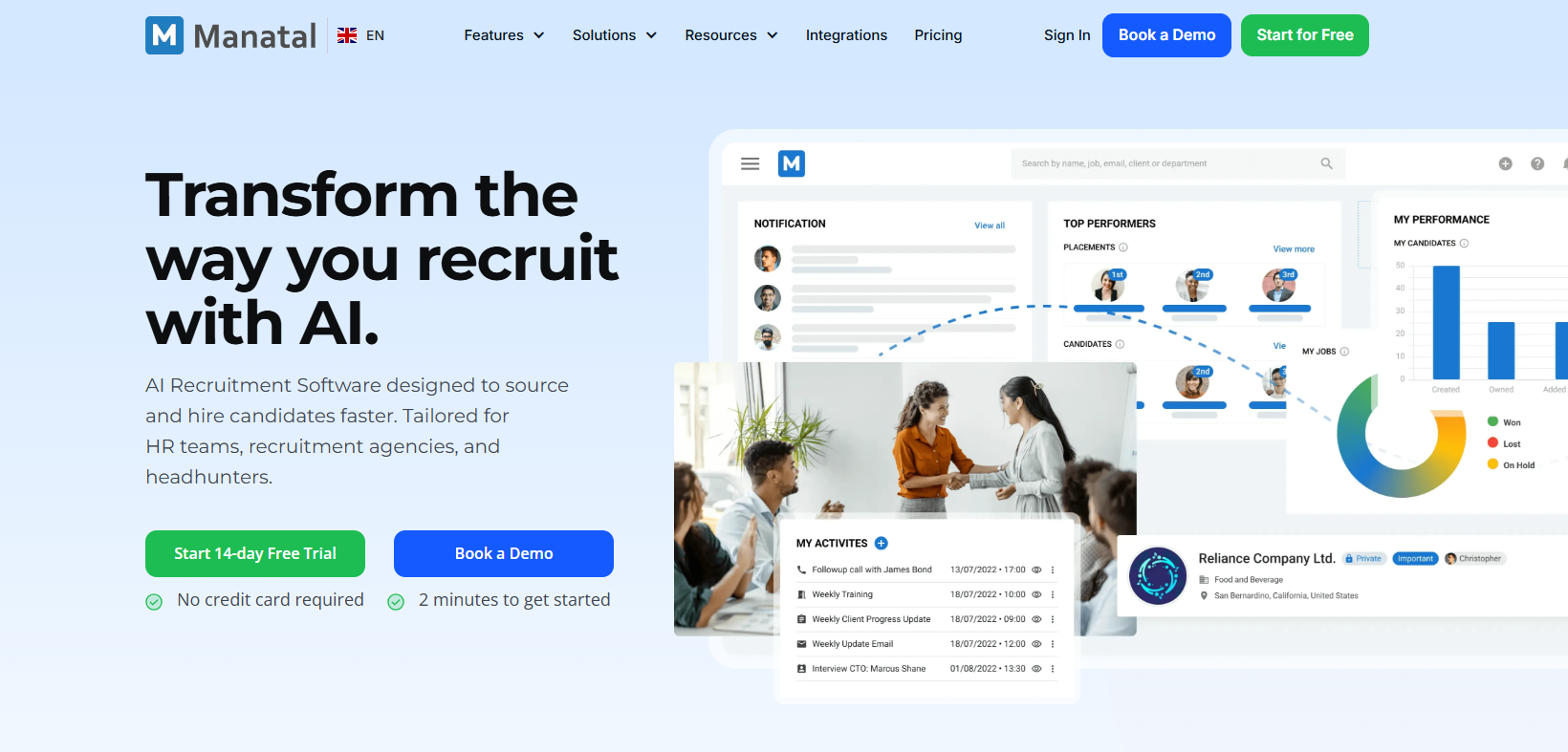
Workflow automation operates at the pipeline level or for an individual job. Triggers include a new application, movement to a selected stage, or removal from a stage.
Manatal also includes AI candidate scoring, resume parsing, profile enrichment, and semantic candidate search. Its collaboration functions cover role-based permissions, a guest portal, tagged notes, and calendars connected with Google or Microsoft services.
Candidate Sourcing and Talent Relationship Management
Candidate sourcing software helps you find, organize, and reconnect with people before they enter an active hiring pipeline.
11. Gem
Gem is a recruiting platform with sourcing, talent CRM, applicant tracking, scheduling, and analytics products. You can use the full platform or connect individual products with an existing ATS.
Its AI sourcing tool searches a database of more than 800 million profiles and supports advanced filters, Boolean search, profile enrichment, and contact information.
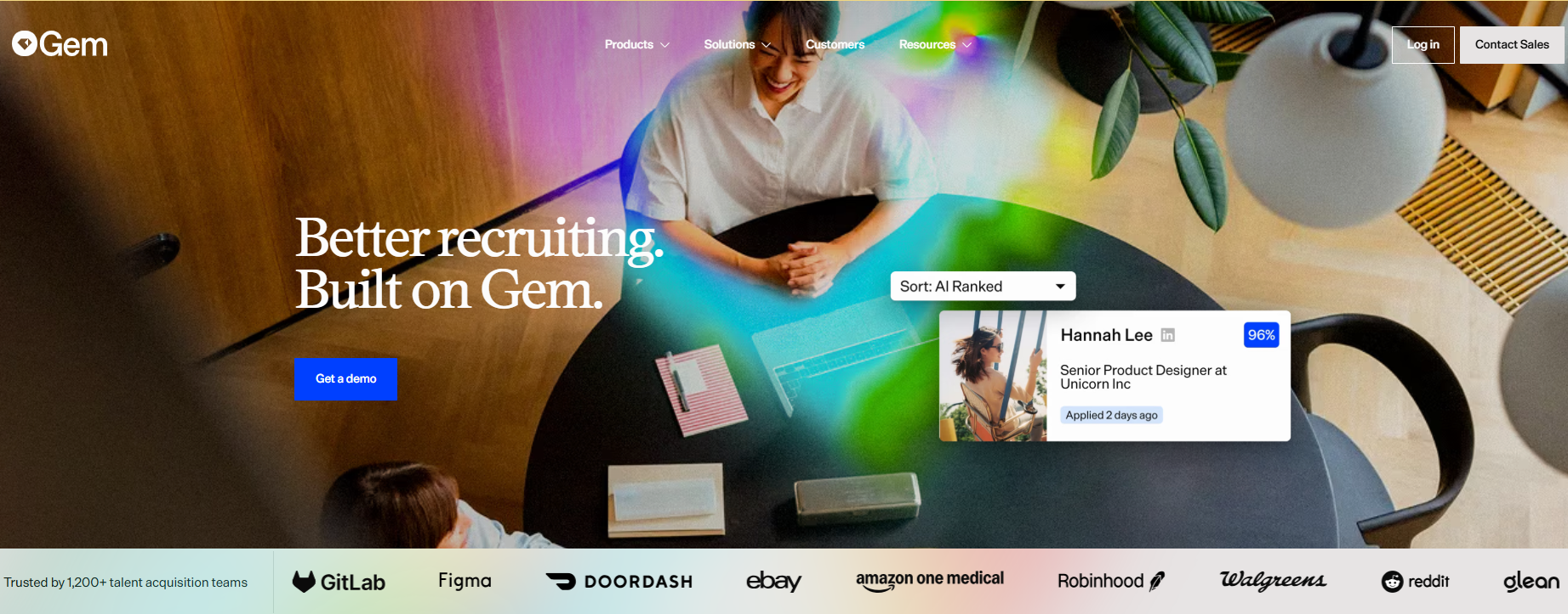
Gem provides outreach automation through personalized, multi-stage sequences across email, SMS, and InMail.
Sequence routing places new prospects into selected campaigns, while send-on-behalf-of options let messages come from agency recruiters, executives, or hiring managers.
The CRM synchronizes stage changes, notes, rejections, and candidate updates with connected recruiting systems.
Candidate rediscovery also searches previous applicants and sourced prospects, which helps organize and reconnect with promising candidates.
12. hireEZ
hireEZ is a recruitment platform with tools for open-web sourcing, ATS rediscovery, native talent sourcing, outreach, screening, and analytics.
It lets you start a search with a job description or candidate profile. The platform reviews available profiles, identifies qualified candidates, and displays information about how each person matches the role.
The Rediscovery feature searches previous applicants already stored in the ATS. It deduplicates records, enriches profiles with updated information, and brings candidate activity into a shared view.
Talent Pools organize former applicants and sourced prospects into searchable groups based on skills, experience, and engagement information. Automated nurture messages also support continued contact.
13. SeekOut
SeekOut is an AI recruiting platform for outbound sourcing, applicant review, candidate outreach, and talent rediscovery.
You can search through natural-language prompts, Boolean queries, or more than 300 filters related to skills, experience, location, education, certifications, and job history.
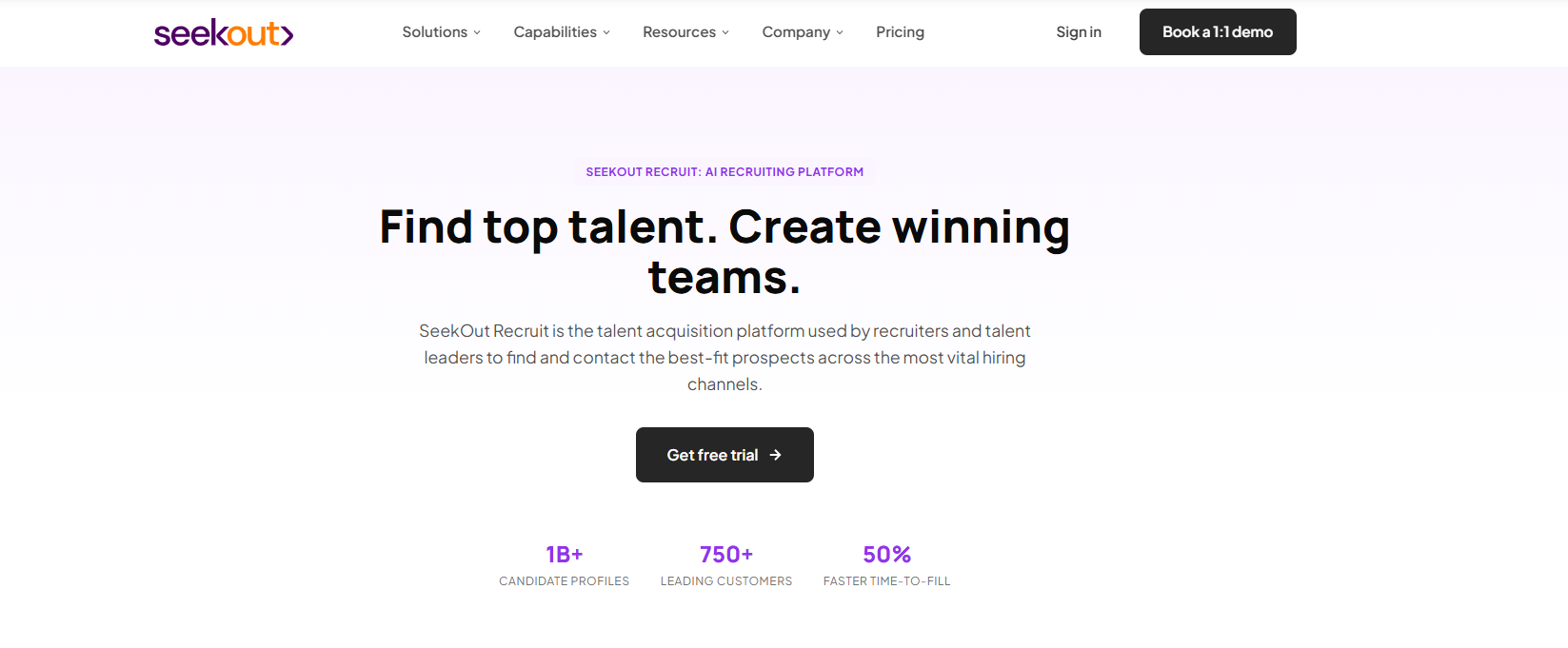
Smart Match uses a job description to build search criteria and present profiles that match the role, giving recruiters a starting point for reviewing the most qualified candidates.
SeekOut’s Talent Rediscovery feature connects with an ATS or CRM. It enriches older profiles with updated information and lets you search public profiles, ATS records, and internal talent from a shared search workspace.
14. Beamery
Beamery provides sourcing, talent CRM, matching, and campaign functions for talent acquisition teams.
The candidate sourcing product searches existing records and adds prospects from external websites through the Beamery Extension.
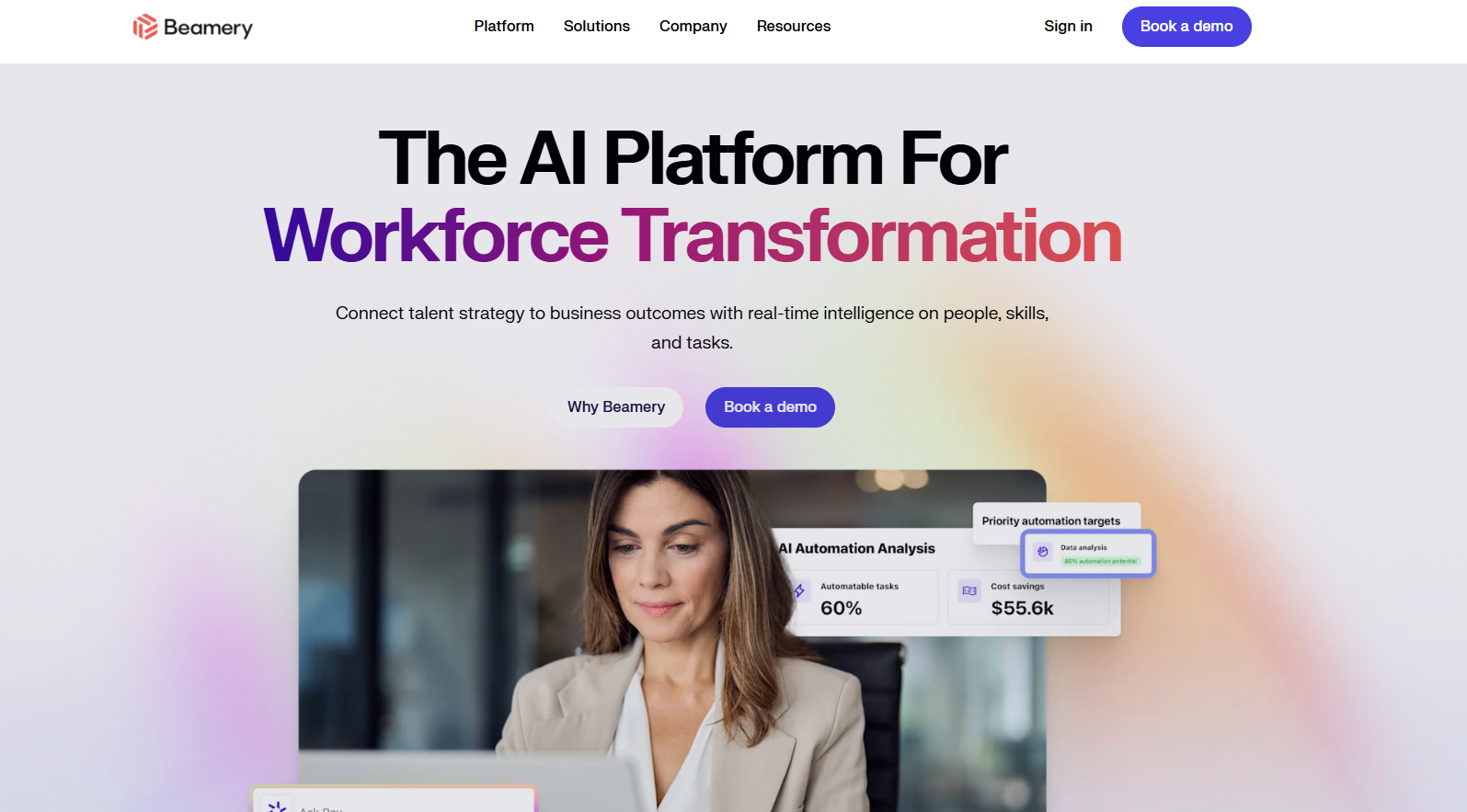
LinkedIn CRM Connect also supports profile transfer from LinkedIn, while duplicate checks show whether a person already exists in the company’s database before a new record is created.
You can organize contacts into pools and pipelines based on skills, roles, events, campaigns, or other criteria.
Shared and private pools, profile tags, custom fields, statuses, and vacancy stages help you manage candidate groups and maintain records for future hiring needs.
15. Phenom
Phenom provides a Talent CRM that works alongside an existing ATS. It brings candidate profiles, application history, skills, preferences, engagement activity, and pipeline information.
Dynamic Lists organize candidate segments according to criteria such as skills, location, job title, and hiring status. These lists update as new profiles enter the CRM or existing records change.
AI Insights and fit scoring also help recruiters review people whose experience aligns with a role. Phenom Campaigns supports personalized email and SMS sequences that start according to candidate behavior or status.
Its integration with LinkedIn Recruiter synchronizes profiles, status updates, candidate history, and sourcing activity between both systems.
Candidate Screening, Assessments, and Interview Automation
Candidate screening and interview software helps you assess skills, manage evaluations, and move applicants through each stage with less manual coordination.
16. HackerEarth
HackerEarth is a technical assessment and interview platform used to evaluate candidates for software engineering and related roles.
Its assessment product supports coding exercises, project-based questions, multiple-choice questions, and tests for areas such as full-stack development, DevOps, and AI skills.
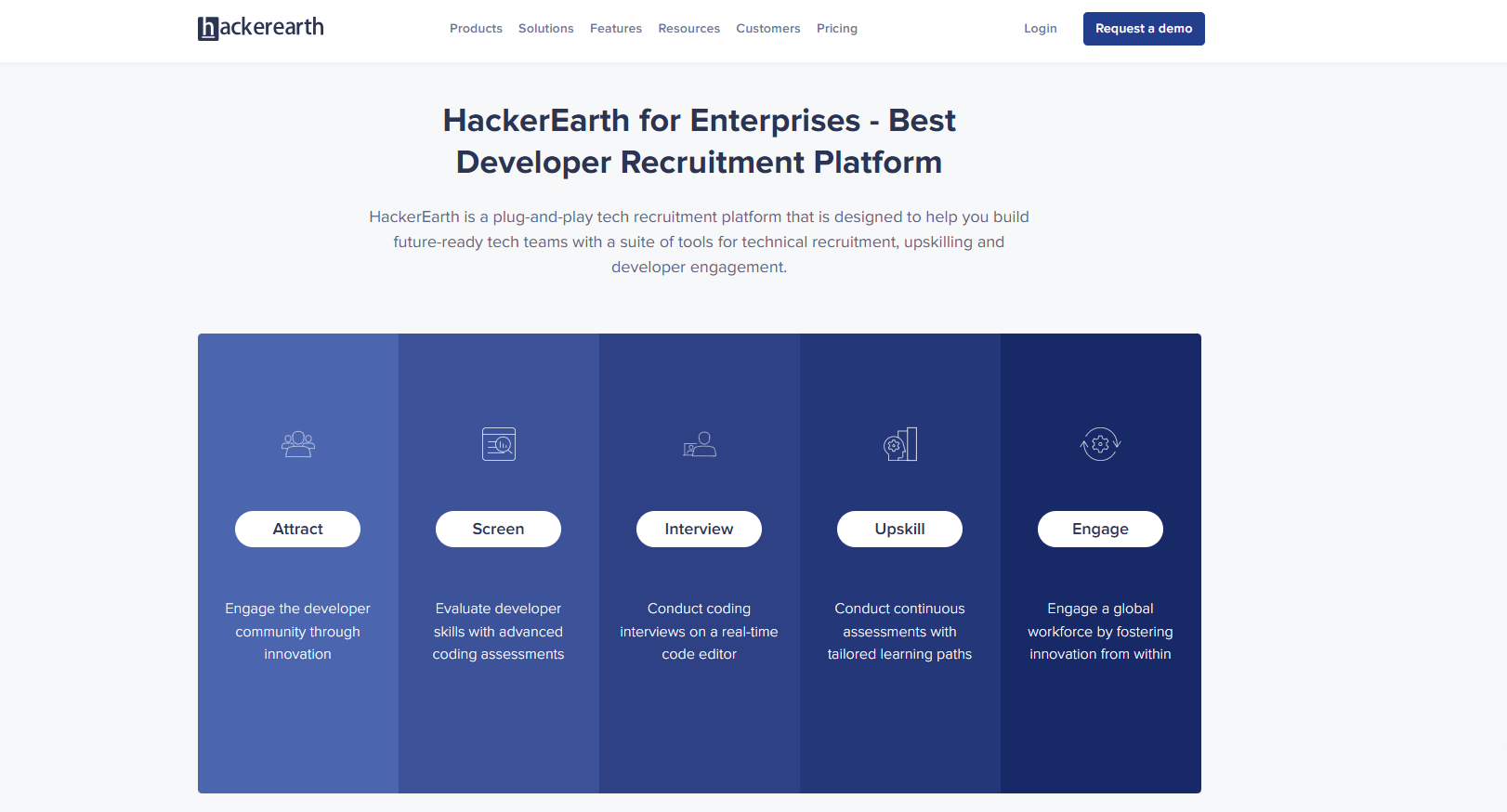
The platform includes remote proctoring controls for the screening process. It has Smart Browser restrictions, video and audio monitoring, identity verification, plagiarism checks, question shuffling, and application controls.
FaceCode supports live technical interviews through a shared coding environment. Candidates write and run code while you review their approach, apply structured scoring rubrics, and use a diagram board for system design discussions.
17. TestGorilla
TestGorilla is a skills assessment and candidate screening platform with more than 350 tests. You can build assessments by selecting tests from the library or using the AI assessment builder.
Each assessment may include several tests and custom questions, such as multiple-choice, essay, coding, or recorded video responses.
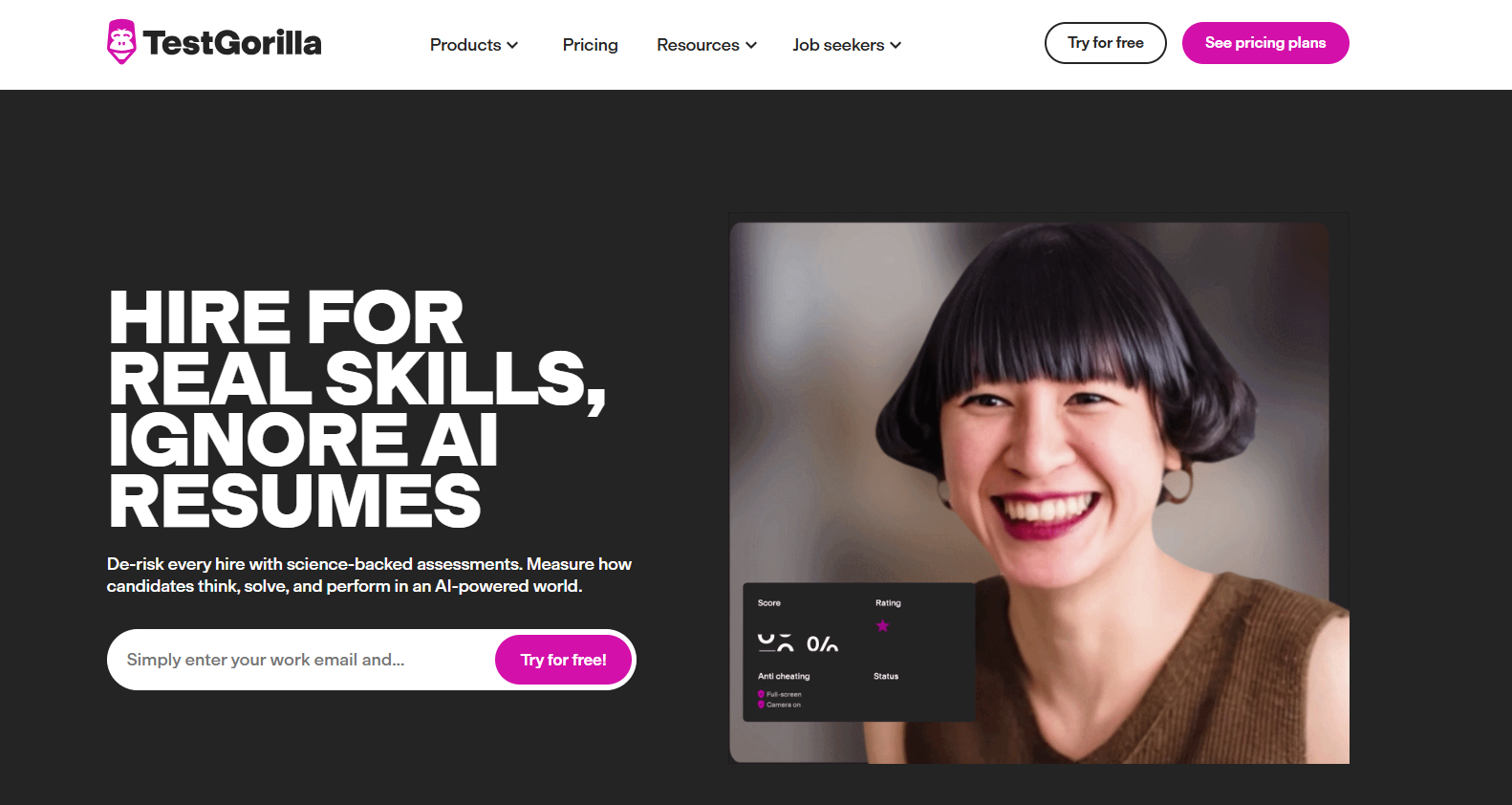
Candidate results pages display assessment scores, percentile rankings, individual test results, and responses to custom questions. You may compare applicants within the same assessment before deciding who advances.
TestGorilla records behavior signals during assessments through full-screen monitoring, IP tracking, randomized questions, copy-and-paste controls, developer tool detection, and candidate behavior logs.
18. HireVue
HireVue is a hiring platform that combines video interviews, candidate assessments, interview scheduling, and workflow automation.
The assessment product includes Virtual Job Tryout simulations, game-based assessments, technical tests, language tests, and AI-scored interview questions.
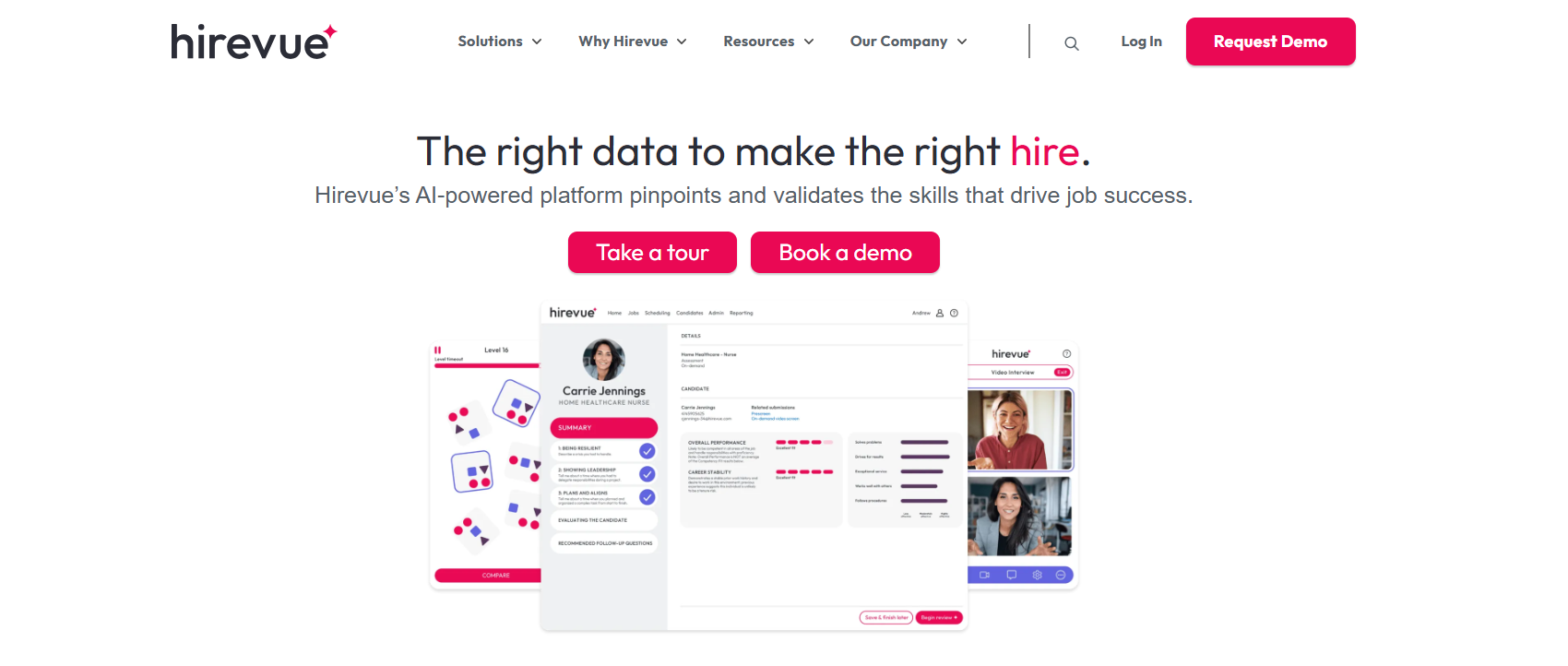
Assessment Builder uses the role description to create a job-related assessment, while results provide information about the skills and competencies measured for each candidate.
HireVue’s scheduling tools connect with employer calendars and send candidates an email or SMS invitation to select an available interview time. Candidates also receive reminders and reschedule through the same system.
19. Codility
Codility is a technical assessment and interview platform for evaluating software engineering skills.
Its Screen product supports take-home assessments built from coding tasks, technical questions, role-based templates, or custom content.
Automated scoring uses test cases to review correctness and, where relevant, the performance of each submitted solution.
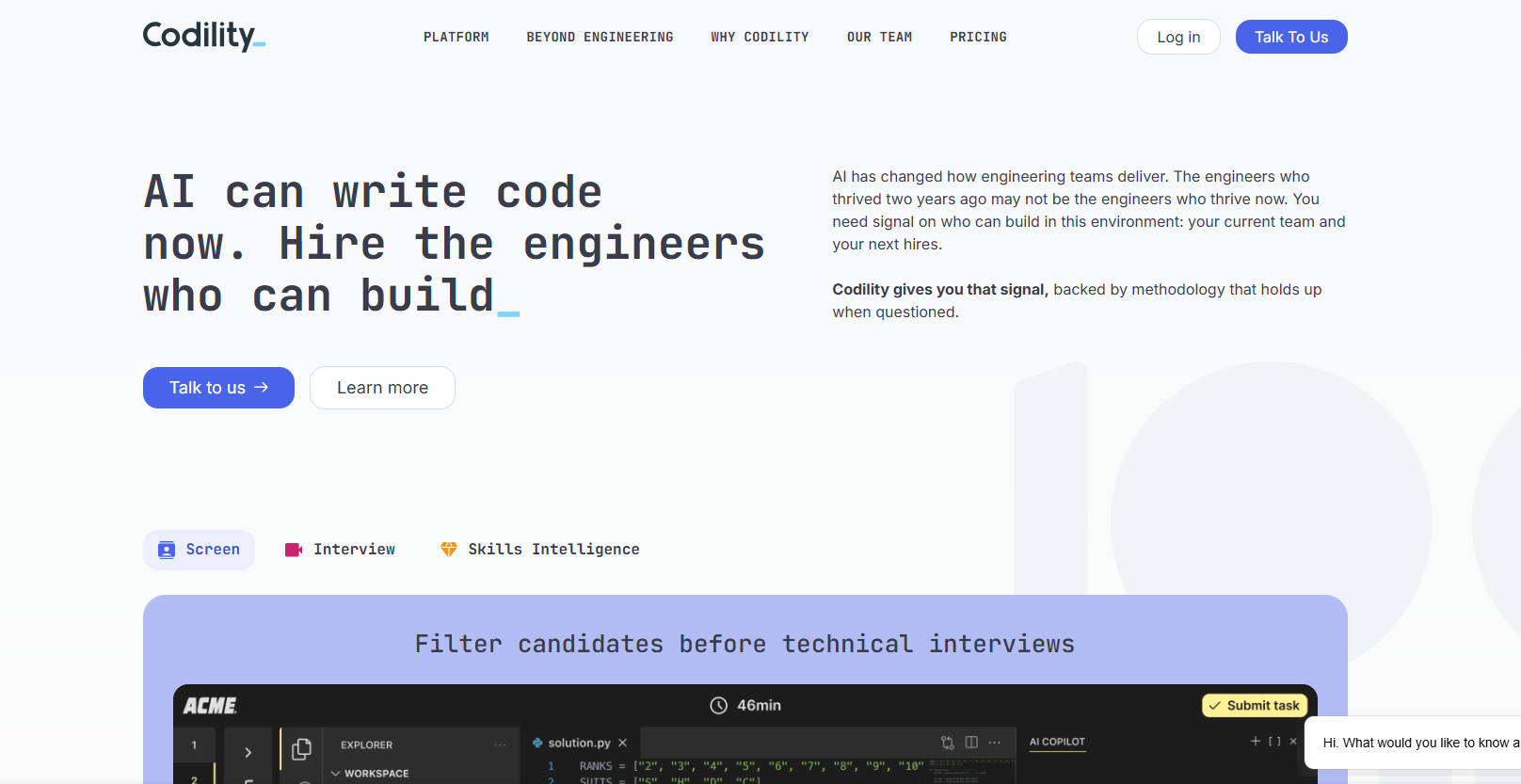
Candidate reports display task scores, code submissions, performance details, and assessment integrity signals. Proctoring options track behavior such as tab changes, copied code, task-description copying, fast completion times, and webcam activity.
The platform also presents real-time integrity alerts during interviews for actions such as browser tab changes, loss of focus, or attempts to copy outside code.
20. Harver
Harver is a pre-employment assessment and interview platform for evaluating candidate skills, behavior, and potential job fit. Assessment responses are compared with matching profiles and role-specific benchmarks.
Based on the criteria you set, Harver scores results and progresses selected applicants to a video interview, live meeting, reference check, or another configured stage.
Harver Interview supports on-demand video responses to questions recorded for each position. Candidates complete the interview from a computer or mobile device, while evaluators review the recordings and apply a shared rating scale.
For live meetings, automated interview scheduling lets candidates select from the available times set by the employer. Harver also generates interview guides with candidate-specific questions based on assessment results.
Recruitment Automation and Talent Intelligence
Recruitment automation and talent intelligence software helps enterprise teams connect hiring activity with skills data, workforce planning, and internal mobility.
21. Eightfold AI
Eightfold AI is a talent intelligence and recruitment platform for talent acquisition, talent management, workforce planning, internal mobility, and resource management.
This hiring tool combines company data, labor market information, skills, employee aspirations, and work signals to build a broader view of internal and external talent.
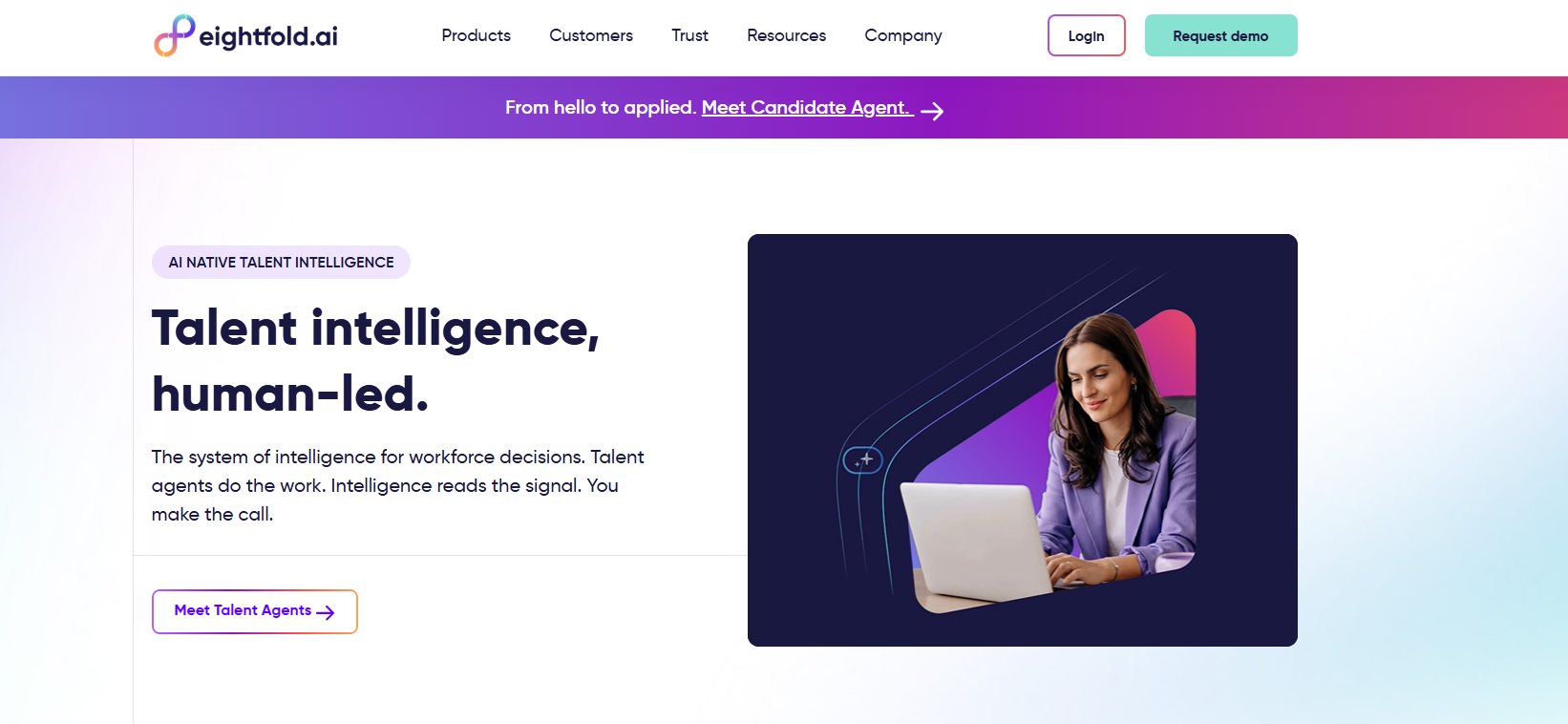
Its Talent Acquisition product supports candidate sourcing, talent rediscovery, screening, scheduling, recruiting events, and candidate relationship campaigns.
The platform uses AI-powered matching to compare people with roles based on skills, experience, potential, and other configured factors rather than relying only on job titles or resume keywords.
22. Workday Recruiting
Workday Recruiting is part of the Workday Talent Acquisition suite. It combines applicant tracking, candidate engagement, HiredScore AI for Recruiting, and the Workday Paradox Candidate Experience Agent.
The Recruiting Hub gives you a central workspace for outstanding tasks, candidate pipelines, applications, and open positions.
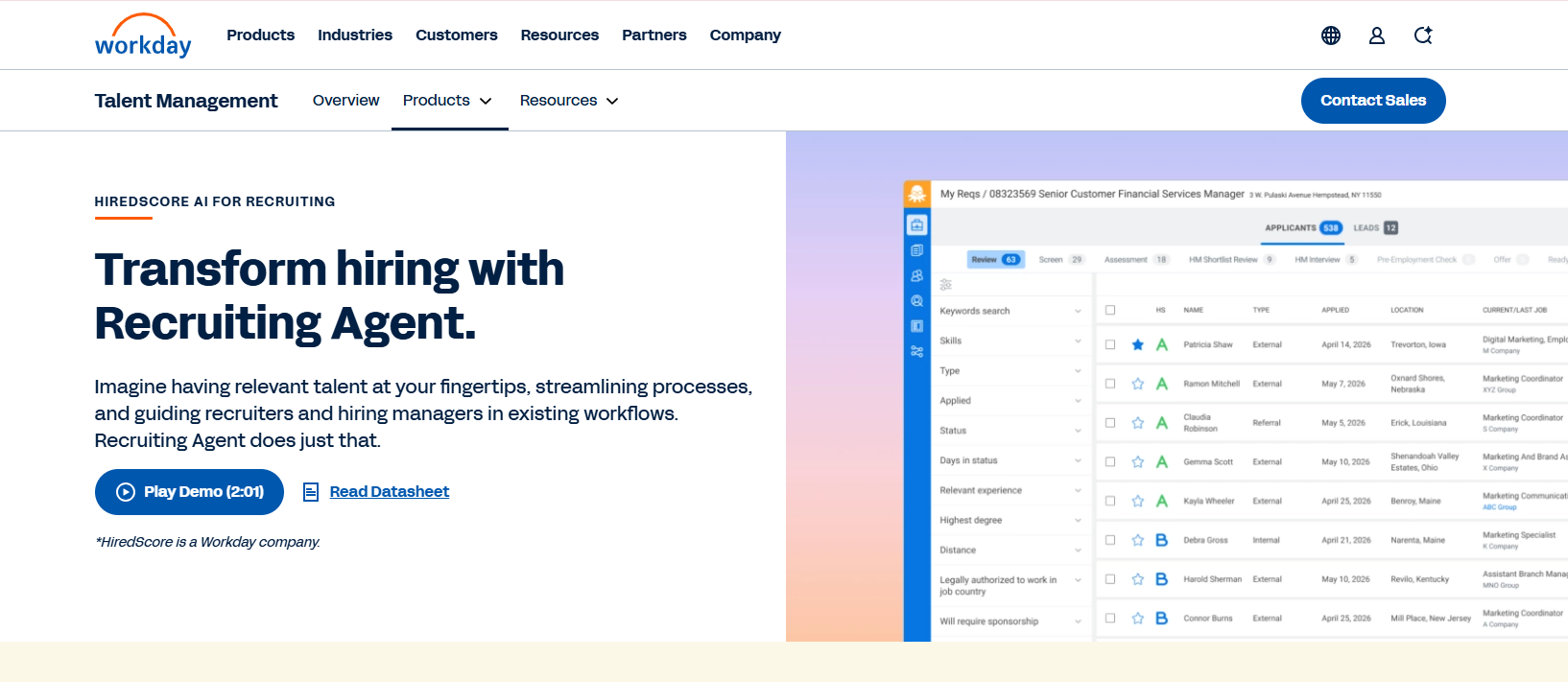
Workday supports high-volume hiring through evergreen requisitions, bulk candidate screening, automated workflow steps, and batch processing for offers and agreements.
The Candidate Experience Agent uses chat and two-way texting to collect information, qualify applicants, arrange interviews, send reminders, and respond to common questions.
23. Avature
Avature is a recruiting automation software that combines applicant tracking, candidate relationship management, recruitment marketing, interviewing, onboarding, and talent management.
Organizations configure workflows, approvals, permissions, candidate data fields, and compliance requirements for different regions, departments, brands, and hiring models.
Its ATS includes agents for candidates, recruiters, and hiring managers. Candidate agents answer questions, recommend roles, arrange interviews, and guide applicants through early screening.
Avature CRM brings prospect profiles, application history, communication, consent records, and recruiting activity into a shared database. You may also build talent pools and send behavior-triggered campaigns through email, SMS, WhatsApp, or WeChat.
24. iCIMS
iCIMS is an enterprise talent acquisition platform that combines applicant tracking, candidate engagement, recruitment marketing, offer management, onboarding, and internal mobility products.
Its Talent Cloud stores candidate and hiring information across these products, while integrations connect the platform with HR, payroll, assessment, background-check, and other recruitment systems.
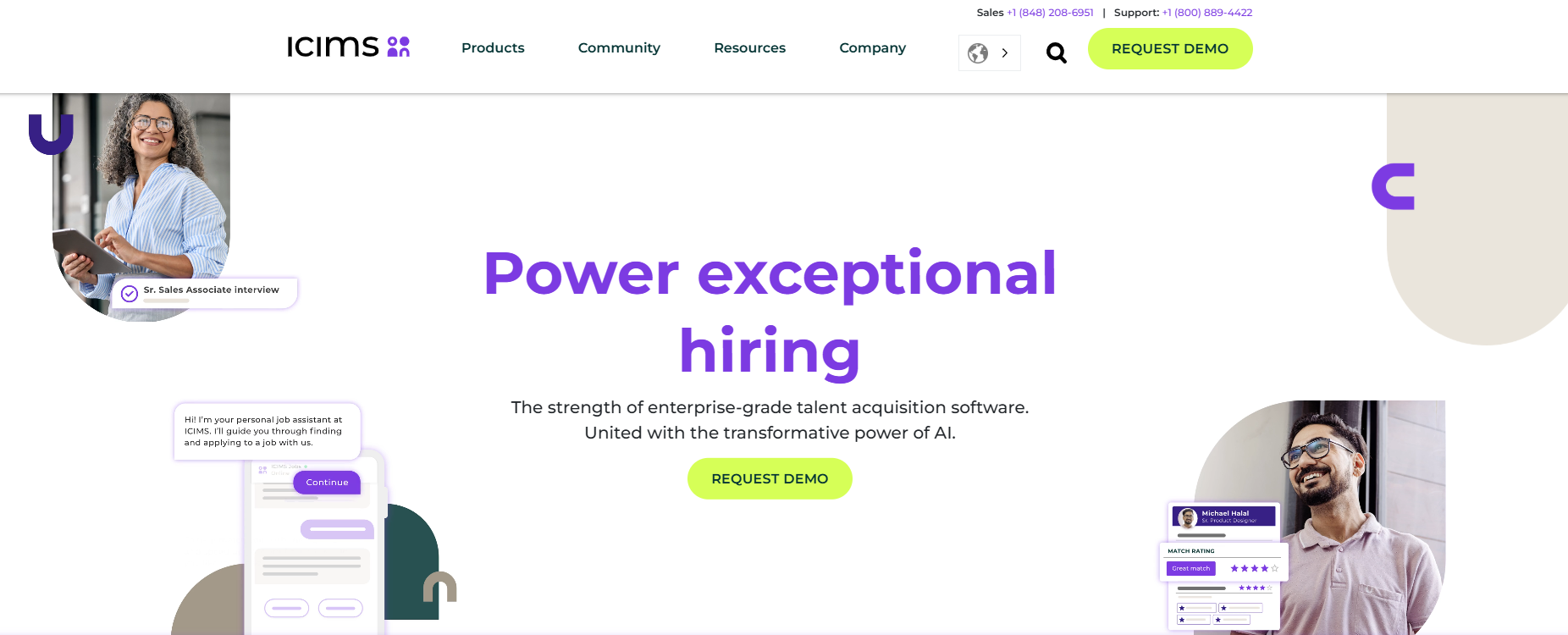
The ATS supports job templates, approval chains, candidate submissions, interview scheduling, offers, and configurable hiring workflows.
You can also communicate through email, text, and video, while candidates select interview times based on the availability set by interviewers. Dashboards and reports track pipeline activity, time to hire, time to fill, source performance, and other recruitment metrics.
25. SmartRecruiters
SmartRecruiters is an enterprise hiring platform built around SmartOS. Candidate profiles, applications, interview feedback, hiring tasks, and offer records remain connected across the talent acquisition process.
Its ATS lets you configure hiring stages, approval paths, screening questions, interview plans, and evaluation criteria for different roles or business units.
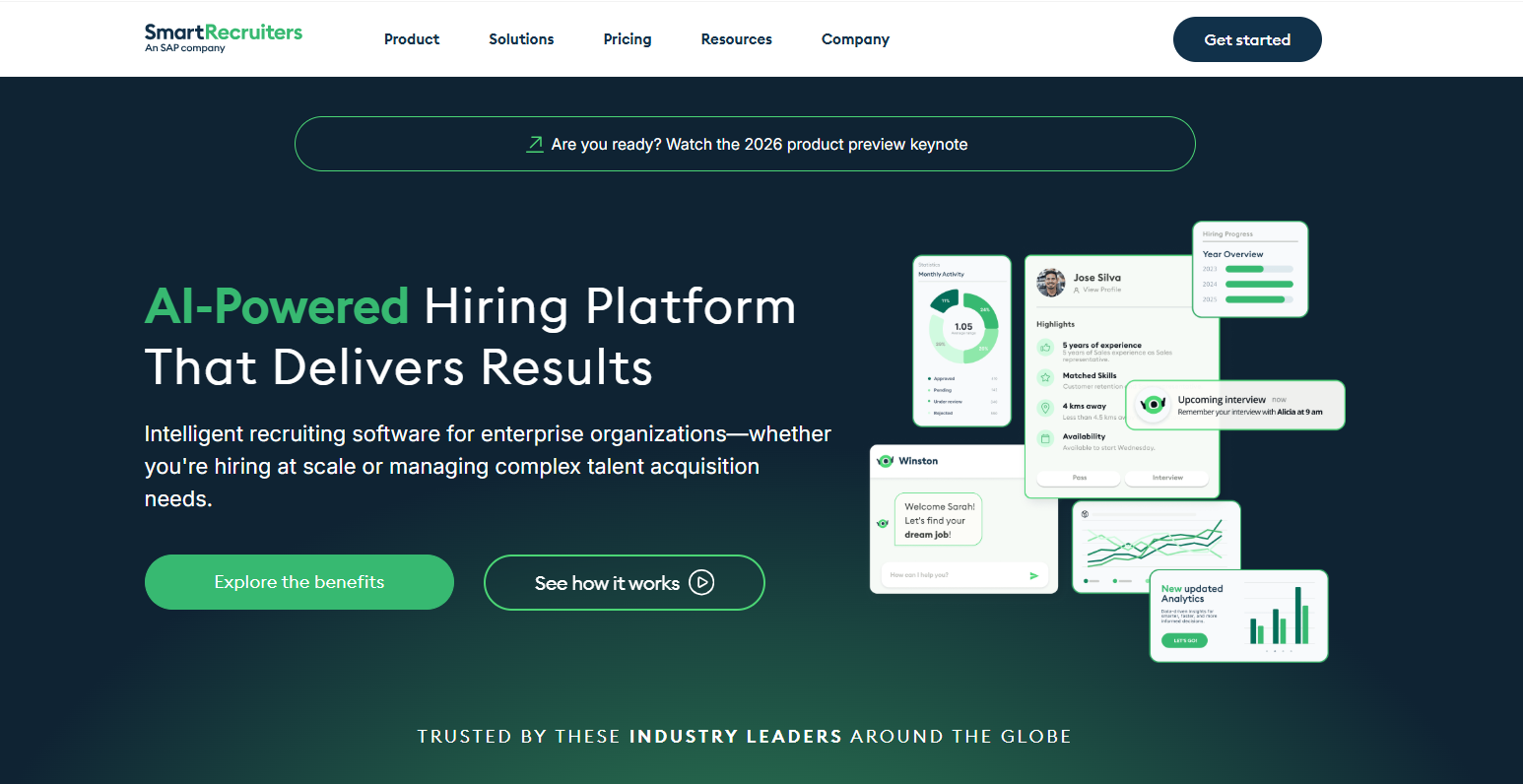
Your recruiters and hiring managers may also review applicant status, exchange feedback, track outstanding tasks, and identify delays from shared workflows and dashboards.
Winston adds AI-based screening, talent matching, interview scheduling, and candidate communication through text, voice, and video.
The system presents candidate match information for recruiter review, sends scheduling prompts, and provides alerts when a hiring task needs attention.
How to Choose the Best Recruitment Automation Software
Choosing the right recruiting automation tool starts with understanding your hiring needs, current systems, and the tasks that take the most time.
Here are the key factors to compare before selecting a platform.
Step #1: Identify Your Main Hiring Bottleneck
Your priority is the part of hiring that causes the most delays, repeated work, or candidate drop-off.
Common problems include sourcing quality candidates, reviewing applications, coordinating interviews, following up with applicants, and moving people through the hiring funnel.
Recent recruitment data provides a better starting point. Response rates, time spent in each stage, interview no-shows, application drop-off, and recruiter workload show where the process needs support.
The best recruitment automation tool should solve a defined problem instead of adding features your team may never use.
Step #2: Decide Between a Full Platform and a Point Solution
A full ATS manages several parts of recruitment, including applications, candidate records, hiring stages, interview feedback, offers, approvals, and reporting.
This option may suit you if you want hiring activity and applicant information stored in one platform.
Although an ATS includes email templates or basic text messaging, communication may not receive the same depth as its tracking features.
A dedicated text recruiting software like TextUs focuses on timely communication instead of replacing your ATS.
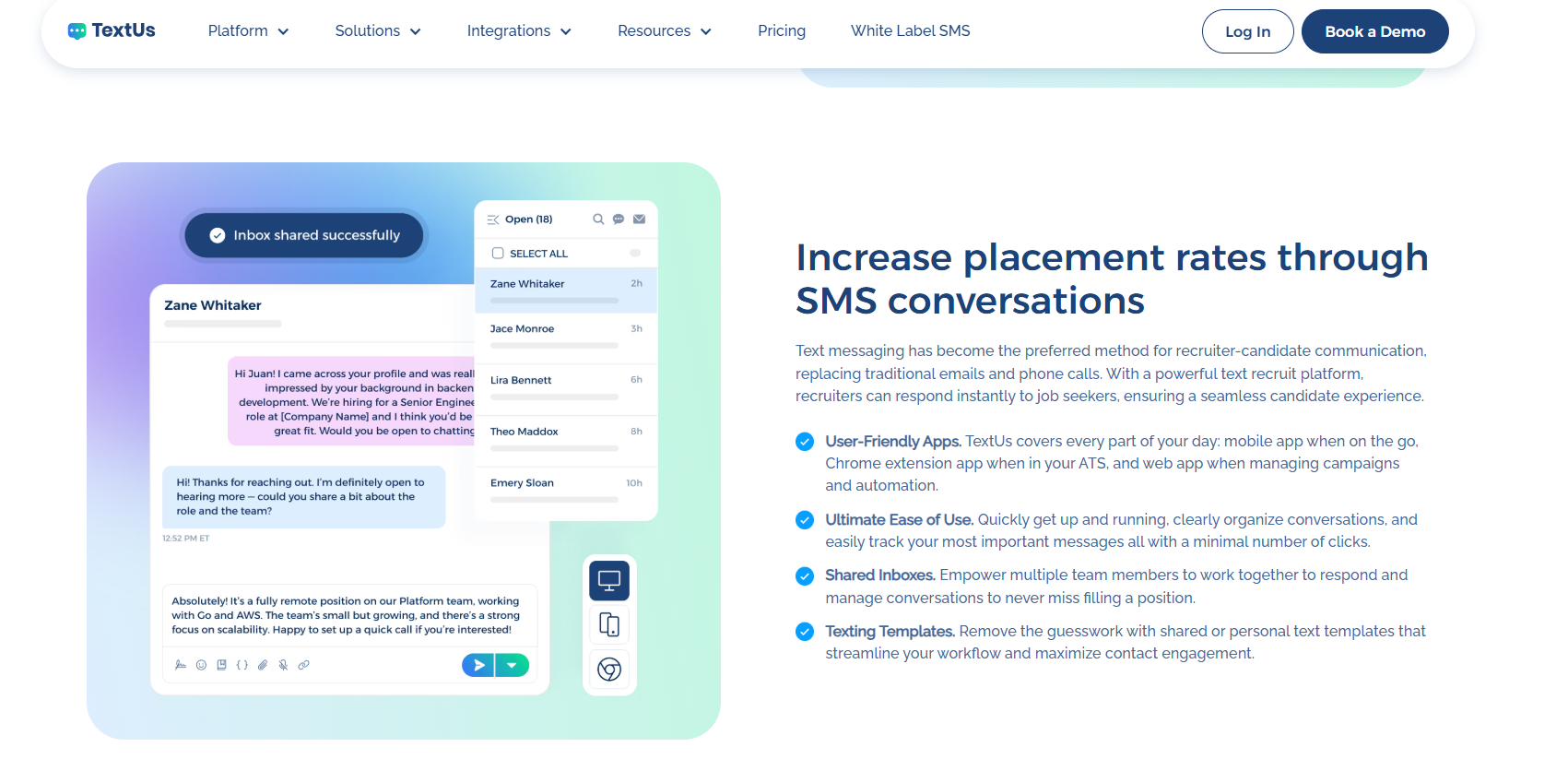
The platform connects with ATS and adds two-way SMS, automated candidate outreach, shared inboxes, campaign management, and conversation logging to the existing hiring workflow.
The ATS remains the system of record, while the texting software handles outreach and ongoing conversations.
This setup is ideal if your company already has an established ATS and still relies on emails, phone calls, or personal mobile numbers to contact candidates.
Book a demo with TextUs today to take a closer look at how candidate texting fits into your current recruitment stack!
Step #3: List Your Required Recruitment Automation Features
Your requirements should fall into three groups: must-have, useful, and optional.
The list can include workflow triggers, candidate messaging, interview scheduling, assessment delivery, approvals, reporting, talent pools, and job distribution.
The longest feature list does not always provide the most value. The right recruitment automation tools should match the work your recruiters perform and the delays your company wants to reduce.
You may also want to check whether the vendor offers a free trial, guided demo, or test account before you commit to a plan.
Step #4: Check Your Existing Recruiting Technology
Your current technology stack may include an ATS, CRM, HRIS, calendar, assessment provider, communication platform, and background-check service.
Any new software should work with these systems or replace them for a specific reason.
Your recruitment team also needs support for its current data fields, candidate stages, user permissions, and reporting structure.
A poor fit may create duplicate records or force users to repeat the same work across separate recruiting tools.
Step #5: Review Candidate Communication Channels
Candidate communication may take place through SMS, email, chat, WhatsApp, voice, or video.
Your chosen platform should support the channels your applicants use and provide two-way replies, reminders, templates, personalization, and clear human handoffs.
Some job seekers may need assistance, request an update, or respond outside standard office hours. Consent controls, opt-out management, message history, and inbox ownership should be part of the evaluation.
Step #6: Compare Integration Depth
An integration label does not always mean that every type of information moves between systems.
Your platform evaluation should confirm which data syncs, how often updates occur, and whether the connection supports one-way or two-way transfers.
Candidate replies, stage changes, interview details, and status updates should sync back to the correct record. Strong integrations support collaborative hiring workflows and reduce the need to copy information between platforms.
Choose TextUs for Stronger Candidate Engagement Without Replacing Your ATS
The best recruitment automation software depends on where work is slowing down. An ATS can organize applications, sourcing software can expand access to talent, and assessment platforms can standardize evaluation.
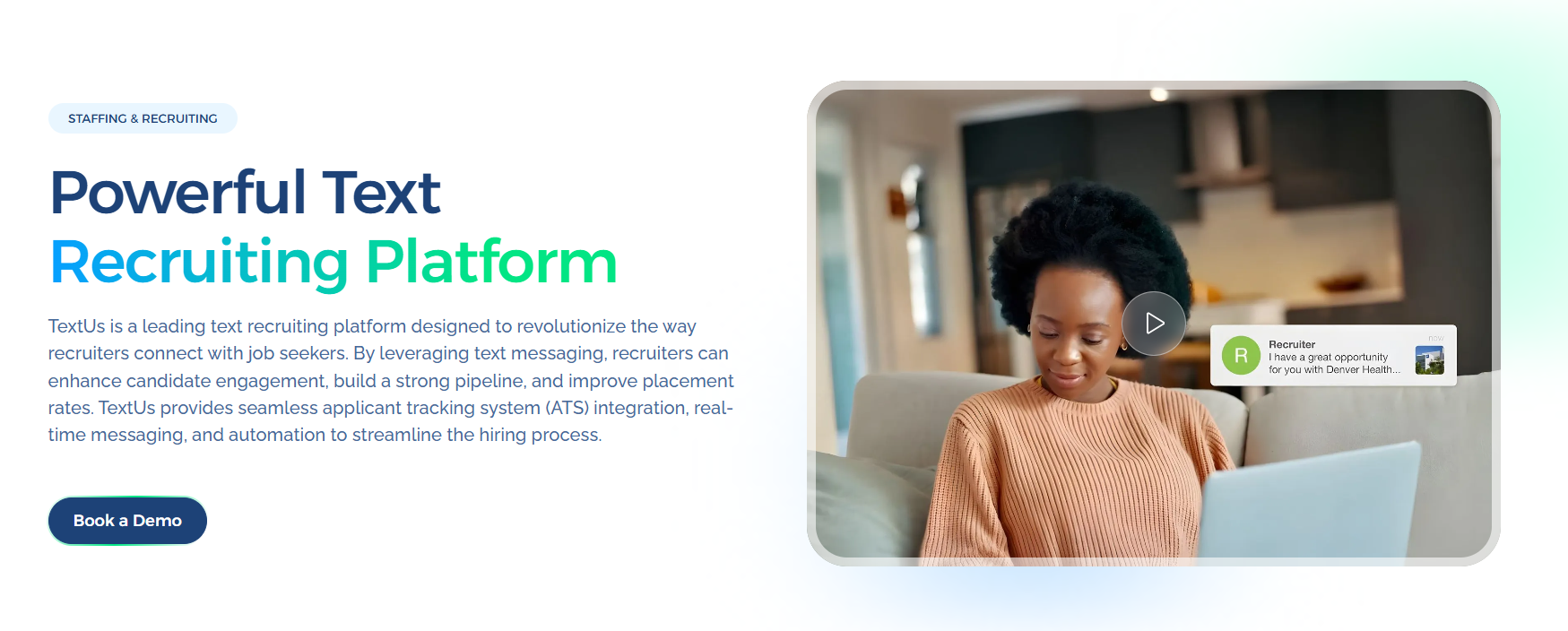
TextUs adds ATS-integrated SMS, automated candidate outreach, shared inboxes, campaigns, and two-way messaging to your existing recruitment stack.
These features help your team manage a growing hiring volume while keeping individual replies visible and connected to the correct candidate record.
TextUs also offers custom plans and enterprise-level pricing for recruiting teams with larger candidate pipelines, more users, and higher messaging needs. This flexibility gives you the capacity and support to expand candidate outreach without outgrowing the platform.
Book a demo with TextUs today to see how business texting fits into your current workflows and integrations!
Continue Reading



Frequently Asked Questions
What is the best software for recruitment?
There is no single platform that suits every company. Greenhouse, Workable, Lever, iCIMS, and SmartRecruiters provide applicant tracking and broader hiring functions.
If you already have an ATS, TextUs is a text automation software with basic built-in messaging through ATS-connected SMS, automated outreach, shared inboxes, and conversation logging.
What is the 70/30 rule in hiring?
The 70/30 rule suggests that a candidate who meets about 70% of the role requirements may still be worth hiring when the remaining skills are trainable. However, this is an informal guideline, not a fixed hiring standard.
What are the top 5 ATS systems?
Five ATS systems worth comparing are Greenhouse, Workable, Lever, iCIMS, and SmartRecruiters.
Their features cover applicant records, hiring workflows, interviews, collaboration, and posting job openings, with Workable and SmartRecruiters also supporting distribution across many job boards.
Business Texting
Built for Results
Create and convert pipeline at scale through industry leading SMS software