
Texting Definitions: 114 Common Acronyms and Their Meanings
Explore 114 common texting abbreviations and acronyms, what they mean, and how to use them in personal and business text messages.

Written by
Adam Hamdan
Published
June 8, 2026

Text abbreviations are common in everyday messaging, especially among younger audiences. But they’re now used far beyond casual conversations.
Some abbreviations make messages faster to scan, especially in short mobile conversations. But others can sound too casual or out of place when used in professional communication.
That's why understanding texting definitions matters for both personal conversations and business messaging.
In this article, we will break down common texting abbreviations, explain what they mean, and show how they apply in different settings. You will also learn how this texting dictionary can become a useful marketing asset for improved customer communication.
TL;DR
- Text abbreviations became common because early SMS messages had limited space, but they still make conversations faster and shorter.
- Common texting abbreviations appear in everyday replies, emotional reactions, scheduling, customer support, sales follow-ups, SMS campaigns, and compliance-related business texting.
- Business texting needs a more careful approach, such as using familiar terms, matching the tone to the customer relationship, spelling out important details, keeping messages readable, and avoiding stacking too many shortcuts in one message.
- TextUs is a compliant-texting SMS platform built to send professional texts, manage conversations, use SMS keywords, and keep every message consistent and on-brand.
What Drives People to Abbreviate Words?
Early SMS messages had strict character limits, which pushed people to shorten words and phrases to fit more into a single message.
Text acronyms also match how people talk in casual messages. A quick “TY” can replace “thank you,” while “BRB” can explain that you are stepping away without adding extra details.
Over time, many abbreviations became part of everyday customer communication because they made quick replies easier and faster to type.
People also text while they are busy, on the go, or switching between tasks. Internet slang words and acronyms make it easier to send a quick reply from a phone screen.
In business text messages, abbreviations can save time, but they need care.
Common terms like “FYI,” “ETA,” and “ASAP” can fit professional messages, while unclear text slang words can make your message harder to understand.
115+ Common Texting Abbreviations and Their Definitions
Texting abbreviations make messages shorter and easier to read. Here are common abbreviations grouped to help you understand where each one fits.
Everyday Texting Abbreviations
You can use these abbreviations for short replies, simple updates, and quick confirmations. They are common in everyday texting and can also fit some business messages when the tone stays professional.
- OK - Okay
- TY - Thank you
- THX - Thanks
- YW - You’re welcome
- NP - No problem
- PLS - Please
- VIP - Very important person
- BTW - By the way
- IM - Instant message
- IMHO - In my humble opinion
- NBD - No big deal
- GJ - Good job
- GL - Good luck
- GLHF - Good luck, have fun
- OMG - Oh my god
- OMW - On my way
- GF - Girlfriend
- GG - Good game
- MIRL - Meet in real life
- MKAY - Mmm, okay
- POV - Point of view
- PPL / PEEPS - People
- PROLLY - Probably
- DM - Direct message
Texting Abbreviations for Emotions and Reactions
These abbreviations show emotion, agreement, surprise, or honesty in casual texts. Use them with care in business texting because some can sound too informal for customer messages.
- LOL - Laugh out loud
- ROFL - Rolling on the floor laughing
- SMH - Shaking my head
- TBH - To be honest
- IMO - In my opinion
- MYOB - Mind your own business
- BF4L or BFFL - Best friends for life
- BFF - Best friends forever
- FR - For real
- IKR - I know, right
- BYOB - Bring your own beer
- ILY - I love you
- IDC - I don’t care
- IDK - I don't know
Texting Abbreviations for Questions and Plans
These abbreviations are common when people make plans, check availability, or ask quick questions. They can be useful in casual scheduling, but customer-facing messages should stay easy for every reader to understand.
- WYD - What are you doing
- WYA - Where are you at
- HBU - How about you
- BRB - Be right back
- TTYL - Talk to you later
- ETA - Estimated time of arrival
- RSVP - Please respond
- IRL - In real life
- AFK - Away from keyboard
- AKA - Also known as
Texting Abbreviations for Appointments and Scheduling
These abbreviations are ideal for appointment reminders, booking updates, and schedule changes. They work best when the date, time, location, and next step are still spelled out in plain language.
- APPT - Appointment
- CONF - Confirm
- TBD - To be determined
- TBA - To be announced
- EOD - End of day
- COB - Close of business
- OOO - Out of office
- AM - Ante meridiem
- PM - Post meridiem
- FYI - For your information
Texting Abbreviations for Customer Support
Support teams use texting abbreviations to share updates, organize requests, and respond faster. Customer messages should still avoid internal shorthand that the reader may not recognize.
- FAQ - Frequently asked questions
- ASAP - As soon as possible
- SLA - Service level agreement
- TKT - Ticket
- REF - Reference number
- CS - Customer service
- CX - Customer experience
- QA - Quality assurance
- MSG - Message
- MTF - More to follow
Texting Abbreviations for Sales Follow-Ups
Sales texting uses abbreviations tied to leads, accounts, and next steps. These terms are useful for internal sales notes, but customer texts should explain anything that could confuse.
- CRM - Customer relationship management
- CTA - Call to action
- ROI - Return on investment
- MQL - Marketing qualified lead
- SQL - Sales qualified lead
- POC - Point of contact
- B2B - Business to business
- B2C - Business to consumer
- NDA - Non-disclosure agreement
- QBR - Quarterly business review
Texting Abbreviations for Text Message Campaigns
Marketing teams use abbreviations to plan, measure, and improve SMS campaigns. Most of these belong in reporting or internal planning rather than the customer-facing message itself.
- SMS - Short Message Service
- MMS - Multimedia Messaging Service
- CTR - Click-through rate
- CVR - Conversion rate
- UTM - Urchin tracking module
- A/B - A/B test
- KPI - Key performance indicator
- CPA - Cost per acquisition
- CPC - Cost per click
- ROAS - Return on ad spend
Texting Abbreviations for Safe and Compliant Messages
Safe texting starts with consent, clear program terms, and simple SMS opt-out language. These abbreviations are useful for understanding compliance, data protection, and responsible business texting.
- TCPA - Telephone Consumer Protection Act
- T&C - Terms and conditions
- PP - Privacy policy
- AUP - Acceptable use policy
- DNC - Do not contact
- PII - Personally identifiable information
- CTIA - Cellular Telecommunications Industry Association
- FCC - Federal Communications Commission
- FTC - Federal Trade Commission
- DPA - Data processing agreement
Texting Abbreviations Businesses Should Avoid or Use Carefully
Some texting abbreviations are common in personal chats but risky in professional messages. They can sound rude, too casual, or unclear, especially when customers expect useful information.
- WBU - What about you
- U - You
- R - Are
- CU - See you
- GR8 - Great
- L8R - Later
- SRY - Sorry
- THO - Though
- BC - Because
- NVM - Never mind
- NVR - Never
- TXT - Text
- FWD - Forward
- H8 - Hate
- J/K - Just kidding
- SUP - What’s up
Text Abbreviation Tips for Better Business Communication
Text abbreviations can make business messages shorter, but they should never make customers pause or guess what you mean.
Here are text abbreviation techniques that can make business texting clearer and more useful for your audience.
Use Abbreviations Your Audience Already Knows
A customer should be able to read your message and know what to do next in a few seconds.
Common terms like FYI, ETA, APPT, and CONF can fit business texts because they support quick updates, reminders, and confirmations.
Less common terms like MTF, AUP, ROAS, or QBR may be familiar to your team, but customers may not know them. Spell them out the first time or avoid them in customer-facing messages.
The message type also matters. Dates, prices, account details, consent language, payment instructions, and safety information should use full words so readers can act promptly.
Match Your Tone to the Customer Relationship
A text to a long-time customer can sound warmer than a first message to a new lead.
For example, TY may feel natural after a friendly exchange, but “Thank you” is better when you are confirming a payment, quote, or account update.
Your tone should match the level of trust already built. A customer who has only interacted with your business once may need clearer wording.
An active customer who regularly texts your team may already understand shortcuts like FYI or ETA from previous conversations.
Context also changes what sounds appropriate. A reminder text can be short, but a support issue needs more care.
A promotional message can use a conversational tone. But consent, billing, and service updates should stay plain and professional.
Spell Out Important Information
Abbreviations are useful for quick updates, but they can weaken messages that contain details customers need to act on.
Use full words for dates, times, prices, addresses, payment instructions, account notices, and policy terms.
A text like “Your APPT is confirmed” may be fine for a simple reminder. A message about billing, consent, safety, or account access should be more complete.
Clear wording usually feels more trustworthy in business communication. Customers are more likely to follow instructions when the message looks professional, easy to read, and free from shortcuts that could be misunderstood.
Keep the Message Easy to Read
If you use too many abbreviations in one message, the reader may need extra effort to understand what you mean.
Use abbreviations only when they make the message smoother. For example, ETA can work well in a delivery update, but a text filled with shortcuts like PLS, LMK, ASAP, and FYI can feel rushed.
Keep the main point easy to spot. Put the most important detail first, use plain words for the next step, and avoid mixing several text acronyms in a single message.
Use Business-Friendly Abbreviations for Customer Messages
Some abbreviations fit customer messages better because they are easy to recognize and tied to common actions. Terms like APPT, ETA, FYI, and CONF can work in reminders, service updates, and quick confirmations.
A good business text message should avoid abbreviations that sound too casual or vague. A customer message should still sound professional, even when it uses a conversational tone.
Use abbreviations only when they improve readability without making the message feel rushed or unclear. For example, “Your APPT is confirmed for 3 PM” is easy to understand, but a message full of slang can make your business look less reliable.
Keep Your Text Abbreviations Professional and Compliant With TextUs
The best SMS marketing platform can make compliance easier by giving your team the tools to manage consent, opt-ins, opt-outs, and message preferences.
TextUs helps businesses send professional SMS messages while managing compliance through features like SMS keywords, automated responses, and standard opt-out terms.
The platform also includes business texting tools designed for professional customer communication. This includes two-way texting, bulk SMS and MMS campaigns, message scheduling, personalization, shared inboxes, CRM integrations, and reporting.
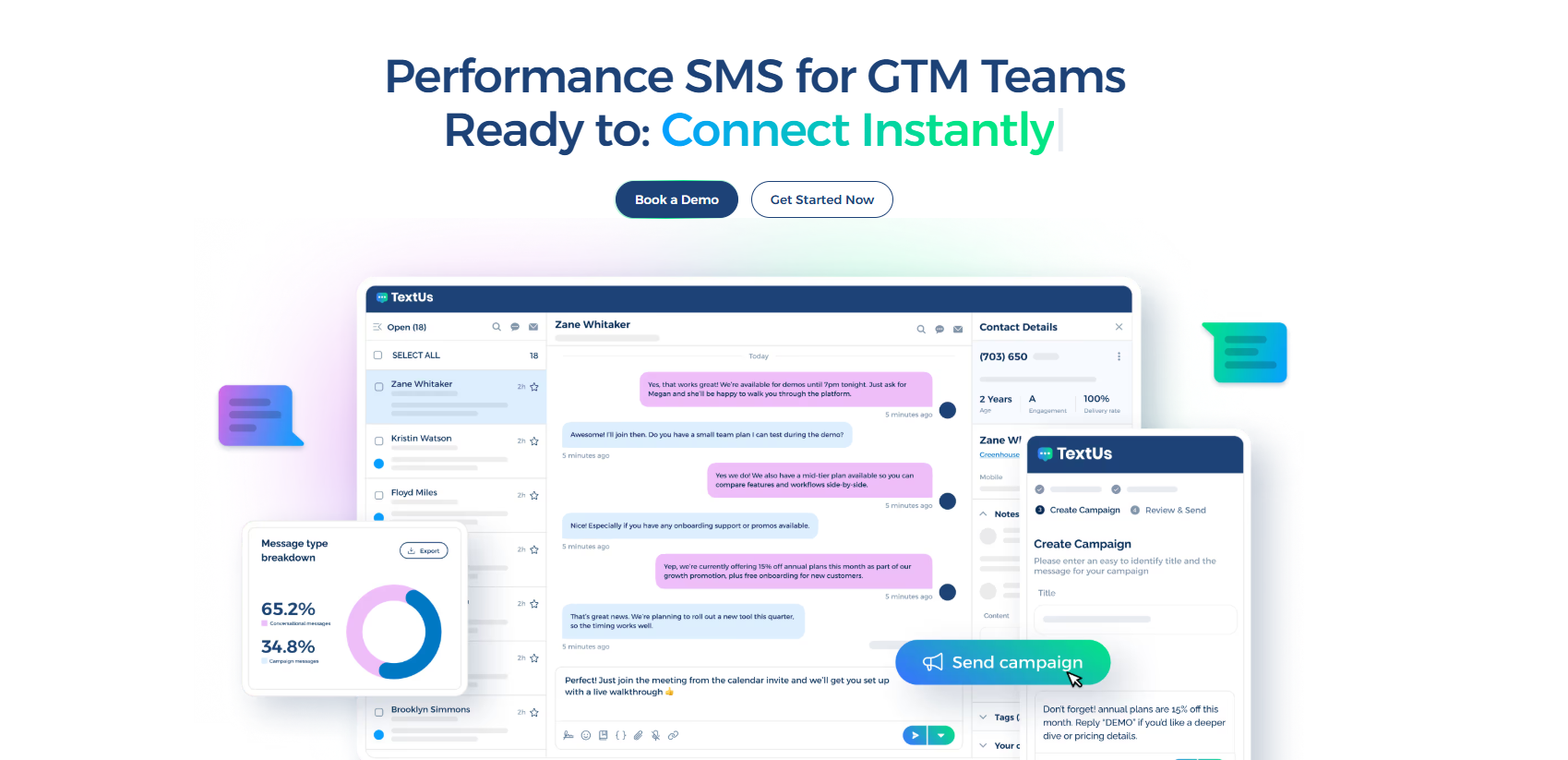
Turn SMS into an effective channel for follow-ups, campaigns, reminders, and updates. Book a demo with TextUs today to see how it can help you create better customer conversations!
Continue Reading



Frequently Asked Questions
What are the most common text abbreviations and acronyms used in 2026?
Some of the most common text abbreviations and acronyms used in 2026 include LOL, BRB, IDK, IMO, NGL, SMH, FYI, ASAP, TTYL, and FR.
A new word or abbreviation can spread fast through social media, so you should check the meaning before using it in customer-facing texts. Some terms can also mean different things depending on the platform, audience, and the right context.
Should businesses use texting abbreviations?
Yes, you can use texting abbreviations when the meaning is familiar, and the message stays clear. Terms like FYI, ETA, ASAP, SMS, MMS, and CTA can fit reminders, customer updates, sales follow-ups, and marketing messages when your audience already understands them.
How many texting abbreviations should you use in one message?
Research suggests that messages filled with abbreviations can feel less sincere and may reduce reply rates in professional communication. It's recommended to use two texting abbreviations in one message at most, especially in business texts.
A message with too many shortcuts can look rushed and may make the sender seem less sincere. Before you send mass texts, use familiar terms only when they support the message, and spell out anything tied to price, consent, account access, or safety.
Business Texting
Built for Results
Create and convert pipeline at scale through industry leading SMS software