
GTM Execution: How to Build a Repeatable Revenue Process
Learn what GTM execution is, what drives a successful execution plan, and how to build a framework that keeps the process moving.

Written by
Adam Hamdan
Published
September 1, 2026

You can have the market, buyer persona, positioning, product, and sales strategy in place and still miss your revenue targets.
The problem often starts when your strategy never becomes consistent action across the people responsible for bringing it to market.
Go-to-Market (GTM) execution is the operating layer between strategy and results.
It connects the people, processes, campaigns, handoffs, measurement, and day-to-day decisions that turn a go-to-market plan into pipeline, customers, and revenue.
In this article, we will explain what GTM execution is, what drives a successful execution plan, and how to build a framework that keeps the process moving.
TL;DR
- A successful GTM plan depends on a defined ICP, consistent messaging, connected channels and data, specific ownership, repeatable handoffs, and technology that keeps every stage of the revenue process aligned.
- A GTM execution framework turns strategy into coordinated action through defined goals, target accounts, connected channels, clear ownership, shared communication, integrated systems, and continuous measurement.
- SMS strengthens GTM execution by reconnecting prospects between sales touchpoints, speeding up follow-up, reducing stalled conversations, and tying activity back to pipeline and revenue.
- TextUs connects SMS across sales, marketing, and customer success to ensure GTM teams can follow up faster, stay aligned, and drive more conversions.
What Is GTM Execution?
GTM execution is the process of turning a go-to-market strategy into coordinated action across the people, channels, technology, workflows, and customer touchpoints tied to revenue.
It acts as the execution layer between the strategy a company creates and the work required to reach prospects, convert opportunities, support customers, and drive revenue growth.
Your GTM strategy may define the target market, positioning, pricing, sales motion, and growth goals. But execution determines how those decisions show up in day-to-day work.
What Drives a Successful Go-to-Market Execution Plan
Here are the key components that keep your GTM execution focused on results:
Ideal Customer Profile (ICP)
A successful execution plan starts with a deep understanding of who you want to reach and which customers are most likely to benefit from the offer.
Your ICP should cover company size, industry, buyer role, common pain points, buying triggers, use cases, and reasons an account may not be a fit.
Basic demographic or firmographic filters are not always enough to guide outreach.
Signals such as intent data and behavioral data can add context around what prospects are researching, which accounts show interest, and where attention may be increasing.
Consistent Positioning and Messaging
Your positioning needs to stay recognizable across marketing campaigns, sales conversations, product messaging, and customer handoffs.
A shared message framework should define the customer problem, value proposition, differentiators, proof points, common objections, and core language used across channels.
Defined GTM Channels
Your GTM channels determine where prospects and customers interact with the company throughout the buying journey.
The mix may include content, email, phone, social media, product experiences, and business text messaging. This depends on how the audience prefers to communicate and how complex the sales process is.
Shared Customer and Account Data
Reliable customer data creates a common source of context across marketing, sales, and customer success.
Multiple teams need access to account activity, contact history, lifecycle stage, past conversations, and engagement signals. It prevents the reconstruction of the customer story at every stage.
Shared data also improves decisions about who needs follow-up and what should happen next.
Ownership and Accountability
Every major GTM initiative needs clear ownership so people know who is responsible for decisions, deadlines, handoffs, and outcomes.
Shared responsibility can become a problem when no one has final accountability for moving a campaign, lead, opportunity, or customer to the next stage.
Strong GTM teams also define where responsibilities begin and end across marketing, sales, RevOps, product, and customer success.
Specific ownership reduces stalled work and makes it easier to identify where an execution problem needs attention.
Repeatable Processes and Handoffs
Poor processes create missed handoffs between marketing and sales or between sales and customer success.
Qualification rules, follow-up expectations, account assignments, handoff requirements, and escalation paths should be documented so execution doesn't depend on individual habits.
A shared GTM playbook can document the steps, information, messaging, and responsibilities that need to follow each account throughout the customer journey.
Technology That Connects the Process
Technology should reinforce the process rather than create another layer of disconnected work.
CRM systems, SMS marketing platforms, communication solutions, analytics software, and sales enablement platforms should share enough data to keep customer activity visible.
Workflows such as lead routing also need to match the way accounts are assigned, qualified, contacted, and moved forward.
How to Build a GTM Execution Framework
A GTM execution framework turns strategy into a structured process that sales teams can follow from planning through measurement.
Here are the steps that help connect priorities, workflows, customer activity, and revenue goals.
Step #1: Confirm the GTM Strategy
Execution should begin with a short check that the market, product, ICP, positioning, pricing, customer problem, revenue goal, and GTM model still point in the same direction.
The chosen motion also needs to reflect how customers buy, whether the company follows a sales-led, product-led, partner-led, or blended approach.
This step helps confirm that the assumptions guiding execution are defined before people, budget, and technology move into action.
Step #2: Turn Business Goals Into Execution Targets
Broad growth goals need to become numbers that departments can act on.
Revenue targets may translate into pipeline velocity, qualified opportunities, new customers, expansion goals, conversion rates, win rate, and deadlines.
A documented action plan should connect those targets with owners and timelines. Shared KPIs also keep marketing, sales, and customer success focused on related success metrics.
Step #3: Define Target Accounts and Buyer Segments
Execution turns an ICP into a real list of companies and people to pursue.
Account tiers help determine where more time, personalization, and sales attention should go based on fit, buying signals, opportunity size, and current interest.
Each account may contain several people with different priorities. The champion, user, evaluator, and decision maker may need different messages and proof before a purchase moves forward.
Step #4: Map the Buyer Journey
The buyer journey should show the actions prospects take from awareness and research through evaluation, purchase, onboarding, renewal, and expansion.
Each stage should connect a customer need with a desired next action. This map also shows when responsibility changes across GTM functions.
The process becomes easier to manage and align teams when each stage has a defined owner and condition for moving the account forward.
Step #5: Choose Your GTM Channels
Every channel should have a specific role in the customer journey.
Content and paid media create awareness, while email handles education. Calls may support deeper conversations, and events or partnerships can build trust.
SMS marketing becomes valuable in the spaces where pipeline health starts to weaken.
A prospect may request information, book a demo, or enter an active sales conversation, then disappear into a full inbox or miss the next follow-up.
A short, permission-based text lets them confirm a meeting, answer a simple question, or bring attention back to an open conversation before deal velocity starts to suffer.
A better GTM tech stack allows each channel to handle the interaction it fits best, while the buyer experiences one connected conversation across every touchpoint.
Step #6: Create Repeatable GTM Plays
Recurring situations need to have a defined process instead of requiring people to decide what happens next from scratch.
A GTM play should identify the trigger, target audience, message, channel sequence, owner, timing, next action, and success measure.
A demo follow-up, for example, may include an email, a sales call, and a permission-based text based on how the prospect responds.
Good execution turns common revenue situations into repeatable processes without making every customer interaction feel scripted.
Step #7: Assign GTM Ownership
People need to know who owns each campaign, account stage, workflow, and decision.
GTM leaders may oversee the broader direction, but individual initiatives still need someone responsible for moving the work forward.
Handoffs also need rules for what information travels with the account.
Better sales marketing coordination keeps campaign history, customer needs, stakeholders, commitments, and next steps available when ownership changes.
Step #8: Create a Shared Communication Process
Customer conversations have to remain visible when multiple teams manage the same account.
Shared inboxes, CRM activity, conversation history, assignments, and communication preferences give customer-facing staff context before the next interaction.
Most teams already communicate through several channels. But business texts may become disconnected when they sit on personal phones or outside shared systems.
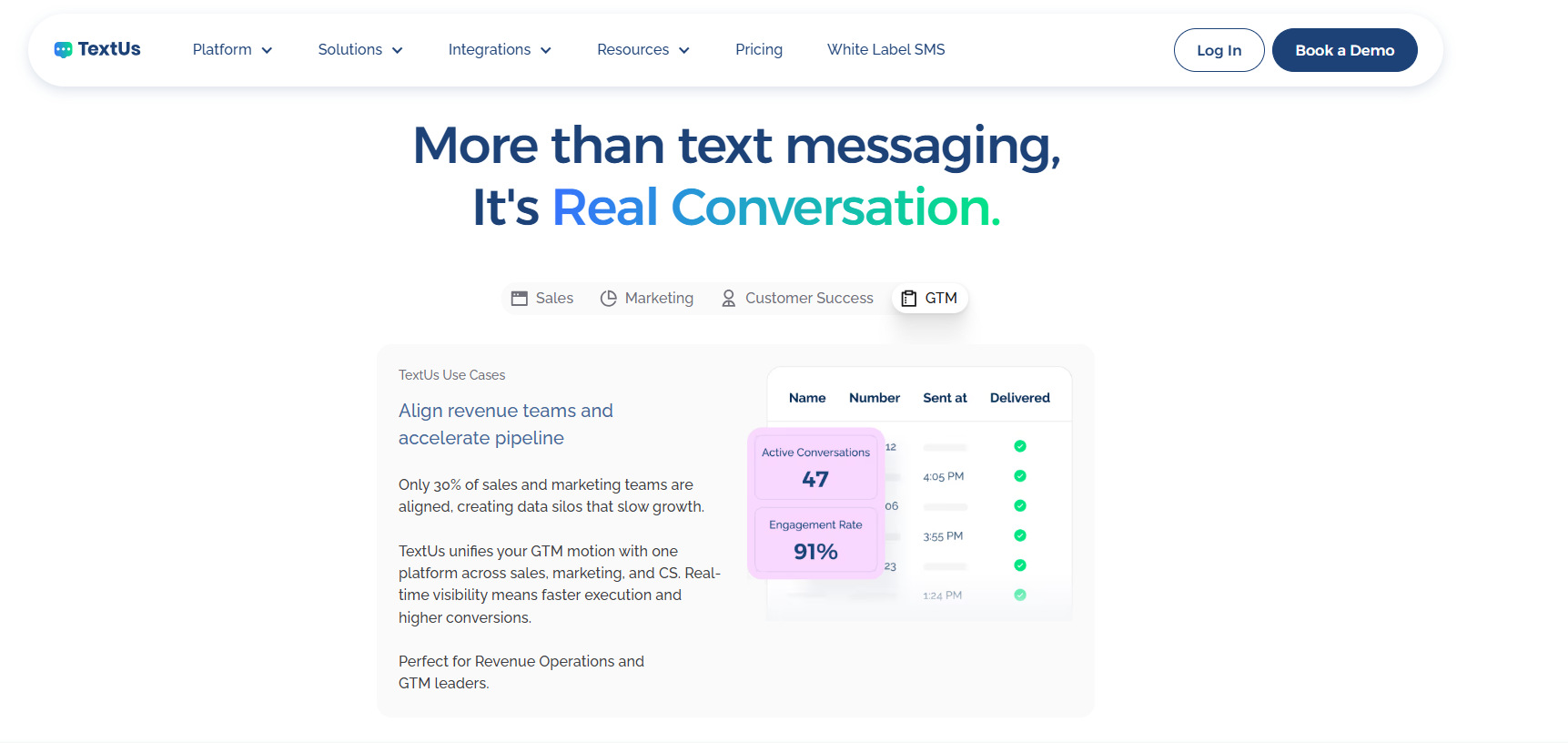
TextUs brings SMS into a shared workspace where sales, marketing, and customer success can view conversations, connect texting with CRM workflows, and maintain context across the GTM process.
Book a demo with TextUs to see how shared business texting can support your GTM execution!
Step #9: Connect Systems and Prepare Customer-Facing Teams
CRM, marketing automation, business communication, analytics, customer success platforms, and AI tools should reflect the process already defined.
Customer information, account ownership, activity history, and workflow updates need to move between systems so people have useful context when they act.
Enablement should prepare staff for real customer conversations through discovery guides, objection responses, templates, competitive information, case studies, and handoff documentation.
When teams work from the same information, customers receive a more consistent experience across the sales and post-sale process.
Integration gaps deserve attention before launch. When things break between platforms, missed activity or outdated account information weaken execution even when the whole strategy is sound.
Step #10: Launch, Measure, and Improve Execution
Campaign data should follow prospects into the pipeline so employees understand what happened before the next conversation.
You need to compare actual execution with the plan before leadership decides the strategy needs to change.
Measurable results such as qualified opportunities, conversion, revenue, adoption, or expansion show whether the process is producing business value.
Regular feedback loops between marketing, sales, customer success, RevOps, and leadership also help identify what should change.
Each cycle builds on what the company learned so future execution has a better chance of producing consistent results.
Where SMS Fits Into a High-Performing GTM Motion
Many sales funnels don't fail because interest is missing. GTM execution breaks when leads drop between major interactions, after a demo request, or when a buyer stops responding.
SMS adds a direct touchpoint inside the GTM motion when another email or voicemail may not get attention.
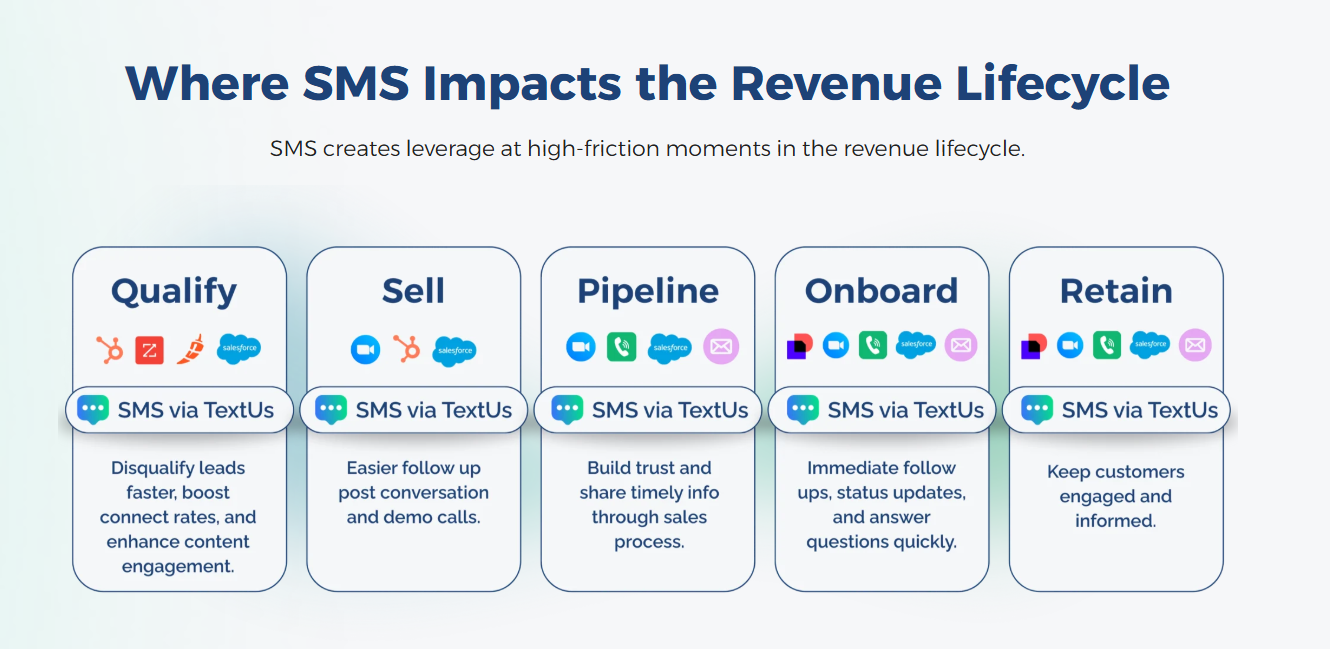
Most teams think about SMS as cold outreach or promotional blasts. But its biggest GTM role appears after a prospect has already engaged.
A short message about a meeting, open question, requested resource, or follow-up keeps the conversation moving without forcing the buyer into another long exchange.
A delayed response also gives competitors more room to take over. SMS creates a faster path back into the conversation when speed is important, and the buyer has agreed to receive texts.
You'll see its business value when SMS activity connects back to your CRM.
Meetings booked, conversations reopened, opportunities advanced, and closed revenue provide measurable outcomes that tell you more than message volume.
Put SMS at the Center of Your Revenue Team Alignment With TextUs
Only 30% of sales and marketing teams are aligned. This cross-functional gap leaves account data, conversations, and follow-up spread across separate systems.
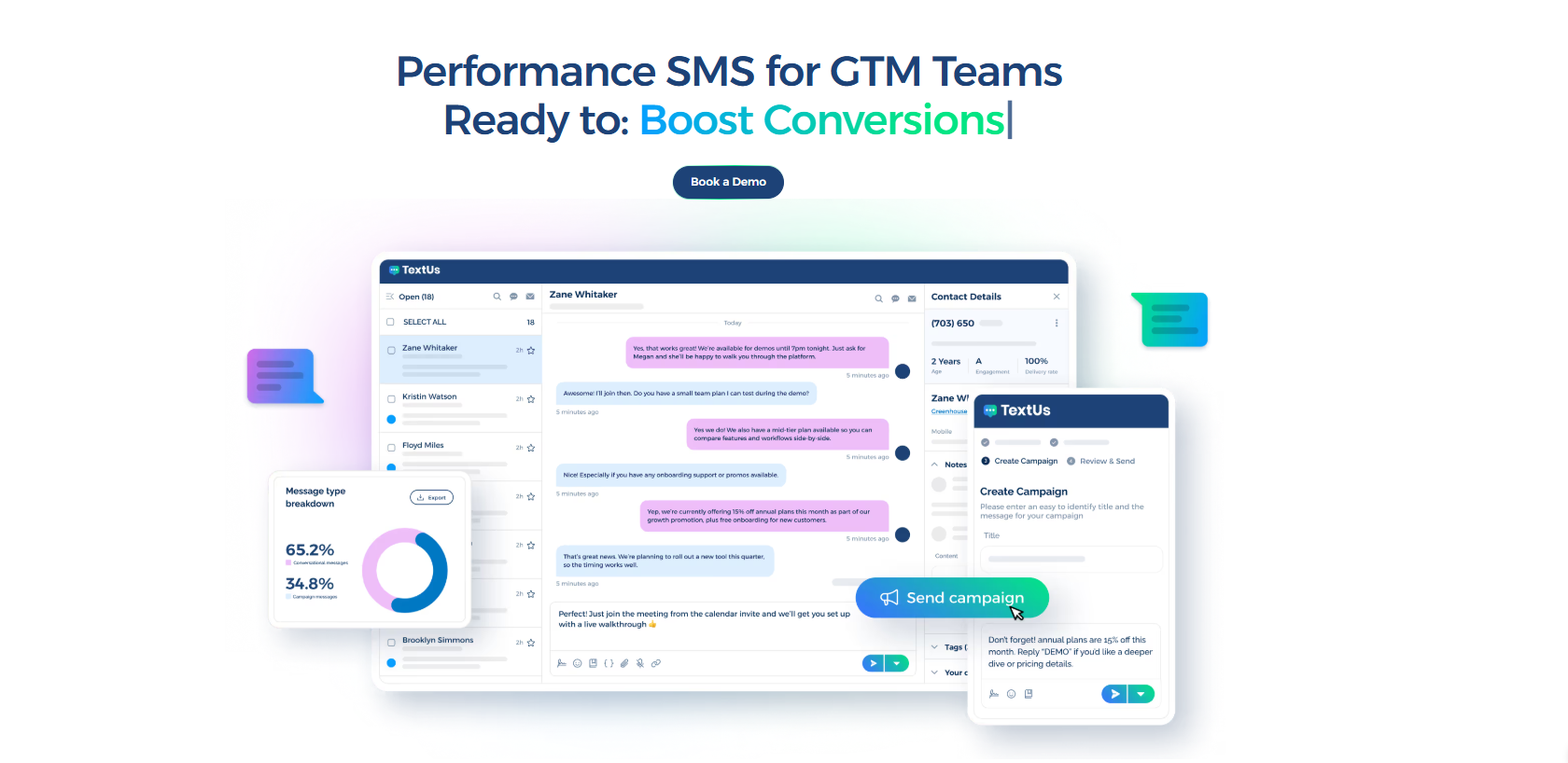
TextUs brings SMS conversations into a shared workspace. Revenue teams can see what happened, who owns the conversation, and what needs to happen next.
This platform also connects texting with the systems already behind your revenue process. Native integrations with Salesforce, HubSpot, and other platforms keep texting connected to existing revenue workflows.
Contacts stay in sync, messages can be logged to the system of record, and shared inboxes help teams manage replies from one place.
Automated campaigns, conversation assignments, and AI-powered engagement scoring also make it easier to identify active contacts and keep opportunities moving.
TextUs Analytics adds visibility into response times, performance metrics, campaign activity, team engagement, and areas where conversations begin to stall.
Book a demo with TextUs to see how SMS can become a connected part of your revenue workflow!
Continue Reading



Frequently Asked Questions
What is GTM execution?
GTM execution is the process of turning a GTM strategy into coordinated action across marketing, sales, customer success, and operations.
It connects planning with real activity so you can generate pipeline and move toward predictable revenue instead of relying on disconnected efforts or vanity metrics.
What does GTM stand for?
GTM stands for go-to-market. It refers to the strategy and process a company uses to introduce a product, reach target customers, generate demand, sell, and expand into new markets.
Most GTM strategies define the target audience, positioning, pricing, channels, sales motion, and customer journey before execution begins.
What is a GTM strategy example?
A B2B software company may use content for lead generation, sales outreach for qualified accounts, and email or SMS follow-up for inbound leads.
For scale-ups, the same strategy expands into new customer segments while using lead scoring. This helps prioritize accounts and reduce wasted spend on prospects with low purchase intent.
Business Texting
Built for Results
Create and convert pipeline at scale through industry leading SMS software