
10 Candidate Engagement Strategies for a Better Hiring Funnel
Use 10 candidate engagement strategies to reduce drop-off, improve communication, and support faster hiring with TextUs.

Written by
Adam Hamdan
Published
October 5, 2026

Candidate engagement covers the interactions between an organization and its candidates before, during, and after the active recruitment process.
However, attracting candidates is only the first step. Slow replies, long interview gaps, poor scheduling, and inconsistent next steps can cause engaged candidates to lose interest.
With the right candidate engagement strategies in place, you'll have a better way to keep communication consistent and build relationships from first contact to final decision.
In this article, we will explore the value of candidate engagement, strategies to improve your hiring process, the metrics worth tracking, and how to build a stronger plan from the ground up.
TL;DR
- Candidate engagement reduces drop-off, improves responsiveness, and supports cost-effective hiring through consistent communication and follow-up.
- Effective candidate engagement starts before application and continues through segmentation, personalized outreach, multi-channel communication, structured follow-up, interview scheduling, status updates, recruiter coordination, automation, and long-term re-engagement.
- You can measure candidate engagement through response, application completion, drop-off, stage conversion, interview attendance, time in stage, Candidate Net Promoter Score, stage-level satisfaction, offer acceptance, and re-engagement rates.
- You can build an efficient candidate engagement strategy by mapping the candidate journey, identifying drop-off points, setting communication standards, and reviewing performance.
- TextUs brings together SMS automation, AI-powered messaging, shared inboxes, and deep ATS and CRM integrations for a more connected recruiting process.
Why Is Candidate Engagement Important?
Great candidate engagement affects more than how candidates feel about your recruitment process.
According to Survale’s Candidate Experience Benchmark Research, 31% of North American candidates said they had not heard back from an employer one to two months or more after applying.
The same research found that lack of consistent communication, ghosting, and no follow-up were the top negative themes reported by candidates.
These gaps show why candidate engagement matters throughout the hiring process.
When qualified job seekers receive timely updates and have a way to ask questions, they're more likely to remain responsive instead of dropping out while considering other opportunities.
Strong engagement also keeps candidates engaged between applications, interviews, decisions, and offers. Fewer unnecessary delays support a shorter time to hire, reduce repeated sourcing costs, and lower cost per hire.
10 Candidate Engagement Strategies to Improve Your Hiring Process
Engagement requires more than occasional updates. Here are 10 effective candidate engagement strategies you can use to create a more responsive experience.
1. Start Engagement Before Someone Applies
Candidate engagement begins before someone submits an application.
Employer branding, career content, social media, referrals, hiring events, talent communities, and job alerts can introduce potential candidates to your organization throughout the recruitment journey.
Your job ad is also an early opportunity to communicate what the role offers, what applicants can expect, and what your company culture looks like.
Some new candidates may follow your company for weeks or months before a suitable role appears. Regular career content and relevant job updates help candidates remain familiar with your organization without pressuring them to apply before they are ready.
2. Segment Candidates Before You Send Outreach
Your candidate engagement process should account for differences between active applicants, passive talent, referrals, event leads, previous applicants, and existing candidates.
Each group enters the hiring process with different levels of awareness, intent, and familiarity with your organization. You may segment contacts by role, location, skills, source, previous interactions, or hiring stage.
For example, active applicants may need interview updates or next-step reminders, while previous applicants may need context about why a new role fits their background before they decide to reconnect.
SMS segmentation makes this approach easier to manage across larger candidate pools. With texting software, you can organize contacts into targeted groups and send relevant campaigns.
More focused outreach avoids irrelevant messages and gives each candidate a clearer reason to respond. It also supports stronger engagement levels since the message reflects where each person is in the hiring process.
3. Personalize Candidate Outreach
Personalization goes beyond adding a candidate’s name to a message. Your outreach should reflect details such as experience, skills, location, previous interactions, or the role they applied for.
That context signals genuine interest and gives candidates a reason to respond.
A sourced candidate may need to know why their experience matches the opportunity, while a previous applicant may respond better when you acknowledge their earlier application and explain why the new role may fit their background.
Recruiting message templates can still save time, but the message should leave room for context that matters to the recipient.
Merge fields handle standard details while recruiters add information that makes the outreach specific to the person.
4. Build a Multi-Channel Candidate Communication Strategy
Email works better for longer instructions and documents, while phone calls suit detailed discussions. LinkedIn also supports sourcing, and career portals handle formal application updates.
Interview reminders, scheduling questions, application follow-ups, status updates, and availability checks all fit well in text conversations.
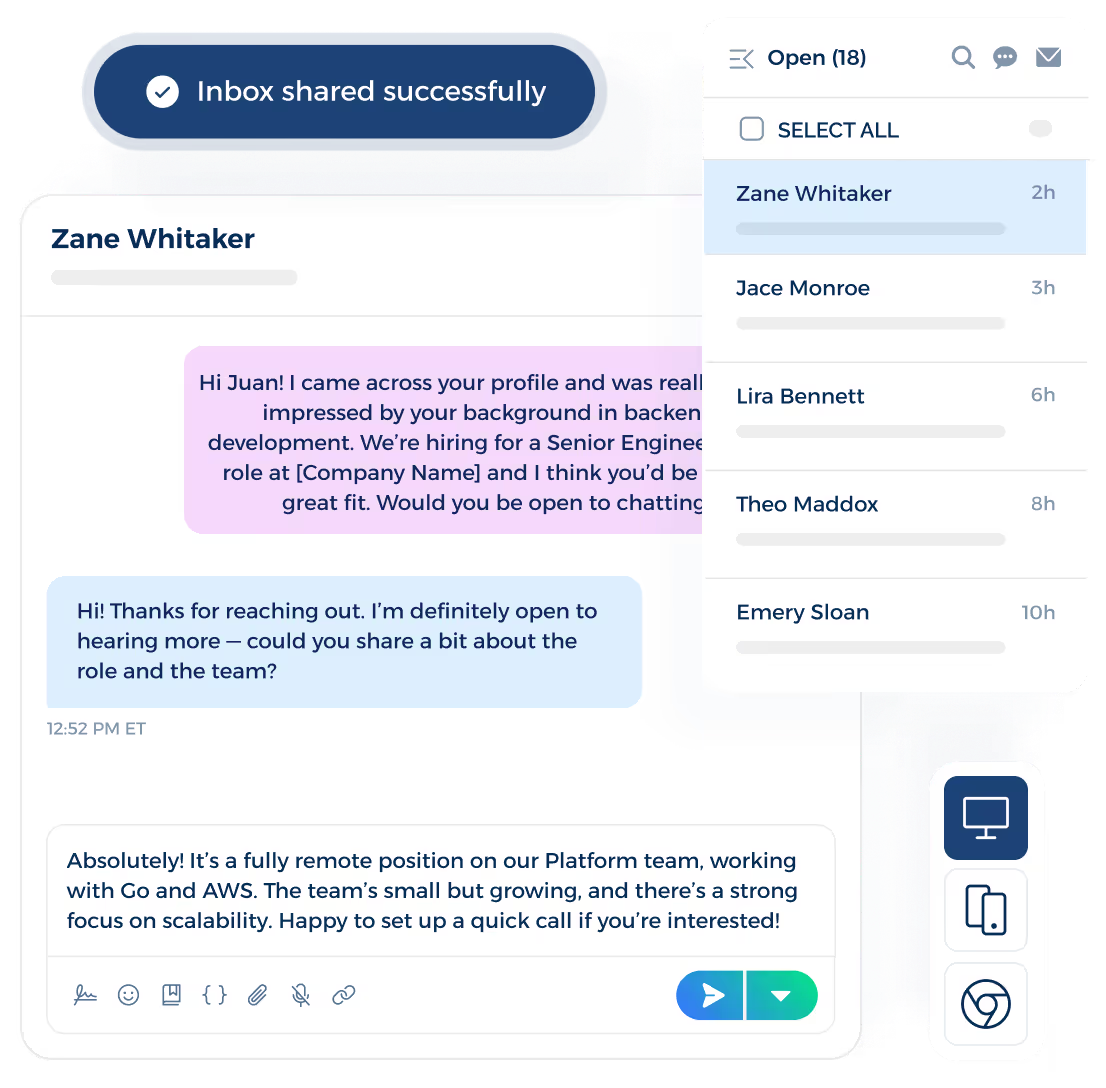
Your candidate engagement plan should define when each channel is used, with SMS marketing serving as the main option for fast, conversational outreach.
Also, pay attention to where each candidate responds so future communication follows the channel they prefer.
TextUs lets you add texting to the mix when emails go unanswered and calls get ignored. Its deep ATS and CRM integrations connect candidate conversations with the systems you already use.
You can use this text recruiting software throughout the hiring process, from re-engaging passive candidates and confirming interviews to closing on a placement.
Book a demo with TextUs today!
5. Create a Candidate Follow-Up Cadence
A candidate who doesn't reply to the first message isn't always uninterested. Work schedules, competing interviews, missed notifications, or poor timing can all delay a response.
You need to define when another message should be sent, how much time should pass, and when outreach should stop. Text automation software helps you build that structure.
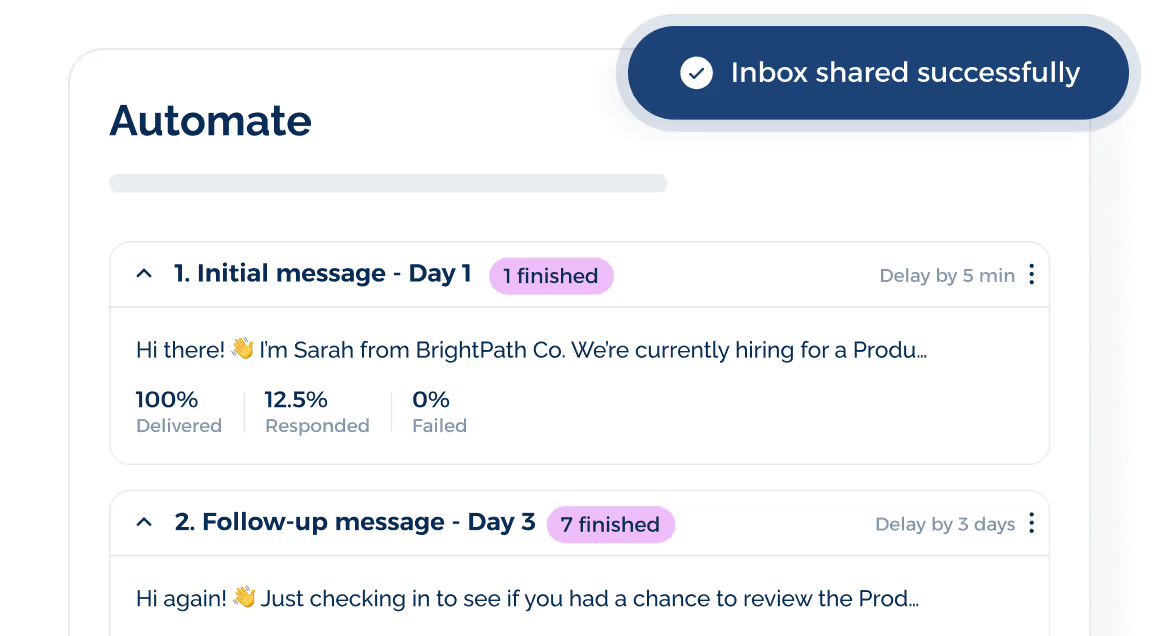
With SMS drip campaigns, you set a sequence of messages that goes out over a defined period, such as an initial follow-up, a second check-in, and a final message if the candidate hasn't responded.
A structured follow-up sequence helps candidates stay engaged without sending repeated messages that may feel excessive.
6. Simplify Interview Scheduling and Send Reminders
Interview scheduling should feel easy for both you and the candidate. Self-scheduling links, calendar integrations, interview confirmations, and simple rescheduling options help you reduce back-and-forth.
Reminder texts can also help maintain momentum before an interview. You may include the date, time, format, location, or meeting link, and any preparation details the candidate needs.
Campaign scheduling lets you choose the date and time for each reminder in advance. That makes it easier to send timely follow-ups after an application, before an interview, or after a conversation.
A smoother scheduling process contributes to a positive candidate experience because candidates spend less time chasing logistics. It also reduces the risk that an interested applicant loses interest while waiting for the next step.
7. Keep Candidates Updated Between Hiring Stages
Some of the most important communication happens when there's no final decision yet.
Qualified candidates may be waiting for interview feedback, another interview, internal approval, or a decision from the hiring manager.
SMS helps you maintain transparent communication without turning every update into a long email.
A short text lets you confirm that the process is still active, acknowledge a delay, and share when the candidate should expect to hear from you again.
When candidates expect an update and receive nothing, interest may drop even if they were initially excited about the opportunity.
8. Coordinate Recruiters and Hiring Managers
Talent acquisition teams need defined ownership for outreach, scheduling, interview feedback, candidate questions, and final decisions.
Your applicant tracking system (ATS) centralizes candidate history, notes, stage changes, and activity. At the same time, text recruiting software adds visibility into ongoing text conversations.
With TextUs, a shared inbox lets your hiring team see which messages have already been sent, review candidate replies, and continue the conversation without starting over.
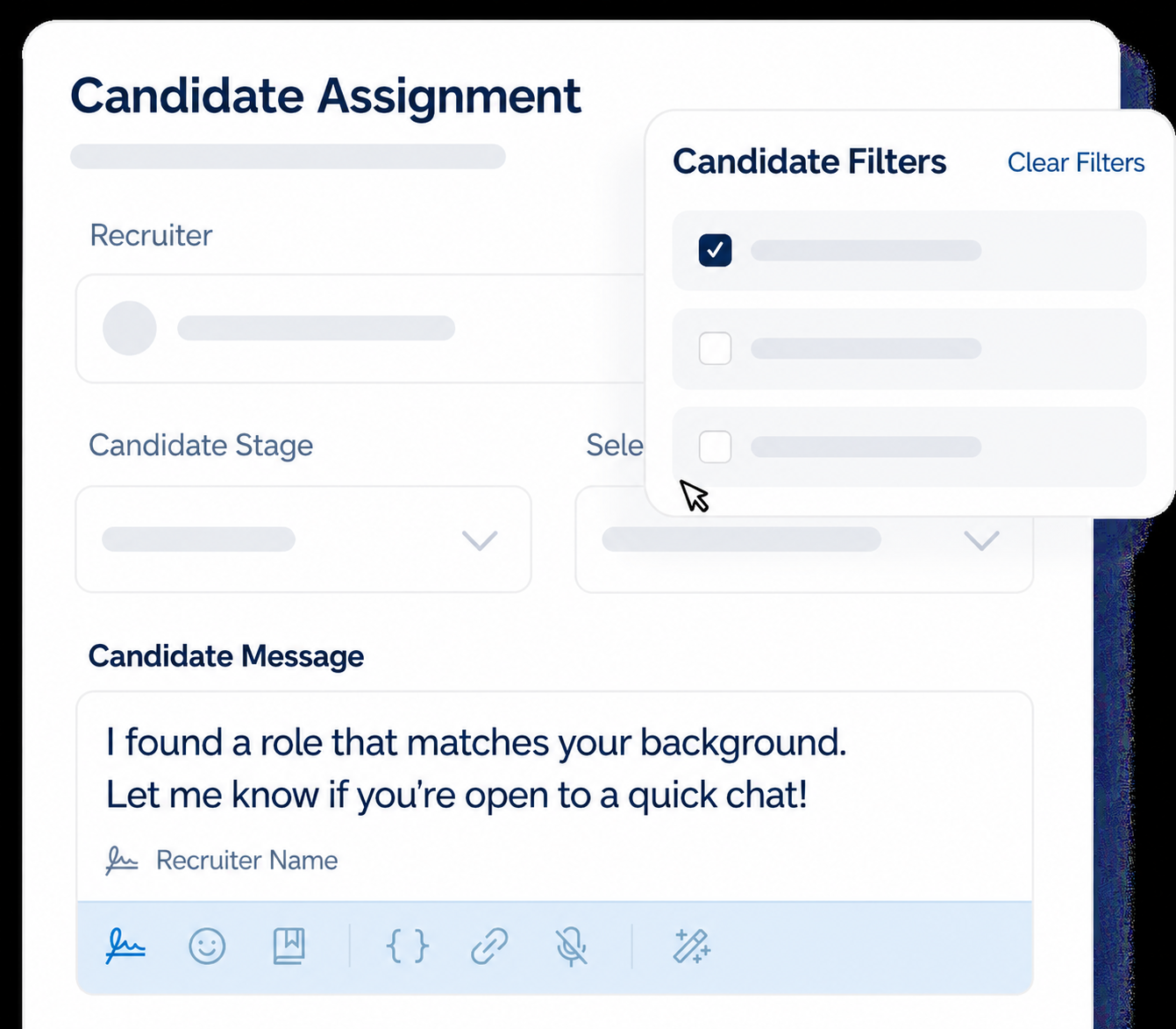
Message assignments also help you define who owns each conversation. That makes it easier to route candidate questions to the right recruiter and prevent missed follow-ups.
Stronger internal coordination reduces the risk of a poor candidate experience caused by repeated outreach, delayed responses, or inconsistent instructions.
9. Use Automation Without Removing Human Interaction
Automation helps you handle repeatable communication such as application confirmations, interview reminders, scheduling messages, status updates, and re-engagement campaigns.
Human involvement still matters when the conversation requires judgment, empathy, or a detailed response.
Interview feedback, compensation discussions, candidate concerns, offer negotiations, and complex questions are better handled by a recruiter who understands the context.
TextUs combines SMS automation, artificial intelligence (AI), and two-way messaging. Routine outreach takes less manual effort while candidate replies remain accessible to your recruiters.
You get the support of candidate engagement tools without making every interaction sound automated or disconnected from the person behind the conversation.
10. Close the Loop and Re-engage Strong Candidates
Candidate engagement shouldn't end as soon as someone leaves the active hiring process.
Rejected candidates who performed well may still be relevant for future roles, especially when the reason for rejection was limited vacancies or another applicant having a closer match.
You can ask strong candidates whether they want to hear about future open positions, then keep their profile and previous interactions available for later outreach.
The same approach supports a candidate who declines a job offer. They may still become a strong hire later if you close the conversation with respect and keep the relationship open.
How to Measure Candidate Engagement
Strong engagement is easier to improve when you know which parts of the recruiting process are working. These are the key metrics you can track to measure candidate engagement:
Candidate Response Rate
Response rate measures the percentage of people who reply to your recruiting outreach.
- Formula: Candidate response rate = candidates who respond ÷ candidates successfully reached × 100
You can review results by channel, role, campaign, and candidate segment to see where your messages generate the strongest interest.
Application Completion Rate
Application completion rate compares the number of people who finish an application with the number who started it.
- Formula: Application completion rate = completed applications ÷ started applications × 100
A decline in completion deserves attention before you assume sourcing is the problem. The issue may sit within the application itself rather than the quality or number of applicants entering your funnel.
Candidate Drop-Off Rate
The candidate drop-off rate shows how many people voluntarily leave your hiring process before completing it.
- Formula: Candidate drop-off rate = candidates who withdraw ÷ candidates who entered the stage × 100
A rise in candidate drop-off after screening, interview scheduling, or final interviews points you toward the exact part of the process that deserves review.
Stage Conversion Rate
Stage conversion rate measures the percentage of candidates who advance from one hiring stage to the next.
- Formula: Stage conversion rate = candidates advancing to the next stage ÷ candidates entering the current stage × 100
You may compare application-to-screen, screen-to-interview, interview-to-finalist, and finalist-to-offer rates.
Interview Attendance Rate
The interview attendance rate shows how many scheduled candidates attend their interviews.
A falling rate may point to weak reminders, scheduling problems, long delays, or declining interest between booking and interview day.
- Formula: Interview attendance rate = attended interviews ÷ scheduled interviews × 100
You should also review no-shows by role, recruiter, interview stage, and scheduling method.
Time in Stage
Time in stage measures how long candidates remain at each step before advancing, withdrawing, or receiving a decision.
- Formula: Average time in stage = total time candidates spent in a stage ÷ number of candidates who completed or exited that stage
Longer periods at one stage may reveal approval delays, scheduling issues, or other bottlenecks that cause candidate interest to decline.
Candidate Net Promoter Score
Candidate Net Promoter Score (cNPS) measures how likely candidates are to recommend your hiring process to others.
The standard calculation subtracts the percentage of detractors from the percentage of promoters.
- Formula: cNPS = % of promoters − % of detractors
Candidates who select 9 or 10 are promoters, those who select 0 through 6 are detractors, and those who select 7 or 8 are passive respondents.
Candidate Satisfaction by Hiring Stage
A single survey at the end of recruitment may hide problems that occurred much earlier.
- Formula: Candidate satisfaction rate = positive responses ÷ total survey responses × 100
Define a positive response in advance, such as a rating of 4 or 5 on a five-point scale, so results remain comparable between hiring stages.
Short surveys after application, screening, interviews, or offers give you stage-specific feedback on communication, fairness, recruiter preparation, clarity, and overall satisfaction.
Offer Acceptance Rate
Offer acceptance rate measures the percentage of formal offers that candidates accept.
- Formula: Offer acceptance rate = accepted offers ÷ total offers extended × 100
A low rate requires deeper analysis rather than an immediate assumption about compensation.
Long hiring timelines, weak communication, role expectations, competing offers, and the candidate’s experience throughout recruitment may all influence the final decision.
Candidate Re-engagement Rate
Candidate re-engagement rate measures how many previous candidates respond when you contact them about another opportunity.
- Formula: Re-engagement rate = previous candidates who respond ÷ previous candidates contacted × 100
Strong results indicate that earlier candidate interactions left enough interest for people to restart the conversation.
How to Build an Efficient Candidate Engagement Strategy
A strong candidate engagement strategy provides you with a more structured way to manage communication and expectations.
Below are the key steps to build an approach that supports stronger engagement and better recruiting outcomes.
Step #1: Map Your Candidate Journey
A candidate journey map gives you a full view of what someone experiences from the moment they learn about your company to the point they begin preboarding.
It also shows where communication feels smooth and where candidates may be left waiting, confused, or unsure about what happens next.
The journey includes job discovery, application, initial screening, interview scheduling, interview stages, hiring decisions, offer communication, and preboarding.
Each touchpoint should connect naturally to the next so candidates understand timing, responsibilities, and next steps.
Step #2: Identify Where Candidate Engagement Drops
Your hiring funnel often shows where candidate interest starts to weaken. Common friction points include:
- Low outreach response rates
- Application abandonment
- Screening drop-off
- Interview no-shows
- Long decision periods
- Offer declines
- Pre-start withdrawals
A rise in candidate drop-off at one stage may signal unclear communication, too much waiting, or unnecessary steps. These patterns help you see where your engagement efforts need the most attention.
The stages with the highest drop-off or longest delays should become the first priority. This prioritization keeps your strategy focused on the parts of the process that have the biggest effect on candidate interest and recruiting outcomes.
Step #3: Establish Rules for Candidate Priority
Not every candidate requires the same level of attention at the same moment.
You can create evaluation criteria that help you decide when a candidate needs immediate follow-up, when a recruiter should step in, and when a contact belongs in a longer-term nurture path.
Signals may include recent replies, interview completion, role fit, application stage, recruiter activity, or signs of active engagement.
TextUs AI-powered Contact Intelligence scores contacts as Cold, Warm, or Hot based on engagement and shows where each contact sits in the relationship funnel. That makes it easier to identify conversations with stronger interest without relying on manual tagging.
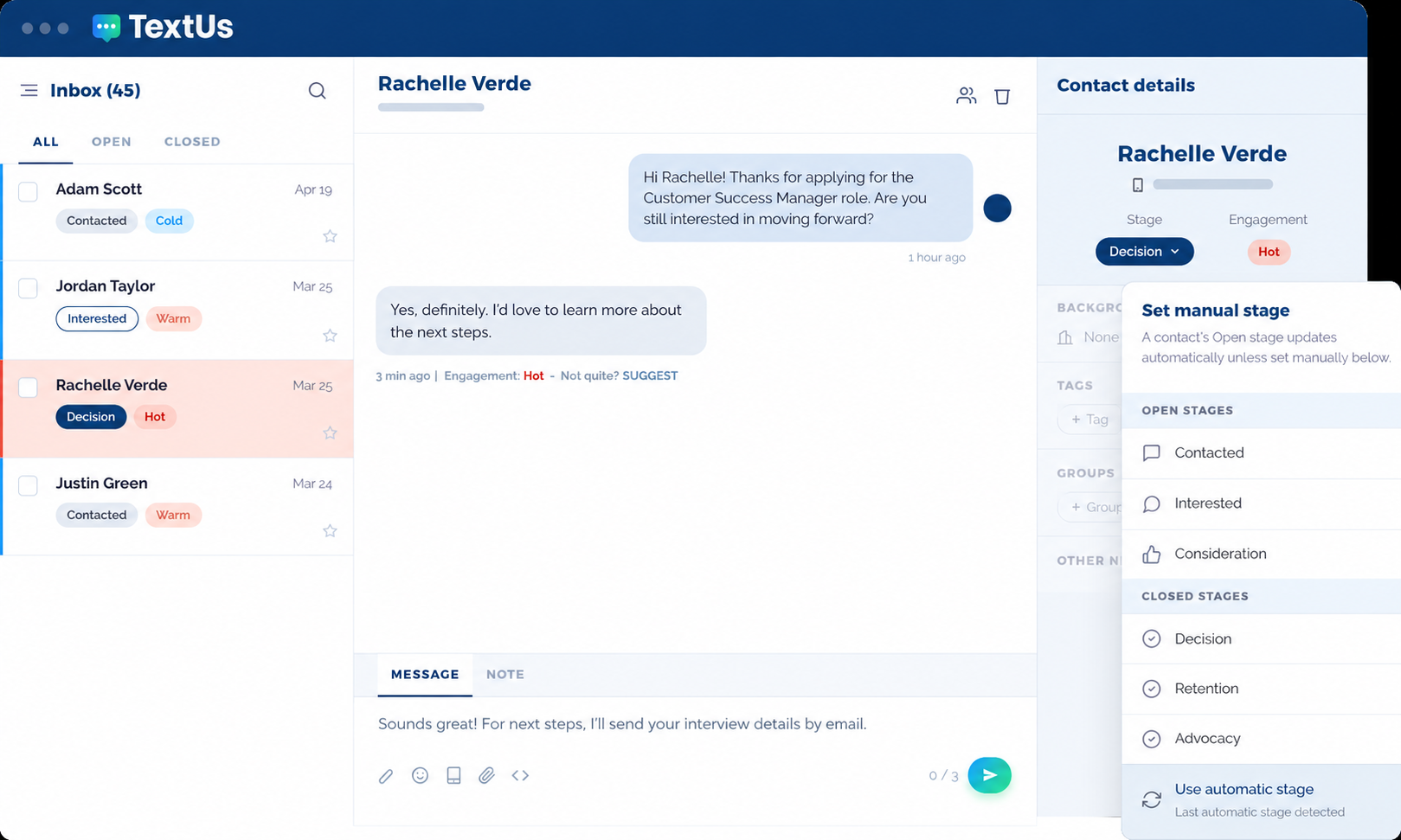
This framework lets you focus attention on potential recruits who need action while still keeping other contacts visible.
Step #4: Set Engagement Standards for Each Hiring Stage
You need to define what good communication should look like from the first contact through the final decision.
Your standards may cover response times, candidate ownership, required updates, follow-up windows, and the information candidates should receive before moving to the next stage.
Also, set clear expectations for recruiters and hiring managers so everyone follows the same basic approach.
This creates more consistent interactions across roles, locations, and recruiters without requiring every interaction to follow the same script.
Step #5: Create a Review Process for Ongoing Improvement
Your strategy shouldn't remain fixed once it's documented. You have to review engagement data at set intervals and look for patterns across roles, recruiters, locations, and hiring stages.
Use those findings to guide engagement improvements rather than changing the process based on isolated feedback.
Over time, this supports continuous candidate engagement and helps you build a stronger system around what produces the best response from talent pools.
Make SMS Part of Your Candidate Engagement Strategy With TextUs
Candidate engagement breaks down when strong applicants wait too long for updates.
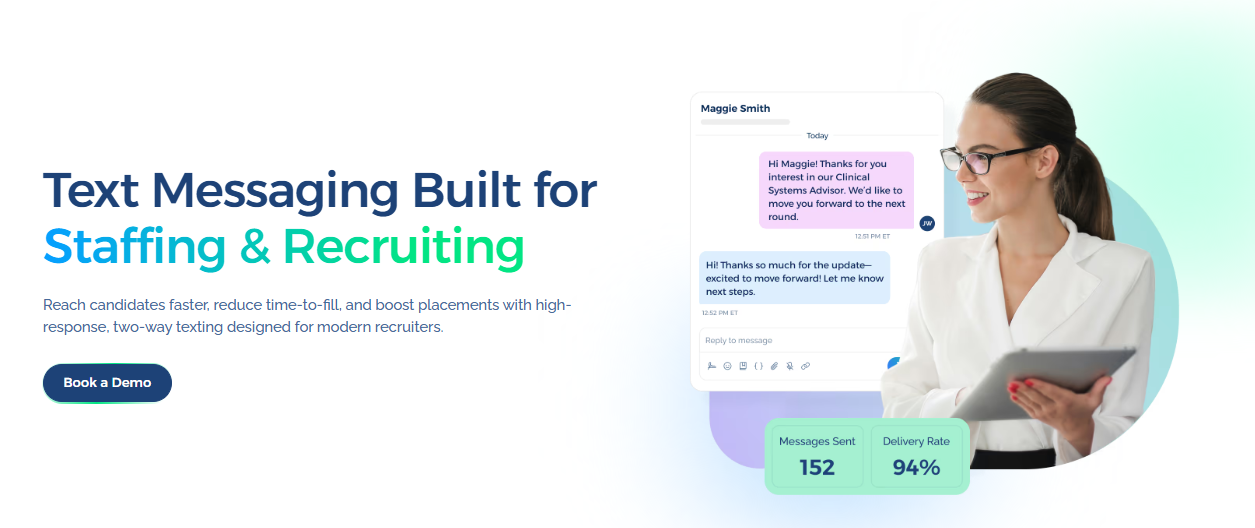
TextUs keeps candidates invested through fast SMS outreach and two-way conversations. It's easier to respond, ask questions, and stay connected throughout the hiring experience.
This SMS platform brings together automated campaigns, scheduled messages, drip sequences, shared inboxes, AI-powered messaging, integrated communication tracking, and deep ATS and CRM integrations.
These capabilities reduce manual follow-up, keep outreach organized, and give your recruiters more time to focus on candidate relationships and placements.
A faster, more responsive communication process also gives you a competitive advantage when top talent is speaking with several employers at once.
Book a demo with TextUs today and improve candidate engagement from first outreach through final placement!
FAQs About Candidate Engagement Strategies
Which metrics should you use to measure candidate engagement?
Measure it through response rates, application completion, candidate drop-off, stage conversion, interview attendance, time in stage, Candidate Net Promoter Score, offer acceptance, and re-engagement rates.
Compare several metrics together to identify delays or friction points.
What are some examples of employee engagement strategies?
Examples include recognition, regular feedback, and career growth opportunities. In recruitment, the same idea applies when you tailor outreach to each candidate’s background and interests.
A software engineer should receive updates about relevant technical roles, while accountants receive CPA openings that better match their qualifications.
What are the 5 C's of interviewing?
The exact framework varies between sources, so there's no single official set of 5 C's.
One common framework defines the 5 C's as character, competence, communication, culture fit, and confidence. These areas give you a broader way to assess a candidate beyond experience alone.
What is the 70/30 rule in hiring?
The 70/30 rule suggests hiring candidates who meet about 70% of the role’s essential requirements, while the remaining 30% consists of skills, tools, or knowledge they may develop after joining.
This approach broadens your talent pool and puts more focus on capability, potential, and willingness to learn.
What is Elon Musk's hiring strategy?
Elon Musk has emphasized evidence of exceptional ability over credentials alone. Recent recruiting efforts have asked applicants to show specific examples of standout work.
The broader business case is to evaluate proven results rather than rely only on résumés. You may also track and measure candidate engagement and identify areas for improvement.
Continue Reading



Frequently Asked Questions
Business Texting
Built for Results
Create and convert pipeline at scale through industry leading SMS software