
How to Build a GTM Tech Stack That Drives Revenue
Learn how to build a GTM tech stack that will help you drive revenue. Discover how to add texting to your tech stack with TextUs.

Written by
Published
July 2, 2026
.jpeg)
Most businesses lose revenue because their tools do not work together when leads, deals, and customers need the next step.
Sales may follow up from one system, marketing may measure campaigns in another, and customer success may step in without the full account history.
This gap creates slow handoffs, missed follow-ups, and unclear visibility into what drives revenue.
In this article, we will break down how to build a stack that supports your go-to-market (GTM) strategy, strengthens your marketing efforts, and turns your tools into a real revenue engine.
TL;DR
- A GTM tech stack is the connected system your business uses to attract buyers, manage leads, close deals, support customers, and measure revenue throughout the full customer journey.
- The right GTM tools are essential because they align sales, marketing, and customer success, reduce missed follow-ups, improve lead management, and keep customer communication tied to shared data.
- A modern GTM tech stack includes core components like CRM, customer lifecycle tools, marketing automation, data enrichment, sales execution, analytics, attribution, and governance.
- To build a strong GTM tech stack, you need to define your business objectives, map the buyer journey, audit current tools, fix process gaps, connect team data, add automation, and review performance over time.
- TextUs adds SMS to your GTM tech stack so sales, marketing, and customer success teams can follow up faster, keep the pipeline moving, and support customer engagement.
What Is a GTM Tech Stack?
A go-to-market tech stack is a set of tools you use to bring products or services to market.
It connects your GTM strategy with the systems you use to attract leads, engage prospects, close deals, support customers, and track revenue throughout the entire process.
For example, when a lead fills out a demo form, your existing tech stack can send the contact into your CRM, alert the right sales rep, send a text confirmation, and track whether that lead becomes a qualified opportunity.
Why Businesses Should Invest in the Right GTM Tools
Without a connected system, sales and marketing teams work from scattered information. A strong GTM tech stack brings those moving parts into one organized system.
Connects Sales, Marketing, and Customer Success
Buyers do not see your business as separate departments. They expect a smooth experience from the first website visit to the final sale and beyond.
A connected GTM stack gives each team access to the same data and reduces confusion during handoffs.
It also makes each interaction more relevant because your team is not starting from scratch each time a buyer reaches out.
Reduces Missed Follow-Ups
Missed follow-ups often happen when tools do not work together.
A form submission may sit in one system, or a customer conversation may happen through email, phone, or text with no shared record.
A modern GTM tech stack reduces those gaps by connecting workflows in your customer relationship management (CRM) tool, marketing automation, sales enablement software, texting platform, and customer success system.
Improves Lead Management
Lead management becomes harder when information lives in forms, spreadsheets, inboxes, ad platforms, and disconnected tools.
A GTM tech stack brings that data into a more organized process through unified systems.
You can use the stack to capture leads, score them, enrich their records, assign owners, and trigger the right follow-up. This makes it easier to spot which leads are ready for sales and which ones need more nurturing.
Supports Better Customer Communication
Your GTM stack should include the channels your buyers and customers use throughout their journey.
The goal is to connect communication tools with lifecycle stages, team workflows, and customer data platforms.
When these channels connect with your business tools, your team gets a more complete view of every customer conversation.
Core Components of a GTM Tech Stack
Here are the main parts of a modern GTM tech stack and how each one supports your revenue process.
CRM and Revenue System
Your CRM is the foundation of the GTM tech stack.
It holds the core records, including accounts, contacts, leads, owners, opportunities, pipeline stages, customer status, forecast categories, and revenue outcomes.
When your CRM system is structured well, your team can track where each buyer stands, who owns the next step, and how GTM activity connects to revenue.
Customer Lifecycle Platform
A customer lifecycle platform manages what happens after a deal closes. It tracks onboarding, product or service adoption, customer health, renewal dates, support risk, and customer value realization.
This component is important because GTM does not stop at acquisition. You also need to retain customers, grow existing accounts, reduce churn risk, and prove ongoing value.
Communication tools can support this stage through onboarding reminders, renewal notices, customer check-ins, and feedback requests.
SMS marketing platforms like TextUs can help align revenue teams and accelerate the pipeline when it is connected to your broader GTM tech stack.
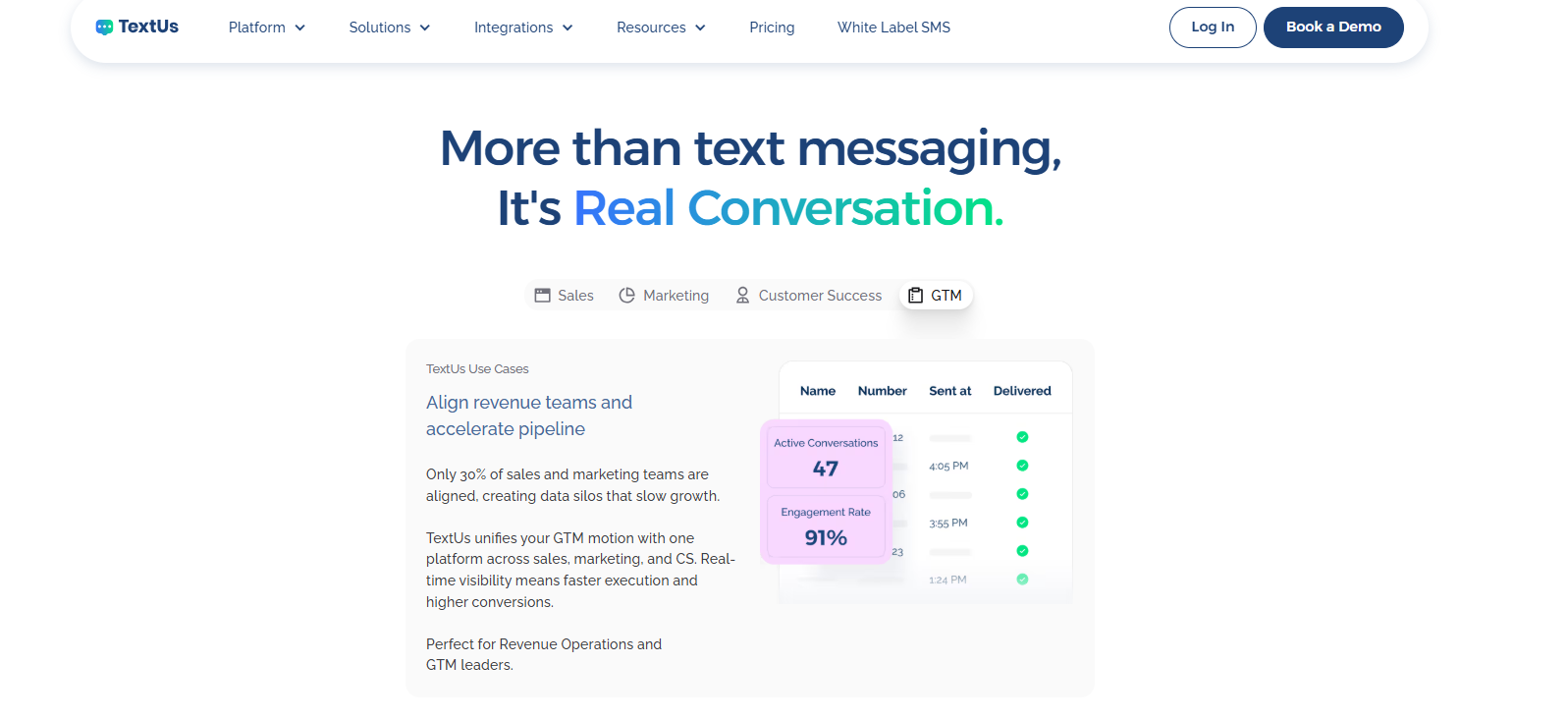
TextUs brings sales, marketing, and customer success into one platform with shared visibility into conversations, follow-ups, and customer engagement.
With a clear view of customer insights, faster execution, and better access to real-time communication data, you can respond sooner and move buyers toward conversion.
Book a demo with TextUs today and see how adding an SMS layer can strengthen your GTM tech stack!
Marketing Automation and Campaign Management
Automation tools manage the campaigns and workflows that bring leads into the funnel.
This layer handles forms, landing pages, email campaigns, nurture paths, audience segmentation, lead scoring, campaign membership, and source tracking.
Not every prospect is ready for sales outreach right away. A strong marketing automation tool gives you a better way to educate leads, track engagement, and pass qualified prospects to sales.
Data, Enrichment, and Buyer Signals
The data layer improves the quality and depth of your contact and account records.
It can add firmographic details, technographic insights, behavioral signals, buying intent, and account-matching logic.
This layer allows you to understand who a buyer is, what company they represent, what they may need, and when they may be ready to engage.
Better data also improves segmentation, routing, lead scoring, personalization, and reporting accuracy.
Sales Execution and Enablement
Sales tools support the activities your team uses to connect with prospects and move deals forward.
This part of the stack can include outreach tools, email sequences, calling systems, meeting scheduling, sales content, playbooks, coaching tools, conversation intelligence, and deal progression workflows.
Teams also get a repeatable process for managing buyer conversations. Managers have better visibility into outreach activity, meeting quality, deal risk, and the steps that lead to closed revenue.
Analytics, Attribution, and Governance
Analytics and attribution tools connect GTM activity to measurable business outcomes.
It brings together campaign performance, funnel movement, pipeline creation, forecast accuracy, customer retention, expansion, and data quality reporting.
You can see which campaigns create qualified leads, which sales actions move deals forward, which customer segments retain best, and which channels contribute to revenue.
Governance also belongs in this layer because your stack needs rules, owners, and data standards to stay useful.
That includes lifecycle definitions, field requirements, source tracking, permission rules, communication standards, and reporting ownership.
How to Build a GTM Tech Stack
The best stack is built around your actual revenue process. Here are the key steps to build a robust GTM stack that connects your teams, tools, data, and customer journey.
Step #1: Define Your Business Objectives
Start by defining your target market, ideal customer profile, buyer personas, sales motion, channels, pricing model, and revenue goals.
For example, if you're a company with a high-touch sales process, you may need stronger CRM, sales engagement, meeting, proposal, and forecasting tools.
If you have a product-led business, you need stronger product analytics, lifecycle messaging, and customer success platforms that match your business needs.
Your core tools should align with how your buyers make decisions. This keeps your stack focused on revenue execution instead of software collection.
Step #2: Map Your Current Buyer Journey
Next, map the entire customer journey from first touch to renewal. Look at how prospects discover your business, how leads are qualified, and how sales conversations begin.
Then review how deals move through the sales funnel, how customers are onboarded, and how your team keeps existing customers engaged after the sale.
This is where SMS marketing can add value to the revenue lifecycle.
During qualification, SMS can help your team disqualify poor-fit leads faster, improve connect rates, and increase engagement with key content.
During the sales stage, text messaging can make follow-up easier after conversations, demos, and missed calls. It gives your team a direct way to keep customer interactions moving when timing matters.
Step #3: Audit Your Current GTM Tools
Many teams have overlapping software tools, unused licenses, disconnected systems, or reporting gaps that create more work than value.
You need to look at which tools support your CRM, campaigns, outreach, customer communication, reporting, and post-sale process within your technology stack.
Then identify which new tools are essential, which ones duplicate another system, and which ones no longer support the way your team works.
Step #4: Identify Gaps in Your GTM Process
Gaps show up when leads move between marketing, sales, customer success, and reporting systems without a clear workflow. These can create data silos that slow execution.
Poor lead routing is one of the most common issues. If leads are not assigned to the right owner fast enough, sales teams may lose valuable opportunities before the first conversation even starts.
Your current tech stack should make it clear who owns each lead, what stage the lead is in, and what the next step should be in your internal processes.
Slow response times can also weaken your GTM performance. When prospects fill out a form, request pricing, or engage with a campaign, your team needs a fast way to follow up.
Step #5: Choose Your Core System of Record
After mapping your current tools and customer journey, look for the points where your GTM process slows down.
These gaps may show up as poor lead routing, delayed follow-ups, unclear attribution, messy CRM data, limited campaign visibility, no shared account view, or weak customer health tracking.
Each issue can create hurdles between teams and make it harder for your business to turn interest into a pipeline.
Sales and marketing alignment is a major part of this step. When GTM teams work from separate systems, they lose visibility into lead activity, campaign engagement, sales conversations, and deal progress.
Step #6: Connect Your Sales and Marketing Data
A GTM tech stack only works when data moves between teams. Marketing needs to know which leads turn into pipeline, and sales needs to see where leads came from and what they engaged with.
Customer success teams need to understand what was promised during the sales process. Leadership needs reports that connect activity to revenue and support data-driven decisions.
SMS marketing software like TextUs unifies your GTM motion across sales, marketing, and customer success. You get one platform for SMS visibility, faster execution, and customer engagement.
With shared communication data, you can respond sooner, reduce missed opportunities, and move more buyers toward conversion. Book a demo with TextUs today!
Step #7: Add Automation Where It Supports the Process
Automation should support your GTM process without making it harder to manage. Start with workflows that reduce repetitive tasks or prevent missed follow-ups.
You may automate lead routing, CRM updates, task creation, demo reminders, campaign triggers, customer status changes, and follow-up sequences to lessen extra marketing tasks.
SMS marketing automation tools can also support moments that require a direct message, such as demo confirmations, appointment reminders, missed-call follow-ups, and customer check-ins.
AI tools can also support faster execution through predictive insights, lead scoring, message suggestions, and workflow recommendations.
Step #8: Set Governance and Ownership
Without ownership, multiple tools become messy, data loses trust, and teams start creating their own side processes.
You have to assign owners for each major tool and define who manages settings, permissions, workflows, data accuracy, reporting, and renewals.
Also, create standards for lifecycle stages, required CRM fields, lead routing, campaign naming, consent tracking, communication rules, and reporting definitions.
Governance keeps the stack usable as your business grows. It also improves data hygiene and makes it easier to decide which tools deserve continued investment.
Step #9: Build Reporting Around Revenue Outcomes
A flexible stack should connect campaigns, outreach, conversations, pipeline, deals, retention, and expansion to business outcomes.
You should be able to see which channels create qualified leads, which campaigns influence opportunities, which customer segments retain best, and which tools contribute to revenue.
If SMS is part of your stack, track delivery, replies, opt-outs, conversions, and revenue, where possible, through analytics platforms.
Your reporting should also connect key metrics such as customer acquisition cost, response rates, pipeline source, conversion rate, usage analytics, sales cycle length, and emerging trends.
Tools like Google Analytics can show website performance, while CRM and attribution tools can turn campaign and sales data into actionable insights.
Step #10: Review and Improve the Stack Over Time
A GTM tech stack is not a one-time setup. You need to review it as your marketing strategy, team, customers, and revenue goals may change.
A regular stack review should look at tool usage, cost, data quality, integration capability issues, workflow performance, reporting gaps, and team feedback.
It should also check whether each tool still supports the customer journey.
Make Texting a Connected Part of Your GTM Stack With TextUs
Your go-to-market tech stack should make sales follow-up easier at the moments where deals often slow down.
TextUs adds SMS to your sales workflow so you can reconnect with interested buyers, confirm next steps, and keep conversations moving after forms, demos, calls, and missed replies.
With TextUs, reps can reach prospects through fast two-way texting while keeping activity connected to your CRM and existing systems.
Your team can respond sooner, reduce stalled conversations, and use SMS as a practical layer inside your revenue process instead of treating it as a separate channel.
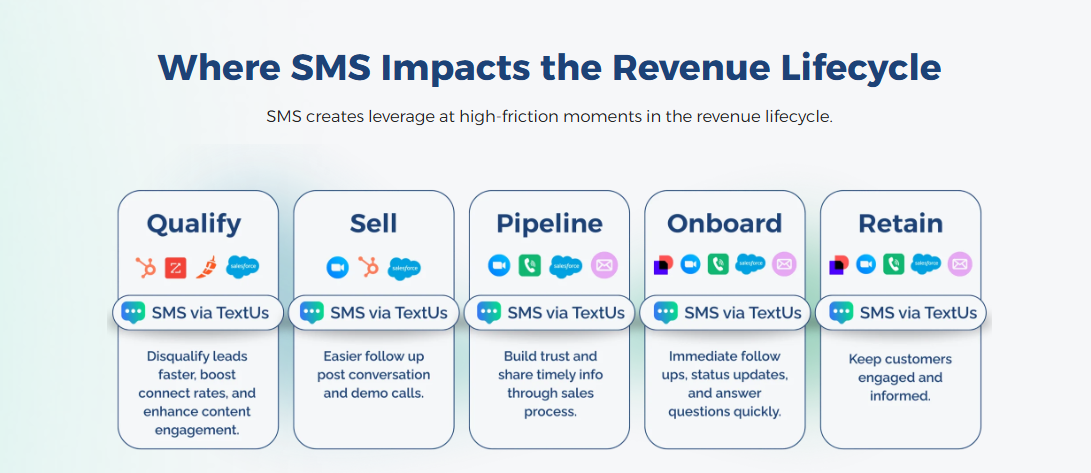
Book a demo with TextUs today and see how it can support faster speed-to-lead, better buyer follow-up, and clearer pipeline visibility!
Continue Reading



Frequently Asked Questions
What are the five pillars of GTM?
The five pillars of GTM are strategy, audience, messaging, channels, and execution.
Strategy defines how your business enters the market. The audience identifies who you are selling to. Messaging explains your value.
What is GTM in tech?
GTM in tech means go-to-market. It refers to the strategy and process a technology company uses to launch, sell, and grow a product or service.
A tech company’s GTM process often includes product positioning, ideal customer profiles, sales motions, marketing campaigns, customer onboarding, revenue tracking, and the tools used to manage each stage.
What is a GTM salary?
A GTM salary is the pay for a role tied to go-to-market work. This can include sales, marketing, revenue operations, customer success, business development, product marketing, or GTM leadership.
The salary depends on the role, seniority, location, company size, industry, and whether the position includes commission, bonuses, or equity.
Business Texting
Built for Results
Create and convert pipeline at scale through industry leading SMS software