
How White-Label Mobile Marketing Can Expand Your Service Offer
Explore our guide to white-label mobile marketing and learn how it works, the main benefits it brings, different services you can offer, and more.

Written by
Adam Hamdan
Published
October 23, 2026

Many businesses reach a point where clients want more ways to communicate, promote offers, and stay connected through mobile channels.
The challenge is meeting that demand without stretching your team across new tools, technical requirements, and service lines.
White-label mobile marketing lets you add branded mobile engagement services while a provider supports the technology and platform.
In this guide, you will learn the benefits of selling a white-label platform, the mobile marketing services you can offer, and which businesses can benefit from them.
You will also learn how to start selling a white-label marketing service, from choosing the right partner to packaging, branding, and promoting your offer.
TL;DR
- White-label mobile marketing can expand your services, create new revenue opportunities, reach more clients, and leave more time for strategy and client growth.
- White-label mobile marketing can cover SMS, mobile apps, mobile advertising, loyalty programs, geofencing, and QR campaigns under your brand.
- SaaS companies, digital agencies, web firms, consultants, creative agencies, and telecom providers can use white-label mobile marketing to expand their client services.
- You can start selling white-label marketing by defining your audience, choosing the right partner, shaping your offer, packaging outcomes, creating demos, building demand, setting up access, connecting business tools, growing search visibility, and tracking sales.
- TextUs lets you launch branded business texting in weeks through white-label, embedded, or API options, with carrier and compliance support.
What Is White-Label Mobile Marketing?
White-label mobile marketing lets you offer marketing tools and services under your own brand while another provider supplies the technology behind them.
These services can include SMS and MMS campaigns, mobile apps, push notifications, QR codes, landing pages, and loyalty programs.
Benefits of White-Label Mobile Marketing
According to Sensor Tower’s State of Mobile 2026 report, consumers spent 5.3 trillion hours across iOS and Google Play apps in 2025, up 3.8% year over year.
This creates more opportunities for you to offer mobile services that match how prospects already spend their time. Here are some of the main benefits of selling a white-label platform:
Add Services Without Building From Scratch
A white-label platform lets you offer mobile marketing tools without the time and expense of creating your own system. This can be a more cost-effective way to expand into new services.
Create More Revenue Opportunities
Mobile marketing can become a new revenue stream alongside your current services. You can offer subscriptions, managed campaigns, service bundles, or packages designed to grow revenue across existing accounts.
Reach More Clients
A broader mobile offer can appeal to businesses with different communication and engagement needs. Retailers may want promotions and loyalty, while service businesses may focus on bookings, reminders, and customer updates.
Focus More on Strategy and Clients
A white-label partner can support the technology, platform updates, and service delivery behind the offer. That leaves more room for your marketing efforts, campaign strategy, client support, and account growth.
Services You Can Offer With White-Label Mobile Marketing
White-label mobile marketing can cover several services based on how your clients want to reach and engage mobile audiences. Below are the main services you can package under your brand.
Text Messaging
SMS is one of the most practical mobile services to add to a white-label marketing offer. Clients can use it across sales, recruiting, customer service, promotions, and retention.
The same channel can support everything from one-to-one conversations to high-volume campaigns, which gives you more ways to package the service around different client needs.
TextUs is a white-label SMS platform that brings those capabilities into one branded experience.
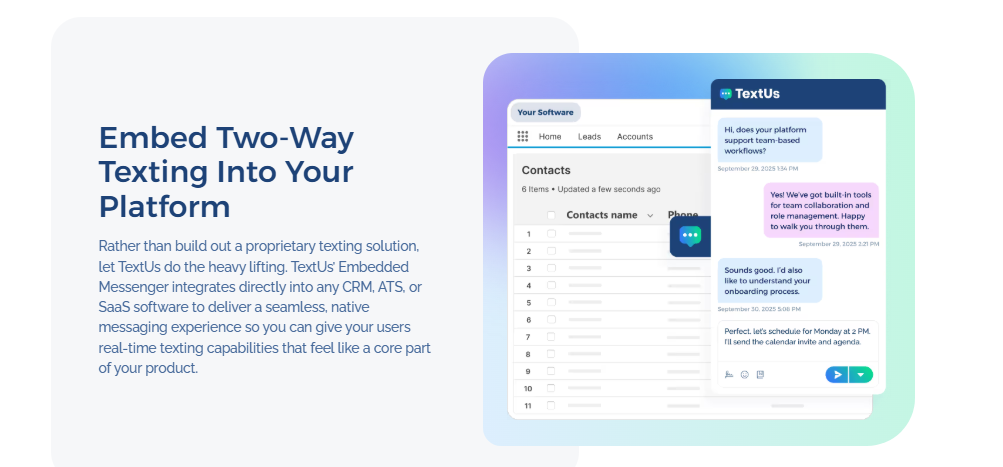
Clients can access campaigns, MMS, templates, drip sequences, keywords, shared inboxes, assignments, and bulk messaging, while your brand remains front and center.
The harder parts of business text messaging sit behind the client experience. Carrier relationships, throughput, routing, 10DLC registration, deliverability safeguards, opt-out handling, and reputation management all need ongoing attention.
TextUs manages those areas, so your team can spend more time on the service clients see and pay for.
Bring AI-powered, fully branded SMS into your platform while TextUs manages the carrier connections, compliance requirements, and messaging infrastructure behind it.
Mobile App Development
Mobile app development lets you offer branded iOS and Android apps without maintaining a full in-house development team.
A white-label mobile app partner handles the technical build while you manage the client relationship, project scope, and final delivery.
Depending on the project, this may include native apps, cross-platform builds, maintenance, push notifications, and custom development for specific client needs.
Mobile PPC and Advertising
Mobile advertising focuses on campaigns built for people searching, browsing, or using apps on smartphones and tablets.
White-label partners manage ad campaigns across search, social, display, and other mobile placements while you remain the client-facing provider.
Campaigns may include mobile-specific creative, device targeting, app promotion, click-to-call ads, and landing experiences designed for smaller screens.
Mobile Loyalty and Rewards Programs
Digital loyalty programs give clients another way to encourage repeat purchases and long-term engagement.
Services can include digital punch cards, rewards, coupons, memberships, referral programs, and mobile wallet passes.
Retailers, restaurants, hospitality brands, and local service businesses may use these programs to keep offers and rewards accessible from a customer's phone.
Location-Based and Geofencing Marketing
Location-based campaigns let clients reach audiences based on where they are or where they have recently been.
Geofencing targets areas around stores, events, competitor locations, neighborhoods, or other defined locations.
A white-label solution may handle audience setup, campaign delivery, optimization, and reporting while the service remains part of your broader service portfolio.
QR Codes and Mobile Campaign Experiences
QR codes can connect physical marketing materials with mobile campaigns. A scan may lead customers to a promotion, sign-up form, text opt-in, loyalty program, coupon, survey, or mobile landing page.
This service can work across printed materials, in-store displays, events, packaging, and direct mail, which gives clients another way to connect offline interactions with mobile engagement.
Who Can Benefit From White-Label Mobile Marketing?
White-label mobile marketing suits several business models that want to expand client services without changing how customers interact with the brand.
Here are the types of businesses that benefit most from this approach.
SaaS and Technology Companies
If you run a SaaS or technology company, white-label mobile marketing can help you add more value around the product your clients already use.
SMS for SaaS supports faster prospect engagement, lead nurturing, and stronger pipeline activity across the customer journey.
TextUs lets you add branded texting through an AI-native, fully branded SMS platform.
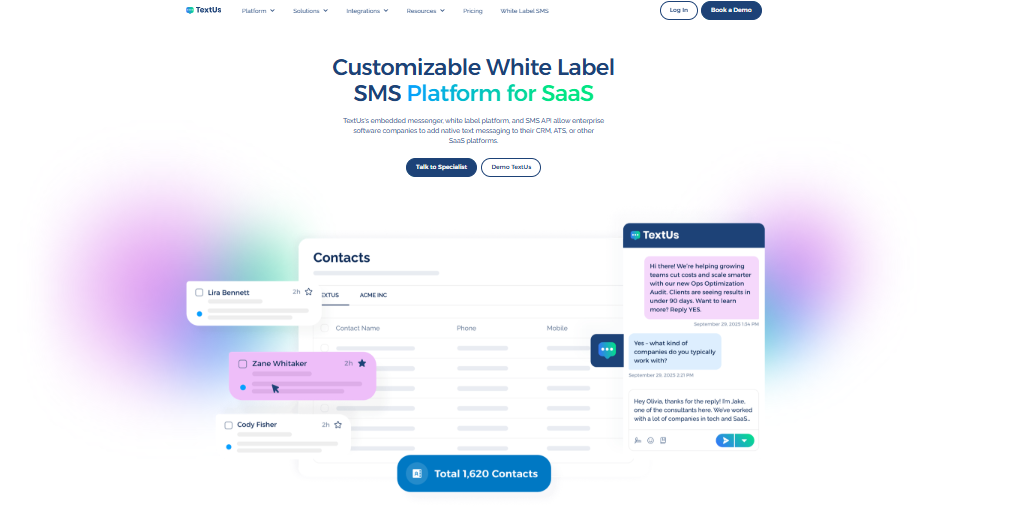
Clients can use two-way messaging, campaigns, automation, templates, and scalable messaging tools within an experience tied to their brand.
Book a demo with TextUs to see how branded SMS can fit into your SaaS marketing and sales strategy!
Digital Marketing Agencies
As a digital marketing agency, you'll manage several parts of a client’s strategy. But your expertise may not cover every channel.
For example, an SEO-focused agency might add paid media, mobile campaigns, or social media management through a specialist partner.
A broader range of digital marketing services also increases the value of each account. Clients stay with one agency for strategy and communication while specialists support services outside the agency’s core strengths.
Web Design and Development Agencies
Having a website project leads to requests for SEO, paid advertising, mobile campaigns, email, and ongoing promotion. White-label partnerships let you continue supporting clients after the initial site launch.
This also creates a natural path from one-time development projects into recurring marketing work. The agency remains the primary contact while additional services complement the website already delivered.
Advertising and Creative Agencies
If you run an advertising and creative agency, you handle brand strategy, media planning, creative production, and campaign concepts while relying on specialists for other channels.
White-label support fills gaps in paid search, mobile campaigns, analytics, or campaign execution. Strategy, creative direction, and communication remain with your agency while specialist partners support specific parts of delivery.
Consultants and Freelance Marketers
As an independent consultant, you have to identify opportunities that extend beyond your own skill set.
As a strategist, you may recommend mobile marketing, paid advertising, SEO, or technical services as part of a wider client plan.
A white-label provider supports those areas while you remain responsible for strategy and the client relationship. This also opens access to larger projects that require more than one marketing discipline.
Telecom and Communication Providers
When you already serve businesses through voice, messaging, connectivity, and related technology, mobile marketing extends that relationship into promotions, customer engagement, and branded communication.
These services sit close to products clients already use, so the move into mobile marketing feels connected rather than like a separate business line.
How to Start Selling a White-Label Marketing Service
A strong branded marketing offer needs more than a platform and a price. Here are the steps to turn your white-label service into an offer you can market, sell, and scale.
Step #1: Choose the Clients You Want to Serve
Your marketing will be stronger when you focus on audiences with clear needs, such as customer communication, promotions, loyalty, bookings, or repeat purchases.
A review of your current clients, past inquiries, and strongest industries can reveal useful patterns. From there, identify the usual decision-maker and the business problem that matters most to them.
Step #2: Find the Right White-Label Partner
The right white-label software affects how confidently you can sell the service once clients start using it.
Brand identity control, platform reliability, integrations, reporting, support, compliance, and room to scale shape the client experience and the amount of work your team will need to manage.
TextUs is a white-label SMS platform that offers three reseller models: a fully branded standalone platform, an embedded messenger, and API access to gain more control over the experience.
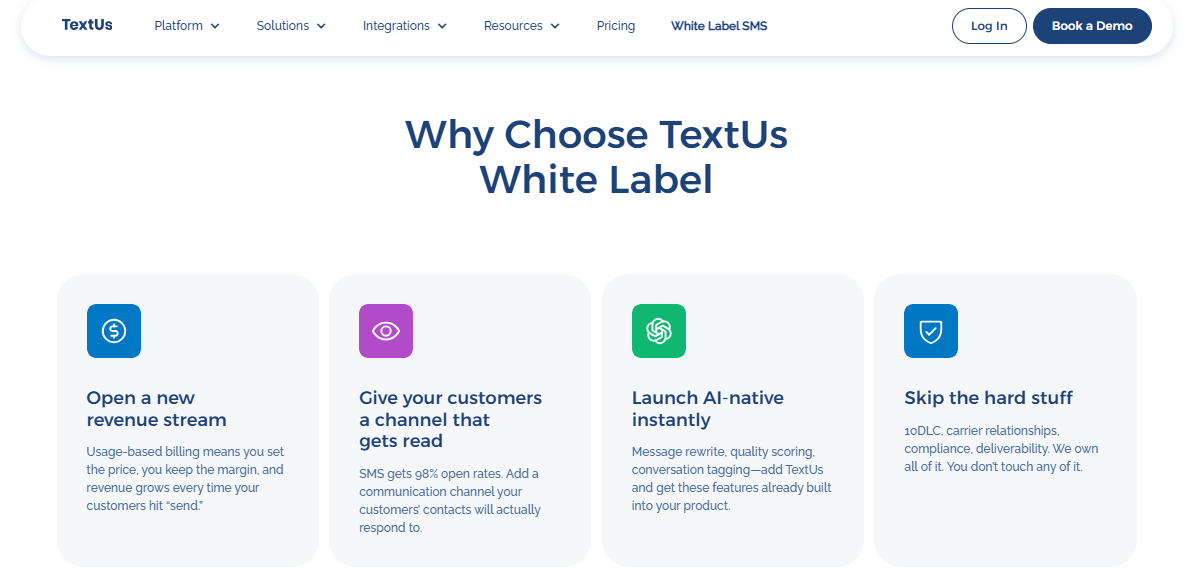
It allows you to decide what end customers pay, with no revenue share on the margin they set. Existing integrations such as Salesforce, HubSpot, Bullhorn, Workday, Greenhouse, and Zapier can also make the service easier to fit into client workflows.
Speed also matters when market timing affects growth. TextUs lets you launch in weeks, which can shorten the path from planning to selling.
For startups, that speed can matter when they need to beat competitors to market.
Book a demo with TextUs today to see how you can launch a branded messaging offer faster and keep your team focused on your core product!
Step #3: Shape Your Positioning and Value Proposition
Strong positioning provides prospects with a reason to choose the service offer instead of another provider or an in-house build.
If you have run a restaurant, you'll care more about repeat visits and promotions. Service businesses may focus on bookings and customer updates.
The message should connect those priorities to your service offerings without turning into a long feature list.
The value proposition should also reflect what makes your offer distinct. This includes faster deployment, branded delivery, easier integrations, stronger support, or access to new features.
Step #4: Package the Offer Around Outcomes
A package built around goals such as faster lead response, more booked appointments, or higher campaign engagement is easier to understand than one centered on message limits or feature counts.
Each package can match a specific use case. A recruiting package may combine candidate outreach, follow-ups, and appointment reminders. A retail package can focus on promotions, loyalty, and repeat purchases.
The scope then defines message volume, automation, reporting, integrations, and support based on that outcome. This approach also creates room for different pricing models.
Step #5: Create Sales Materials and Product Demos
Prospects usually understand the offer faster when they can see how the service would work for their business.
A short sales deck, one-page overview, campaign examples, screenshots, and live demonstrations can explain the value without relying on a long feature list.
Relevant design assets can also show how branded messages, campaign dashboards, landing pages, or customer experiences may look.
Each demo should reflect the prospect’s priorities. A retailer may want to see promotional campaigns and loyalty communication, while a service business may care more about reminders, follow-ups, and two-way messaging.
Step #6: Build Your Pre-Launch Demand
Interest can start before the service is ready to sell. Careful planning can help you collect leads, test demand, and learn which messages attract the strongest response.
Teaser pages, early-access forms, email outreach, SMS marketing campaigns, or short demos can introduce the offer to selected prospects. Existing clients can also join a pilot program or waitlist before the full launch.
Paid search through Google Ads may support demand once your audience and offer are defined. Relevant ad extensions can highlight demos, pricing, or service options.
Early feedback also shows which industries, services, and use cases deserve the most attention once sales begin.
Step #7: Set Up Branding and Client Access
The client experience should be consistent from the first login. That means the platform, account setup, support materials, and user permissions all need to reflect how you want the service presented.
A strong white-label setup has to include custom branding, your own logo, branded domains, customized login pages, and client-facing materials that match the rest of your offer.
Account roles and permissions also matter when several users need access to campaigns, conversations, or reporting.
Client access should stay simple. Specific user roles, organized account structures, and a straightforward onboarding process reduce confusion once the service goes live.
If several clients will use the platform at once, separate account spaces and permissions also make management more practical. This keeps each client’s data, campaigns, and users organized under the same reseller program.
Step #8: Connect Your Existing Systems
The service becomes much easier to adopt when it fits your existing processes and client tools.
CRM platforms, ATS software, sales systems, and automation tools can keep contacts, conversations, and campaign activity connected instead of creating another isolated workflow.
A new CRM lead triggers a follow-up, while an ATS status change may start an outreach sequence. Some clients may also need payment gateways connected to mobile offers, subscriptions, or customer journeys.
TextUs supports this type of connected workflow through native integrations, API access, webhooks, and its Chrome extension.
You can bring texting closer to the tools clients already use while keeping conversations and activity tied to the work happening there.
Step #9: Build Organic Search Visibility
Search-focused website pages can target specific industries, services, and problems instead of relying on one broad service page.
Helpful guides, comparison pages, case studies, and FAQs also answer common buyer questions throughout the research process. Each piece should connect naturally to the service you want prospects to explore next.
Google Search Console can show which queries already generate impressions and clicks for your site. Those insights reveal topics worth expanding, pages that need stronger positioning, and search terms that attract potential clients.
Step #10: Track Leads, Conversions, and Sales
Performance data shows whether your marketing is attracting the right prospects and turning interest into revenue.
Lead sources, demo requests, conversion rates, sales cycle length, and revenue by channel can reveal which parts of the strategy deserve more investment.
Regular reviews also show where prospects drop out of the sales process. A high number of inquiries with few conversions may point to problems with pricing, positioning, or follow-up.
These insights guide future campaigns and help you refine the offer based on what produces actual sales rather than traffic alone.
Expand Your Offer Through Branded Business Texting With TextUs
TextUs helps you turn business texting into a branded service that fits naturally within your white-label offer.
Clients get access to the key features for business texting, including campaigns, two-way messaging, MMS, templates, drip sequences, shared inboxes, automation, and reporting.
TextUs adds AI-powered personalization through Smart Messaging. It flags high-risk messages and offers rewrite suggestions that reduce compliance risk while preserving the sender’s voice.
You stay in control of the client experience, packaging, and pricing while TextUs supports the messaging layer that powers your offer.
Finally, the platform supports industry-leading deliverability through message pacing, reputation management, carrier-compliant safeguards, routing, and carrier relationships.
Book a demo with TextUs today to see how branded business texting can boost your overall white-label strategy!
FAQs About White-Label Mobile Marketing
Is white-labeling illegal?
No. White-labeling itself is a legitimate commercial model when the provider authorizes you to rebrand and resell its product or service.
The agreement still needs to respect trademark rights, advertising rules, and any regulations tied to the service. In the U.S., certain licensing arrangements may also fall under franchise rules, depending on how the relationship is structured.
How much does a white-label cost?
White-label services often range from about $300 to $8,000+ per month per service, depending on scope, provider, and client requirements.
Entry-level services may sit near the lower end, while enterprise or customized packages can cost several thousand dollars each month.
Can I buy a white-label app?
Yes. White-label app platforms let you create and resell apps under your own branding.
Depending on the provider, this may include branded dashboards, custom domains, emails, iOS apps, Android apps, and tools for managing multiple client projects
What are the most profitable white-label products to sell in 2026?
Profit depends on demand, pricing, recurring revenue potential, delivery costs, support requirements, and customer retention.
Current reseller opportunities include mobile apps, business texting, marketing software, loyalty platforms, paid media, and content creation services.
Continue Reading



Frequently Asked Questions
Business Texting
Built for Results
Create and convert pipeline at scale through industry leading SMS software