
How to Market a Staffing Agency: 12 Strategies That Drive Results
Learn how to market a staffing agency with 12 practical strategies for attracting clients and candidates, supported by TextUs business texting.

Written by
Adam Hamdan
Published
November 5, 2026

As a staffing agency, you'll compete for attention on two fronts at once. Employers need qualified people, while candidates want opportunities worth responding to.
Without a marketing strategy, you may struggle to turn your staffing services into a steady flow of client conversations and candidate interest.
Knowing how to market a staffing agency means more than posting jobs or promoting services. Your marketing needs to reach the right companies, attract relevant candidates, and create paths for both audiences to take action.
In this article, you'll learn the importance of marketing in staffing, practical ways to attract clients and candidates, and how to build a strategy that keeps your efforts aligned.
TL;DR
- Consistent marketing helps you attract clients and candidates at the same time, creating more opportunities for job orders, stronger talent pipelines, and faster placements.
- This guide covers staffing marketing strategies, including niche positioning, value proposition, SMS marketing, text-to-apply, website conversion, SEO, social proof, social media, lead nurture, re-engagement, referrals, and hiring events.
- A strong recruitment agency marketing strategy sets clear goals, defines client and candidate audiences, maps each journey, matches channels to goals, segments contacts, plans timely follow-up, and measures results.
- TextUs helps move clients and candidates from interest to response with two-way SMS, automated sequences, targeted campaigns, and connected staffing systems.
How Marketing Supports Staffing Industry Success
Client acquisition remains a major challenge for staffing firms. According to Sense’s 2025 State of Staffing Report, 65% of respondents identified attracting new clients as their biggest obstacle.
Consistent marketing keeps your agency visible to companies before and during active hiring periods instead of relying on prospects to find you on their own.
In a competitive market, candidate marketing matters just as much. Employers turn to recruitment agencies since they need access to qualified people who match their hiring requirements.
Job advertising, search, social media, referrals, email, and text marketing help you build and maintain relationships with candidates before the right opportunity becomes available.
Marketing connects both sides of the business. Client campaigns create demand for staffing services, while candidate campaigns build a talent pool with the right skills to fulfill new requests.
When both sides stay active, you have more opportunities to match candidates with the right employers.
More client conversations create opportunities for new job orders, while a responsive candidate pool supports faster placements.
How to Market Your Staffing Agency in 12 Easy Ways
A strong marketing approach helps you reach the right clients and candidates while creating more opportunities for meaningful conversations.
Here are 12 strategies to strengthen how you market your staffing agency.
1. Define Your Staffing Niche
A focused niche makes it easier to explain who you serve and what types of roles you specialize in.
Start by reviewing the industries, job categories, locations, and employment types where your agency has the most experience.
Your niche should also reflect the job market you want to compete in. Look at hiring demand, common skill shortages, client needs, and the types of candidates your recruiters already know how to reach.
Specialization sharpens your market position. Instead of presenting your agency as a general staffing provider, you can build messaging around a specific audience and show why your experience fits their hiring needs.
Once your niche is defined, you can use it to guide your website content, outreach, advertising, social media, and texting campaigns.
2. Build Your Staffing Value Proposition
Your value proposition should explain what makes your agency different from other firms competing for the same clients and candidates.
Broad claims such as “great service” or “quality candidates” do not say enough on their own.
Faster submissions, access to top talent, lower hiring risk, specialized expertise, or meaningful time savings all make your offer more specific.
Client feedback, placement history, retention data, and recruiter expertise also reveal where your agency stands out. Those details make your positioning more credible and give prospects something concrete to compare.
3. Use SMS to Start Conversations
Instead of relying only on email, social media, or phone calls, SMS marketing creates a direct connection between your staffing campaigns and the people you want to reach.
SMS for staffing agencies helps promote new openings, hiring events, availability checks, or referral opportunities.
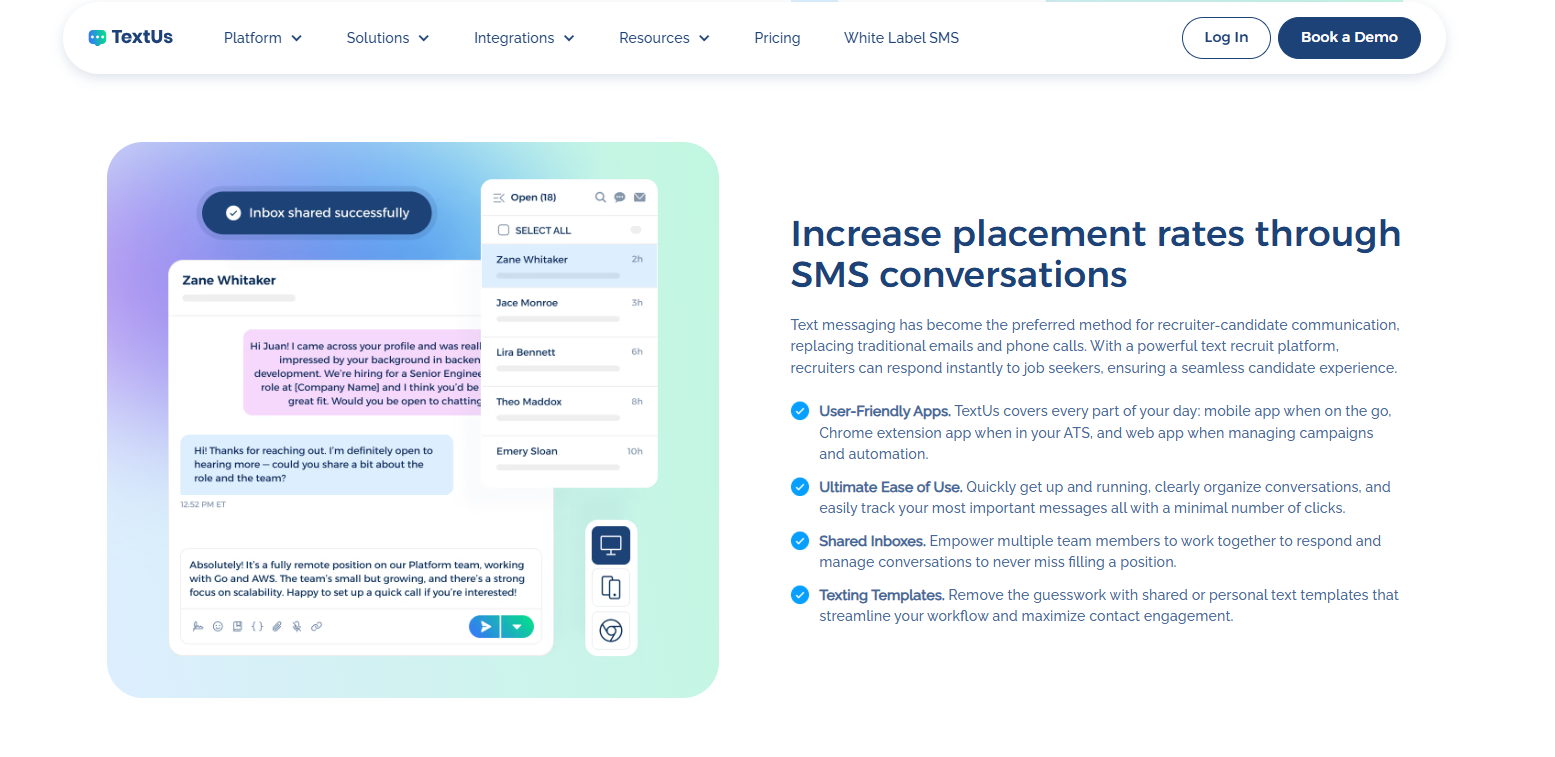
It also keeps your agency connected with job seekers who showed interest before but may not have been ready for a specific role.
On the client side, texts can support lead follow-up, meeting confirmations, account re-engagement, and outreach when relevant candidates become available.
TextUs supports these campaigns with personalized bulk text messaging, drip campaigns, and custom SMS keywords. You can use these tools to reach larger candidate groups while still creating paths for direct conversations.
The platform also provides shared inboxes and integrates with applicant tracking systems such as Bullhorn, Greenhouse, and Workday.
Candidate messages sync with connected systems, which reduces manual data entry and gives the staffing team better visibility into ongoing conversations.
Book a demo with TextUs today to see how business texting can support candidate outreach, client follow-up, and recruiter communication!
4. Create Text-to-Apply Campaigns
Rather than asking someone to remember a website or complete a lengthy form, text-to-apply campaigns shorten the path between seeing a job opportunity and starting a conversation.
A candidate only needs to text a designated keyword or scan a QR code to begin the application process from their phone.
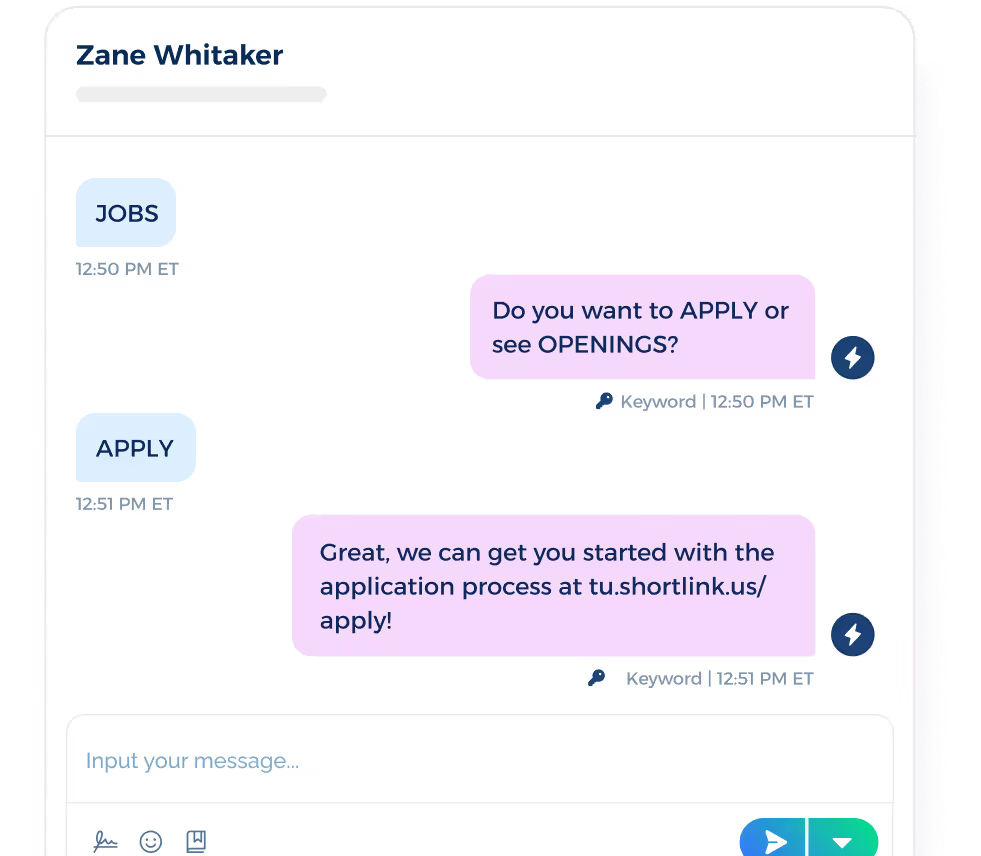
This approach fits job fairs, social media posts, digital ads, flyers, career pages, and signs placed near high-traffic locations. It can be valuable when recruiting for temporary roles or positions that need a steady flow of applicants.
Fewer steps between interest and recruiter contact also support a more streamlined process, especially when candidate information flows directly into your systems.
5. Turn Your Website Into a Lead Source
Your website becomes the first place a prospective client or candidate evaluates your agency.
A conversion-focused site makes it easy for each audience to understand what you offer and take the next step without searching through unrelated information.
Clients may want to explore your staffing services, industry expertise, case studies, and contact options, while candidates need direct access to open positions and application pages.
Each important page should lead toward a specific action. Request-talent forms, click-to-text buttons, SMS opt-ins, and text-to-apply prompts provide visitors several ways to move from browsing to direct contact with your agency.
Short forms, clear menus, fast-loading pages, and accessible contact options reduce unnecessary steps between initial interest and a completed inquiry or application.
6. Build a Stronger SEO Presence
Search engine optimization (SEO) puts your agency in front of employers and candidates already searching for staffing support or open roles.
Your SEO strategy should focus on the terms people use when they have a specific hiring or employment need. Service pages, industry pages, location pages, and individual job listings create more opportunities to rank for relevant searches.
Content also strengthens search visibility when it answers questions your audience already asks. Salary guides, hiring trends, workforce reports, and industry data can attract employers researching hiring decisions before they contact an agency.
Accurate business information, location-specific pages, reviews, and a complete Google Business Profile help search engines also connect your agency with nearby staffing searches.
7. Build Trust With Social Proof
Social proof shows clients and candidates what it's like to work with your staffing agency.
Testimonials, reviews, and placement stories provide evidence that supports the claims you make in your marketing.
Client case studies are stronger when they include specific outcomes. Metrics such as roles filled, retention rates, hiring speed, savings, or increased revenue show the business impact behind your service.
Positive feedback about recruiter communication, interview support, and placement experiences also helps new candidates understand what they can expect before they engage with your agency.
8. Grow Reach Through Social Media
Social media extends your agency’s reach beyond people already searching for staffing services.
Platforms such as LinkedIn give you space to share open roles, hiring insights, placement stories, and recruiter expertise with both employers and candidates.
Your recruiters also play an important role in this strategy. Personal profiles create more engagement than company pages, especially when you share useful observations and respond to questions.
Different post formats can support different goals. Job announcements attract candidates, while hiring trends, client success stories, and workforce insights can initiate conversations with employers.
9. Nurture Leads With Email and SMS
Not every client or candidate is ready to act after the first interaction. SMS and email keep those contacts engaged until the timing is right.
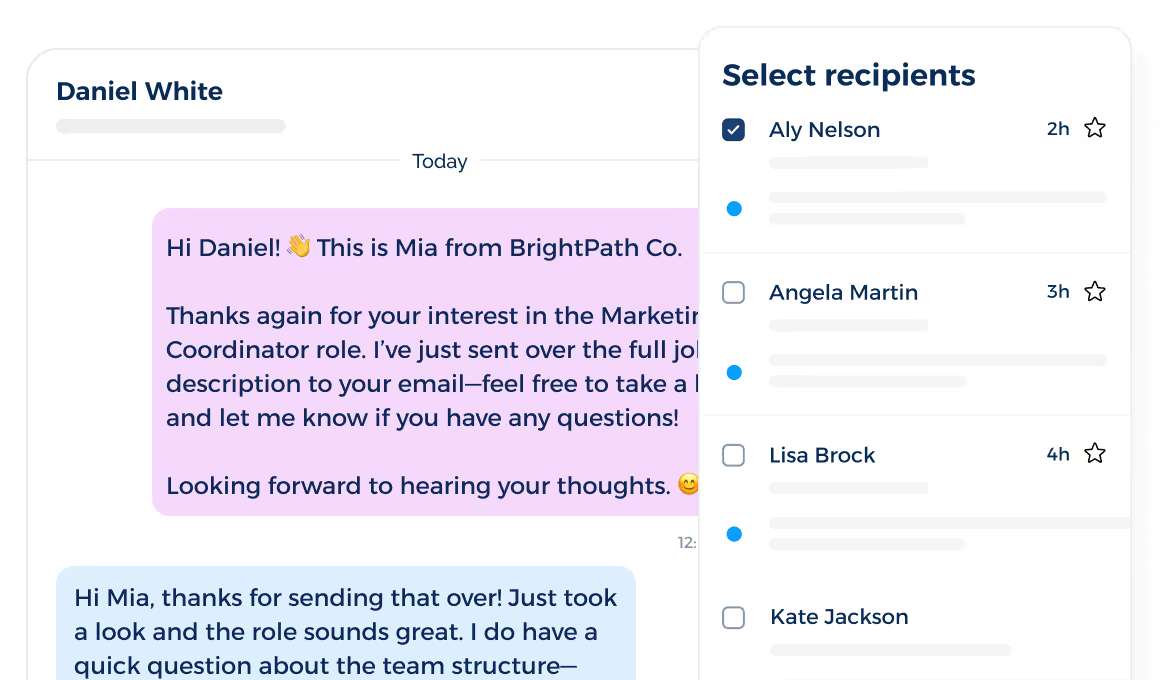
Email fits longer updates, hiring insights, newsletters, case studies, and other resources that need more context. SMS is best for short follow-ups, reminders, availability checks, job alerts, and questions that invite a quick reply.
The two channels also serve different stages of the relationship. A prospect might receive an email with a staffing guide, then a text after requesting more information.
A defined nurture sequence keeps outreach from becoming random. Messages follow a set cadence based on interest, past activity, or where someone sits in your pipeline.
10. Re-engage Past Job Seekers
An existing database contains valuable contacts who already know your business.
Former clients, previous applicants, placed candidates, and inactive prospects may become relevant again as hiring needs and availability change.
Past candidates already have profiles, interview notes, and prior communication on file. Someone who moved through part of the hiring process could fit a new opening, especially when the role requires similar experience.
Previous clients also need regular follow-up. Seasonal needs, new projects, or changes in hiring volume create another reason to reconnect.
People who previously joined your temporary workforce or expressed interest in similar opportunities may be open to another assignment when circumstances change.
11. Build a Staffing Referral Program
Referrals bring in new clients and candidates through trusted relationships. Placed candidates, current customers, former clients, and internal employees introduce people who may be a good fit for your services.
A structured program makes those referrals easier to generate and track. Incentives, referral links, post-placement messages, and periodic reminders give participants a reason and simple way to take part.
Client referrals also open the door to relationships with strategic partners and other businesses in your network.
TextUs can also help you bring more referrals into your recruiting process through its integration with Staffing Referrals. It lets you send referral requests and reminders, while the platform lets promoters submit candidates on your behalf and tracks those referrals for you.
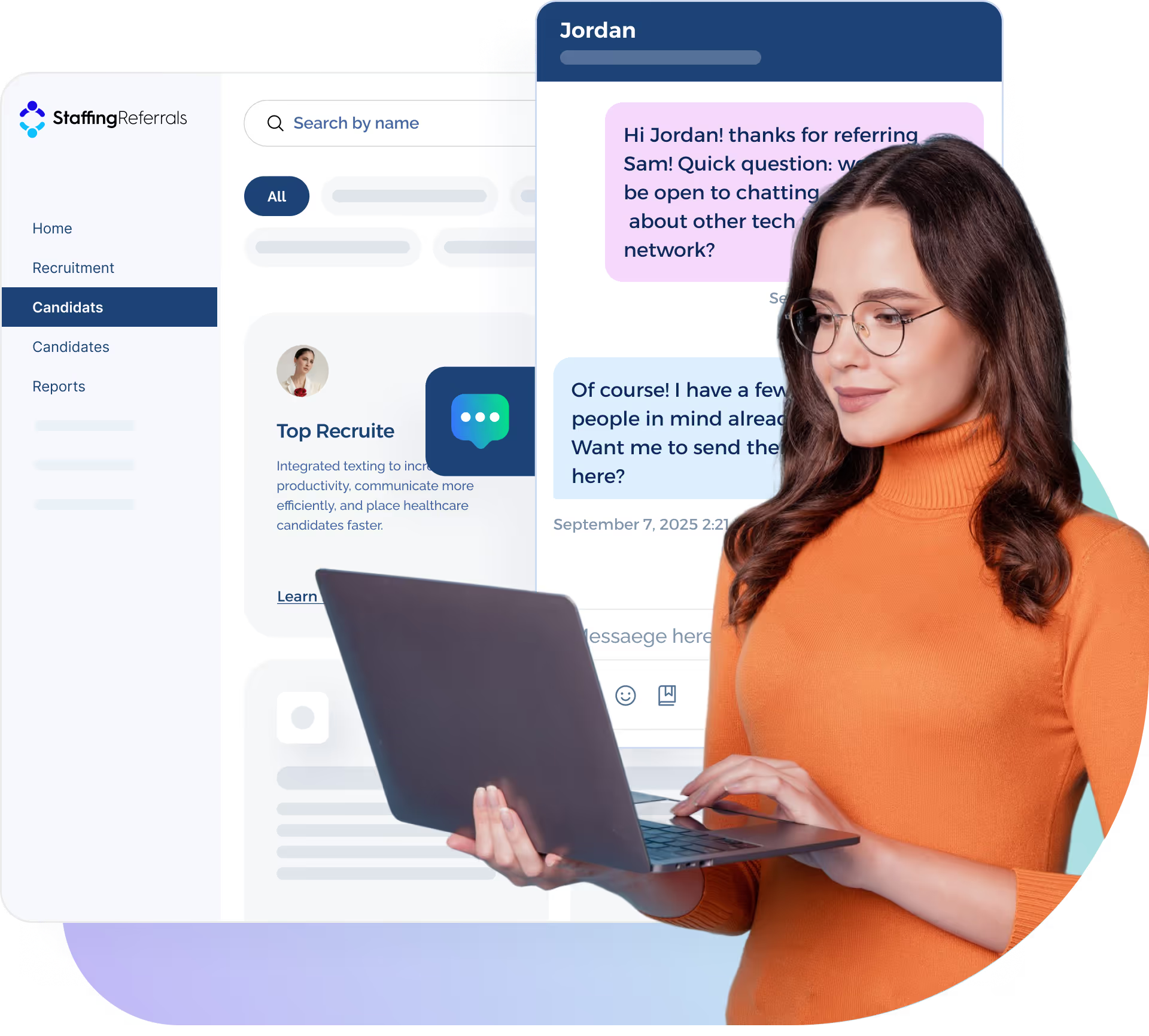
This connection gives you a more organized way to reach your existing network, encourage more referrals, and add referred candidates to your pipeline without relying on manual follow-up.
12. Promote Hiring Events
Hiring events create an opportunity to meet candidates, answer questions, and introduce open positions in a more direct setting.
Promotion should begin before the event itself. Social media, email, SMS, job boards, and local partnerships drive registrations and help you reach people who may not already follow your staffing brand.
Text messaging adds another touchpoint once someone registers. Confirmation texts, event reminders, location details, and last-minute updates keep attendees informed without requiring them to check email throughout the week.
The event may be over, but your communication with attendees should continue. Follow-up texts and emails help you reconnect with attendees and move qualified contacts toward the next stage.
How to Build a Marketing Strategy for Your Recruitment Agency
Here are the key areas to consider when shaping a plan that supports client acquisition, candidate engagement, and sustainable growth.
Set Goals Around Business Priorities
Specific goals provide direction for your marketing decisions and make results easier to evaluate.
Priorities might include generating qualified client leads, increasing candidate responses, reducing time to fill, reactivating previous contacts, or supporting expansion into new markets.
The right goals depend on where your business needs the most support. Some staffing companies focus on client acquisition, while others need a stronger candidate pipeline or better retention.
Define the Audiences You Want to Reach
Your marketing message should reflect the priorities of each audience.
Hiring managers can focus on candidate quality, speed, specialization, and hiring costs. Candidates may care more about relevant roles, communication, and the overall experience.
Audience needs also vary by sector. Employers in healthcare, finance, and manufacturing often face different workforce demands, timelines, and hiring requirements.
Map Each Path From Interest to Placement
Client and candidate journeys follow different paths, so each one needs its own marketing flow.
A client could discover your firm through search, request more information, speak with sales, and submit a job order before recruiting begins.
Candidates may enter through a job ad, referral, social post, or text campaign. From there, application review, resume screening, recruiter outreach, interviews, and placement impact the overall experience.
TextUs supports the communication between these stages through automated sequences and two-way texting. Sequences can send scheduled follow-ups and stop once a candidate replies, which allows a recruiter to take over the conversation at the right point.
Match Channels to Each Marketing Goal
Each marketing channel plays a different role in the staffing process.
SEO and content support discovery, while email, paid media, referrals, and social outreach help you reach defined client and candidate segments.
Texting keeps conversations moving after a marketing touchpoint. Candidates can respond to job opportunities, while clients continue the discussion after forms, events, or earlier outreach.
TextUs supports handoffs through two-way messaging, shared inboxes, and integrations with recruitment software. This connection improves operational efficiency by keeping outreach and responses tied to the same workflow.
Book a demo with TextUs today to see where texting fits within your staffing marketing strategy!
Segment Your Marketing Database
A well-organized database allows you to send more relevant messages to the right contacts.
Client segments might include industry, company size, location, hiring history, or past engagement.
Candidate segments can reflect role type, location, experience, availability, placement history, or previous applications.
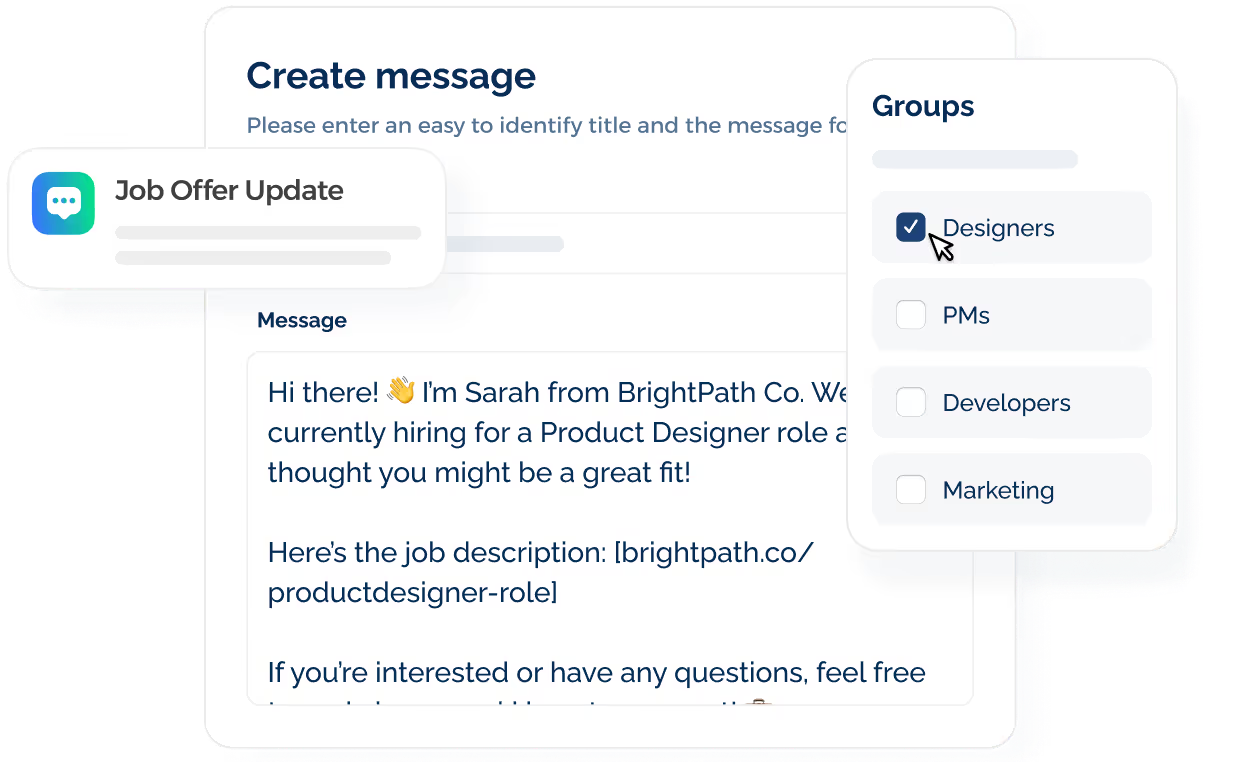
SMS segmentation also improves campaign timing. A former client with seasonal hiring patterns needs different outreach from a prospect that recently submitted a staffing request.
A targeted message also creates a more seamless experience because contacts receive information tied to their needs.
Plan Your Follow-Up Process
Ownership should be established from the start, with expectations for who responds, when follow-up happens, and how conversations move to the next stage.
Response timing matters because interest can fade quickly after someone submits a form, replies to a campaign, or asks about an open role.
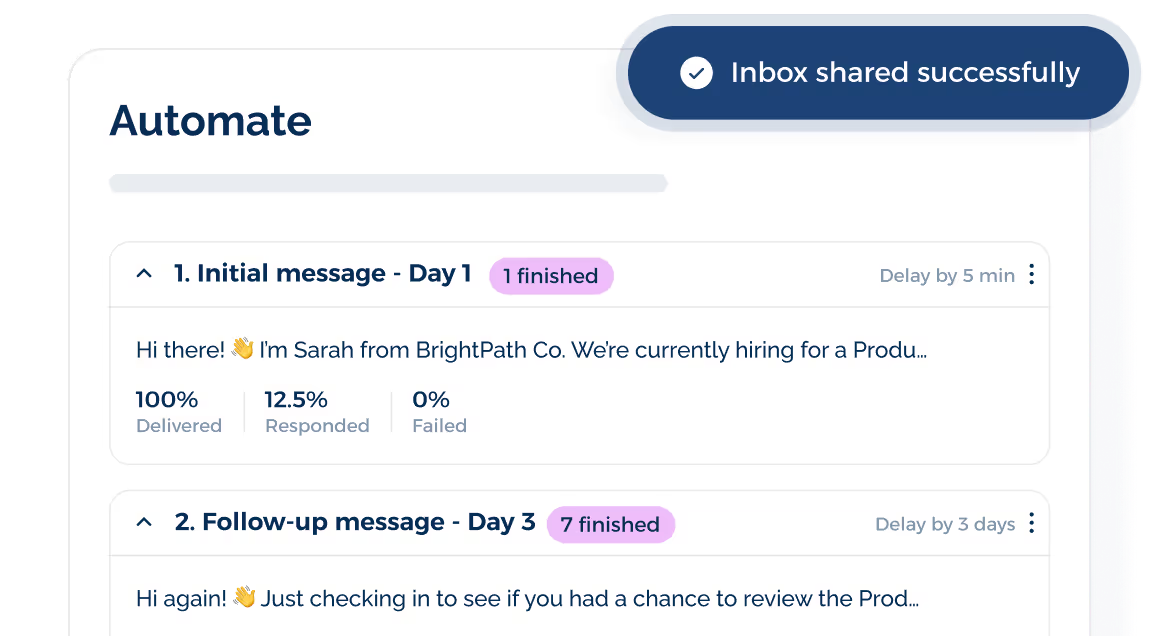
Set practical response targets based on the type of inquiry instead of letting messages wait several working days without attention.
SMS automation can handle confirmations, reminders, and scheduled outreach, while recruiters or sales reps step in once a personal conversation is needed.
Measure Your Marketing Results
The most valuable metrics show whether campaigns generate qualified leads, candidate responses, interviews, job orders, and placements.
Client-side measurement includes lead volume, meeting bookings, conversion rates, acquisition cost, and repeat business.
Candidate metrics may cover applications, response rates, interview attendance, placements, and referral activity.
Channel-level data also shows where your budget produces the strongest return.
Response rates, email engagement, paid campaign conversions, referral sources, and organic search leads reveal which tactics move contacts closer to a conversation or placement.
A complete view of performance also exposes hidden costs that surface when campaigns create interest but fail to convert.
Turn Marketing Interest Into Staffing Opportunities With TextUs
Getting attention is only the first step. You need to turn that interest into real conversations before client leads cool off or candidates move on.
TextUs is an SMS solution built to support faster communication throughout your staffing operations.
Personalized campaigns, automated follow-up, conversational texting, and shared inboxes allow your team to manage outreach while reducing repetitive administrative tasks.
CRM integrations with platforms such as HubSpot and Salesforce also support campaign activity and message logging.
Its staffing integrations with Bullhorn, Greenhouse, Workday, and Oracle Taleo can keep candidate conversations connected to recruiting workflows.
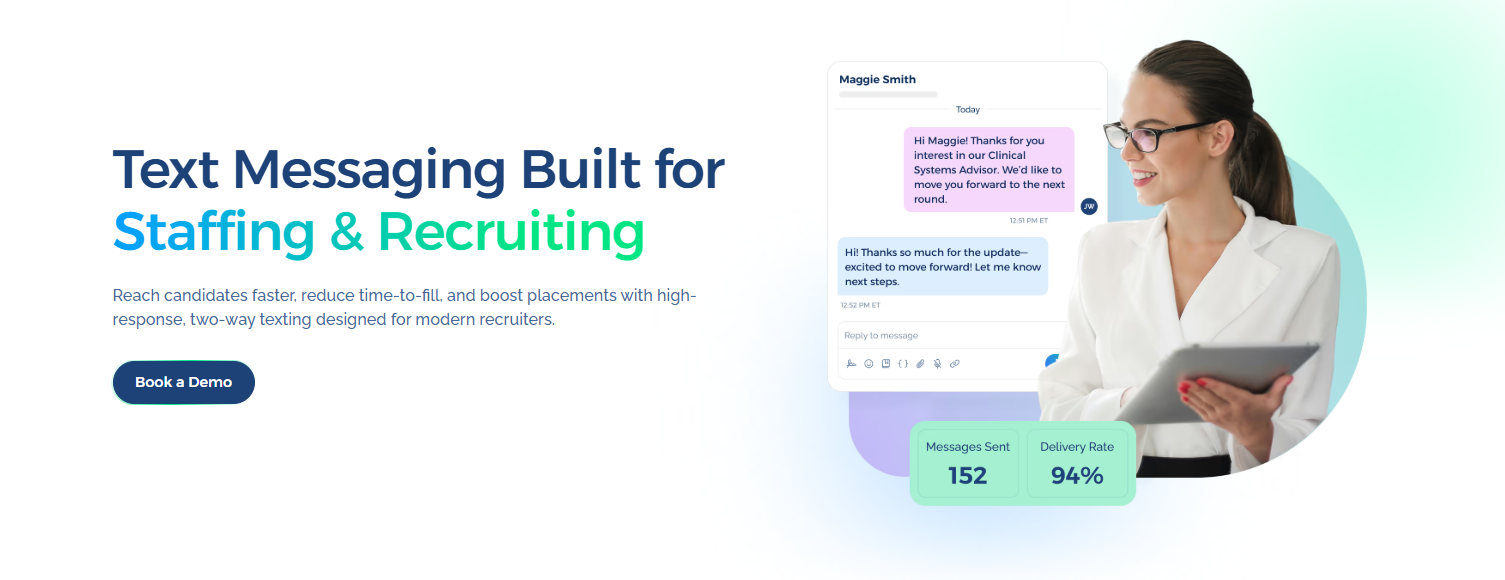
Book a demo with TextUs today to see how business texting can turn more staffing marketing activity into conversations, job orders, and placements!
FAQs About How to Market a Staffing Agency
How to get clients for your staffing agency?
A defined niche, referrals, SEO, social media, direct outreach, and SMS follow-up can help you reach employers with active hiring needs.
The best mix depends on your market and client profile. Your highest-performing channels should contribute to actual conversations and job orders rather than traffic or impressions alone.
What is the 80/20 rule in recruiting?
The 80/20 rule applies the Pareto Principle to recruiting, where a smaller share of sourcing channels, clients, or activities often contribute to a larger share of results.
The percentages aren't meant as an exact formula, but the principle will help you identify where your recruiters spend time most effectively.
What makes a good staffing agency?
A good staffing agency understands client needs, screens candidates carefully, communicates consistently, and follows through during the placement process.
Strong candidate matching also reduces the chance of a bad hire and the real cost that comes with replacing one.
How much money do I need to start a staffing agency?
There's no single conservative estimate because startup needs depend on your business model, operating costs, and working capital.
Temporary and contract staffing also usually require more cash than direct-hire recruiting because the firm often covers worker payroll before clients pay their invoices.
Continue Reading



Frequently Asked Questions
Business Texting
Built for Results
Create and convert pipeline at scale through industry leading SMS software