
How to Measure and Improve Recruiter Productivity
Learn how to measure recruiter productivity, reduce repetitive work, and improve candidate communication with practical metrics and TextUs.

Written by
Adam Hamdan
Published
September 23, 2026

Recruiters handle sourcing, outreach, screening, interviews, scheduling, follow-ups, and reporting throughout the day.
But productivity isn't measured by how many tasks you finish or how many candidates you contact.
Stronger productivity comes from moving qualified candidates forward with less wasted effort and fewer delays.
In this article, we will explore the importance of recruiter productivity, which metrics define it, the common issues that affect recruiter output, and practical ways to improve results.
By the end, you'll also see how SMS recruiting can speed up communication and reduce repetitive candidate follow-up.
TL;DR
- Recruiter productivity improves placement results when you reduce repetitive work, speed up candidate communication, and protect time for higher-value tasks.
- Productivity is best measured through hires or placements, capacity, hiring speed, qualified candidates, response rates, funnel conversion, offer acceptance, redeployment, drop-off, response time, placement quality, cost per hire, and candidate experience.
- Productivity drops when manual follow-up, phone tag, credential chasing, poor redeployment, disconnected systems, context switching, slow feedback, weak segmentation, and burnout consume recruiter time.
- You can improve recruiter productivity by tying goals to hiring outcomes, using text messaging, connecting ATS workflows, automating follow-up, standardizing processes, using templates, centralizing candidate information, and prioritizing engagement.
- TextUs helps you move candidates faster with two-way texting, automated follow-up, shared inboxes, ATS integrations, and engagement insights.
The Importance of Recruiter Productivity for Staffing Firms
Productivity has a direct impact on placement volume, fill rates, cost per placement, and revenue per recruiter.
When too much time goes to administrative tasks or slow follow-up, you have less capacity to engage qualified candidates and maintain a positive candidate experience.
The pressure is even higher in healthcare staffing, where clinicians may compare several active opportunities and communicate with multiple recruiters at once.
Faster outreach and consistent follow-up help you reach candidates before competing agencies.
Does Higher Recruiter Productivity Mean More Work?
Higher productivity doesn't mean adding more requisitions, increasing activity quotas, or expecting recruiters to fit more work into the same day. The goal is to save time on repetitive individual tasks.
Better workflows create productivity gains by reducing unnecessary steps across sourcing, communication, scheduling, and hiring-manager coordination.
Recruiter Productivity Metrics You Need to Track
Recruiter productivity looks different across roles, industries, and hiring models. Here are the key metrics and benchmarks that help you evaluate recruiter output and overall performance.
Hires or Placements Per Recruiter
This metric measures how many successful hires each recruiter produces during a set period.
The basic formula is: Hires Per Recruiter = Total Hires ÷ Number of Recruiters
Placements per recruiter may be more relevant if your revenue depends on contract or temporary placements.
Recruiter Capacity and Open Requisitions
Recruiter capacity measures how much active hiring work you can manage without sacrificing candidate quality, response speed, or hiring outcomes.
Position complexity, hiring volume, geography, candidate availability, credential requirements, recruiter responsibilities, and hiring-manager involvement all influence that capacity.
Time to Hire
This metric tracks the time between a candidate joining the hiring process and agreeing to the job offer.
A shorter time to hire can indicate an effective recruiting process. But speed needs to stay balanced with candidate fit and hiring quality.
You can review each stage to find where delays occur, such as screening, interview coordination, collecting feedback, approvals, or offer preparation.
Time to Fill
This metric measures how long it takes you to fill an open position from the point the hiring need or requisition begins.
Its main difference from time to hire is that it captures a broader part of the recruiting cycle, including time spent before a specific candidate enters the process.
Time-to-fill periods stretching across several weeks may point to sourcing challenges, approval delays, narrow talent pools, or slow decisions.
Qualified Candidates Per Requisition
Qualified candidates per requisition measures how many applicants or sourced prospects meet the core requirements for an open role.
A large applicant pool may look productive at first. But fewer candidates with stronger qualifications can create better results than hundreds of weak matches.
When you consistently identify good candidates, less time goes toward reviewing poor-fit applications and more qualified prospects move into conversations sooner.
Candidate Response Rate
Candidate response rate tracks the percentage of candidates who reply to your outreach.
Low response rates create more calls, emails, voicemail, and follow-up work. Higher engagement leaves more time for actual candidate conversations.
You can compare response rates by role, candidate segment, communication channel, recruiter, and outreach message.
Paying attention to response patterns can reveal whether the problem comes from timing, message relevance, candidate targeting, or the communication channel itself.
If candidate replies are slowing down your pipeline, book a demo with TextUs today and see how it keeps conversations moving!
Speed to Candidate Response
Speed to candidate response measures how long it takes you to contact or reply to a candidate after an application, inquiry, response, or new assignment match.
Healthcare staffing is a strong example because travel nurses, locums, and allied clinicians may receive several opportunities at once.
Delays of several hours can affect whether a candidate continues the conversation with you or moves forward with another recruiter.
Submission-to-Interview Rate
Submission-to-interview rate measures how many candidates you submit who receive an interview request from a client or hiring manager.
A low rate can indicate weak qualification, poor intake, unclear role requirements, or candidate submissions that do not match expectations.
Better alignment results in fewer submissions but a higher percentage moving into more interviews and later hiring stages.
Interview-to-Offer Rate
Interview-to-offer rate measures how many interviewed candidates receive an offer.
A low conversion rate may indicate weak candidate matching, inconsistent interview criteria, unnecessary interviews, or a disconnect between recruiters and decision-makers.
Higher interview volume doesn't mean better productivity. You can create more value by sending a smaller group of qualified candidates than by producing high interview activity with poor conversion.
Offer Acceptance Rate
Offer acceptance rate measures the percentage of job offers candidates accept.
Your communication, compensation expectations, process speed, candidate relationships, job fit, and transparency throughout the hiring process can all influence the result.
A low acceptance rate may mean you are spending significant time on candidates who never reach a successful hire or placement.
Redeployment Rate
Redeployment rate measures how previous contractors, travelers, clinicians, or temporary workers move into another assignment after completing an earlier placement.
You can use this metric to understand how well you maintain relationships with candidates who have already completed screening, qualification, or prior assignments.
Redeployment can reduce the need to rebuild every candidate search from the beginning.
Candidate Drop-Off Rate
Candidate drop-off rate tracks the percentage of candidates who leave the process before reaching the next hiring stage.
Drop-off may occur during application completion, screening, interview scheduling, credential collection, offer review, or pre-start communication.
Recruiting analytics can show where the largest losses happen and whether those points repeat across roles or recruiters.
Recruiter Response Time
Response time measures how long candidates wait for a reply after contacting you or completing an important hiring step.
Slow responses can create repeated candidate questions, missed opportunities, lower trust, and extra follow-up work.
You can track response time across email, phone, texting, and the CRM or ATS used to manage candidate activity.
Quality of Placement
Quality of hire or placement looks beyond recruiting speed to determine whether successful candidates produce the expected result after the hiring decision.
If you recruit for internal positions, you can track performance, retention, hiring-manager satisfaction, and ramp time.
If you work in staffing, successful starts, assignment completion, client satisfaction, early attrition, and redeployment may provide a better picture.
Cost Per Hire
Cost per hire measures how much you spend to produce a successful recruiting outcome.
Recruiter labor, sourcing tools, job advertising, software, agency costs, technology, and other recruiting expenses may all contribute to the calculation.
This metric is more useful when you compare cost with placement quality, speed, and recruiter capacity instead of treating a lower number as the only goal.
Staffing firms may use cost per placement when contractor starts, or temporary assignments are the main revenue outcome.
Candidate Experience
Candidate experience reflects how applicants and prospects perceive your communication, scheduling, transparency, follow-up, respect, and support throughout the recruiting process.
A fast process can still create a poor experience when candidates receive little information or struggle to reach a real person.
Common Factors That Affect Recruiter Productivity
Productivity can drop when too much time goes to repetitive work, slow communication, or disconnected recruiting processes.
A productivity problem does not always come from low recruiter effort. It may come from repetitive work, slow communication, unclear ownership, or disconnected systems.
Here are the most common issues that can limit your capacity and slow placement progress.
Too Much Manual Candidate Follow-Up
Interview confirmations, application updates, availability checks, reminders, credential requests, job alerts, and start-date messages take up a large part of your day.
When the same follow-up repeats across dozens of candidates, meaningful conversations keep slipping down the to-do list. Manual communication also becomes harder to manage as candidate volume grows.
Phone Tag and Slow Candidate Response
Phone tag creates extra work when candidates cannot answer your first call.
A single outreach attempt may turn into voicemail, email, another call, and several follow-ups before a conversation begins.
The problem becomes more costly if you're a small team having several urgent openings to fill at once. You'll spend a large share of the day trying to reach candidates instead of discussing roles with qualified ones.
Repetitive Credential and Document Requests
Healthcare recruiting adds another layer of follow-up. Travel nurses, allied clinicians, and other medical professionals need licenses, certifications, and compliance documents before a placement.
Missing paperwork can hold up a submission or start date even when candidate interest is already confirmed. Repeated requests also add work for recruiters, credentialing staff, and candidates.
Poor Candidate Redeployment Processes
Past candidates already come with valuable context, including work history, qualifications, previous placements, and prior conversations.
When those candidates disappear into the ATS after an assignment, you start another sourcing search even though qualified people already exist in your database.
Disconnected Recruiting Systems
Recruiting work becomes harder when candidate texts, emails, notes, calendars, spreadsheets, and ATS records sit in separate systems.
The same issue may occur when sourcing activity in LinkedIn Recruiter does not stay connected to candidate records in the ATS or CRM.
You spend time searching for conversation history, copying information, or updating the same candidate record more than once.
Too Much Context Switching
Your day involves constant movement between the ATS, email, phone, SMS, calendar, sourcing software, job boards, and internal communication.
Each switch pulls attention away from the candidate or task you were handling and adds small delays throughout the recruiting process.
Slow Hiring Manager or Client Feedback
Recruiter speed only goes so far when a client, facility, interviewer, or hiring manager takes too long to respond.
Qualified candidates may sit in limbo while you chase feedback, provide repeated status updates, and try to keep their interest. Long feedback cycles also make it harder to decide where your attention belongs.
Large Candidate Pools With Weak Segmentation
A large candidate database has limited value when every contact receives similar outreach. Candidates tend to respond more when an opportunity matches their skills, location, availability, or experience.
Better segmentation also reduces time spent sorting replies from people who don't fit the opening.
Recruiter Burnout and Excessive Workload
High requisition volume, constant follow-up, frequent interruptions, and pressure to respond fast can make recruiting workloads difficult to sustain.
The average recruiter still has limited time and attention. Adding more activity without removing low-value work hurts candidate experience and placement quality.
How to Improve Recruiter Productivity
Better productivity starts with reducing wasted effort and making each stage of the hiring process easier to manage. Below are practical ways to improve your output without lowering candidate quality.
TA teams should connect new tools to a specific productivity goal rather than adding software without changing the underlying practice.
Set Productivity Goals Around Hiring Outcomes
Recruiter activity has more value when it connects to outcomes such as hires, placements, candidate response rates, conversion, quality, and time to fill.
Message counts, calls, or profiles reviewed may show activity. But they don't show whether candidates are moving through the hiring process.
A productivity plan shows whether your work moves candidates forward, especially when one recruiter manages several open positions.
Activity still has value, but message volume or call counts should not define productivity across your organization.
Automate Time-Sensitive Candidate Communication
Email still has value for longer instructions and documents. Text messaging fits moments where faster responses help break communication delays.
Recruiting messages such as candidate availability, interview reminders, scheduling questions, and quick status updates need a faster exchange than a long email thread.
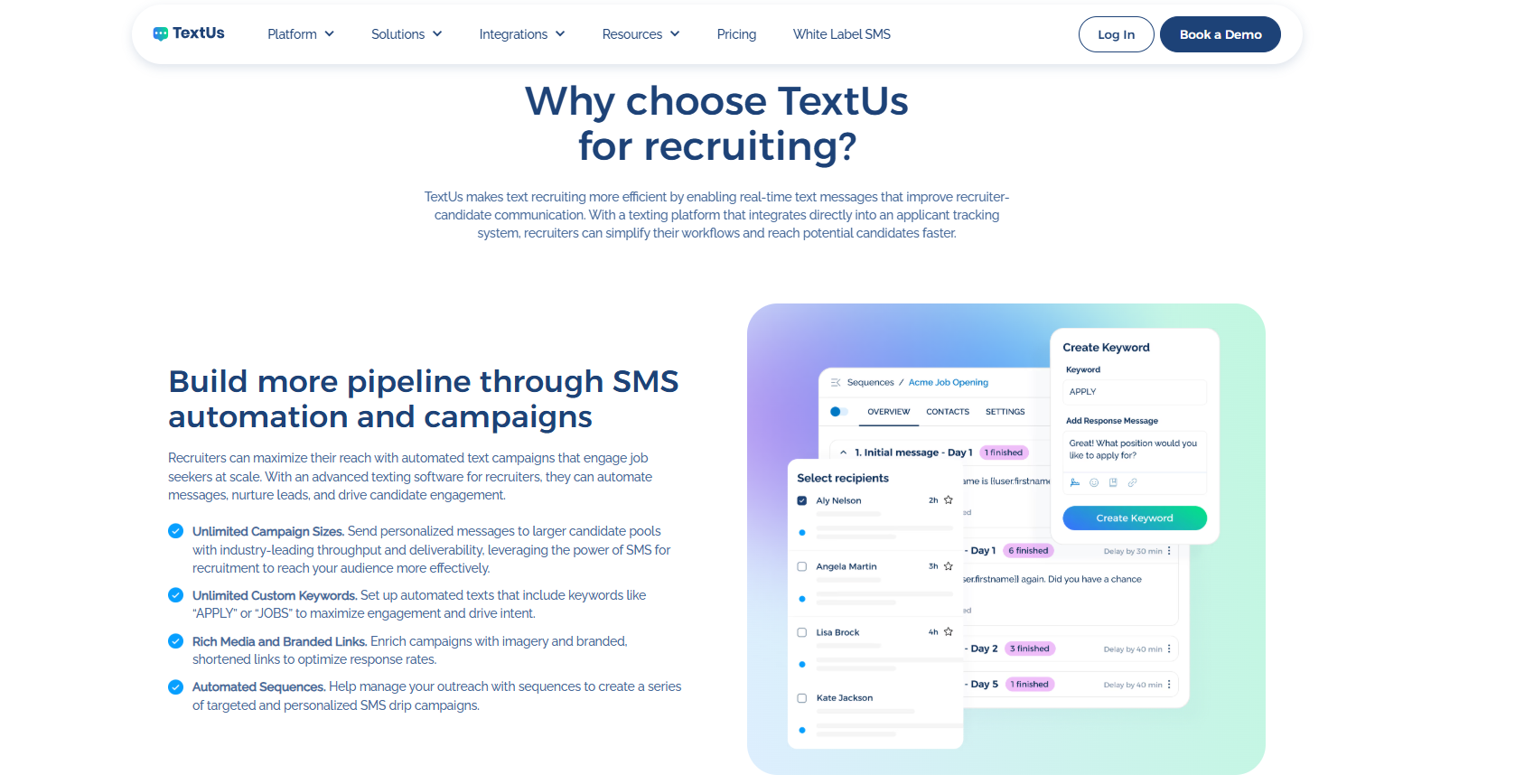
TextUs supports two-way texting, scheduled messages, drip campaigns, and real-time conversation management in one platform.
It handles repeatable communication while you stay involved when a candidate replies or needs personal attention.
Time-sensitive outreach also doesn't need to depend on recruiters remembering every follow-up.
Scheduling automation reduces the amount of manual coordination required around interviews and candidate availability.
You can prepare individual messages and campaigns in advance, while recurring campaigns support outreach that follows a set cadence.
SMS keywords also create a faster route from interest to action. A candidate who replies with a keyword enters a relevant sequence for next steps, links, or reminders.
This helps you turn high-volume candidate replies into specific next steps, such as confirming availability or scheduling an interview. Book a demo with TextUs today!
Keep Candidate Communication and Context Connected
Candidate communication is easier to manage when texts and conversation history stay connected to your existing recruiting systems.
TextUs integrates with systems such as LaborEdge, JobDiva, Greenhouse, JobAdder, BlueSky, eRecruit, Workday, Oracle, SAP SuccessFactors, and SymplrCTM. It reduces repeated data entry and the need to reconstruct previous SMS conversations.
A connected recruiting workflow also means less switching between unrelated applications just to understand what happened with a candidate.
Shared inboxes add another layer for a small team or any organization where several recruiters and coordinators communicate with the same candidate pool.
Conversation assignments and internal notes make ownership easier to follow when work moves between people.
Standardize Repeatable Recruiting Processes
Screening, interview feedback, candidate disposition, communication, and internal handoffs all require decisions about who owns the next action.
Standardization makes it easier to understand who owns each step and what needs to happen before a candidate moves forward.
This structure is valuable in technical roles, where screening criteria, interview stages, and stakeholder feedback may involve more steps than a standard role.
A defined process reduces unnecessary back-and-forth without forcing every position into the same workflow.
Standardization still needs room for context. Credential requirements, candidate availability, specialized roles, or complex interviews may require a different path.
Use Templates for Common Recruiting Conversations
Recruiters write the same types of messages across different candidates and requisitions.
First outreach, follow-ups, interview reminders, availability requests, credential requests, re-engagement, and status updates rarely need to begin with a blank message.
Templates reduce drafting time and provide a consistent starting point. You can adjust the details for the candidate, role, hiring stage, or situation rather than rewriting the full message each time.
TextUs provides SMS templates for pre-written responses. Personalized campaigns also add candidate information through dynamic fields, which keeps high-volume communication customized.
Templates also separate repeatable structure from human judgment. The message framework stays consistent, while tone and sensitive details still come from the recruiter handling the conversation.
Prioritize Recruiter Time Based on Candidate Engagement
Not every open conversation needs the same level of attention at the same moment.
A candidate who just asked about an interview, completed a requested action, or responded after several follow-ups may need more attention than someone who has not engaged.
Response history, recent conversations, interview stage, completed actions, and expressed interest provide signals about where recruiter attention may have the most impact.
TextUs Contact Intelligence adds another layer by using artificial intelligence (AI) to score contact engagement based on the context of the conversation.
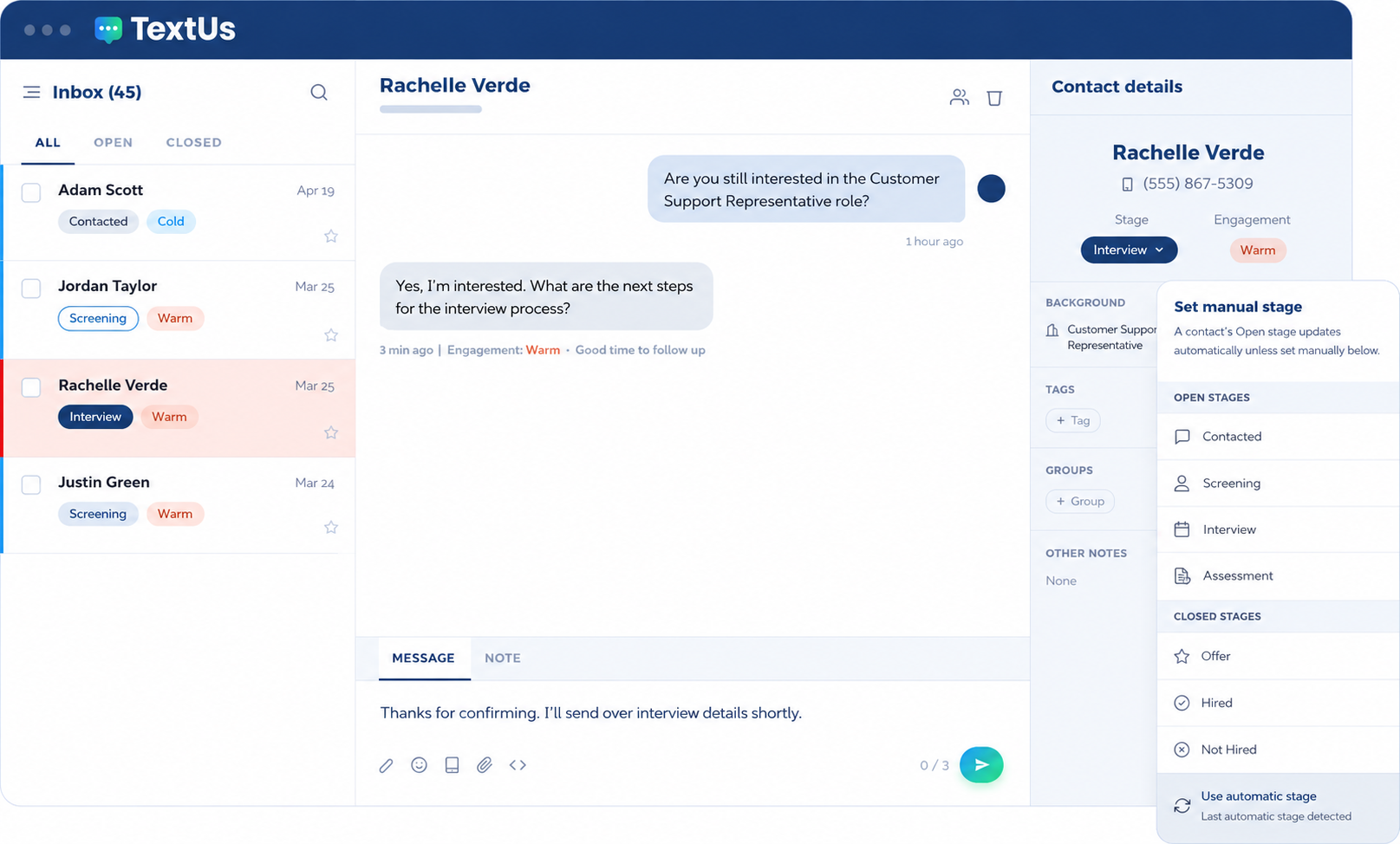
This makes it easier to spot a highly engaged candidate asking about an interview or assignment instead of treating every open conversation with the same priority.
Human judgment still stays at the center of the decision. The strongest approach combines behavioral signals with role requirements, recruiter context, and the candidate’s actual situation.
Turn Candidate Messaging Into a Productive Recruiting Workflow With TextUs
Productivity improves when less time goes to repeated follow-up and more time goes to candidate conversations.
TextUs helps you reach candidates through conversational texting. Scheduled texts, SMS marketing campaigns, and follow-up sequences reduce repetitive outreach.
The platform helps you track engagement and prioritize active conversations through messaging analytics and Contact Intelligence.
It also integrates with ATS, which keeps candidate messages closer to the workflows you already use.
You spend more time on qualification, relationship building, placements, and conversations that need human attention.
Book a demo with TextUs today to see how better candidate communication can improve recruiter productivity!
FAQs About Recruiter Productivity
What is the 70/30 rule in hiring?
The 70/30 hiring rule is a hiring principle where candidates meet about 70% of job requirements. The remaining 30% covers skills or knowledge they may develop after joining the company.
This approach encourages you to separate essential job description requirements from skills candidates can learn after hire.
What are the 5 C's of recruitment?
One recruitment framework defines the five C's as competency, character, communication, culture fit, and consistency. It examines whether candidates can perform the role and communicate well.
What are good KPIs for recruiters?
Useful KPIs include hires per recruiter, response rates, hiring speed, conversion rates, candidate quality, and offer acceptance.
Different companies may prioritize different metrics based on hiring volume, recruiter workload, role complexity, and business goals.
How many positions should a recruiter fill per month?
According to Ashby, the average recruiter reached 7.3 hires per quarter by Q1 2026. When Ashby separated the results by function, business recruiters averaged 5.0 hires per quarter, while technical recruiters averaged 3.8.
The gap between these two functions shows why technical hiring and business recruiting need different productivity expectations.
Continue Reading



Frequently Asked Questions
Business Texting
Built for Results
Create and convert pipeline at scale through industry leading SMS software