
How to Choose the Best SMS Short Code Service
Compare SMS short code service pricing and features, and see how TextUs supports setup and campaign management.

Written by
Adam Hamdan
Published
September 25, 2026

Short codes are built for speed and reach. But getting one up and running involves several steps.
Campaign setup and ongoing management can add extra work, especially if you plan to use SMS short code messaging as a long-term communication channel.
The right SMS short code service should make it easier to launch campaigns, manage replies, handle carrier requirements, and keep communication moving.
In this article, you’ll learn what to look for in an SMS short code provider, what affects pricing, and how to compare your options.
You'll also find how the best SMS platform can support setup, carrier requirements, and ongoing campaign management.
TL;DR
- When choosing a short code provider, look for one that covers registration, carrier support, high-volume sending, two-way texting, automation, compliance, integrations, and reporting.
- SMS short code service costs vary by number type, lease term, message volume, and provider fees, with dedicated short code leases ranging from about $500 to $1,500.
- Choose an SMS short code service based on your use case, number type, expected message volume, total cost, contract terms, and the provider’s experience with similar campaigns.
- TextUs helps you move from short code setup to day-to-day campaign management with carrier support, automation, two-way texting, and reporting built into the platform.
What to Look for in an SMS Short Code Service Provider
The provider you choose affects far more than getting a short code number. Here are the main factors to compare before choosing a provider.
Registration and Carrier Support
Short code registration involves more than choosing a number and activating a messaging account. That's why carrier support is worth comparing when you evaluate providers.
A service that handles more of the coordination with U.S. carriers and network operators reduces the amount of back-and-forth your staff has to manage.
Changes to campaign details, message flows, or subscriber acquisition methods require updates before further messages are sent. So, ongoing support is just as important.
TextUs is an SMS platform that guides you through the registration process, including campaign information, opt-in documentation, and other details required during carrier approval processes.
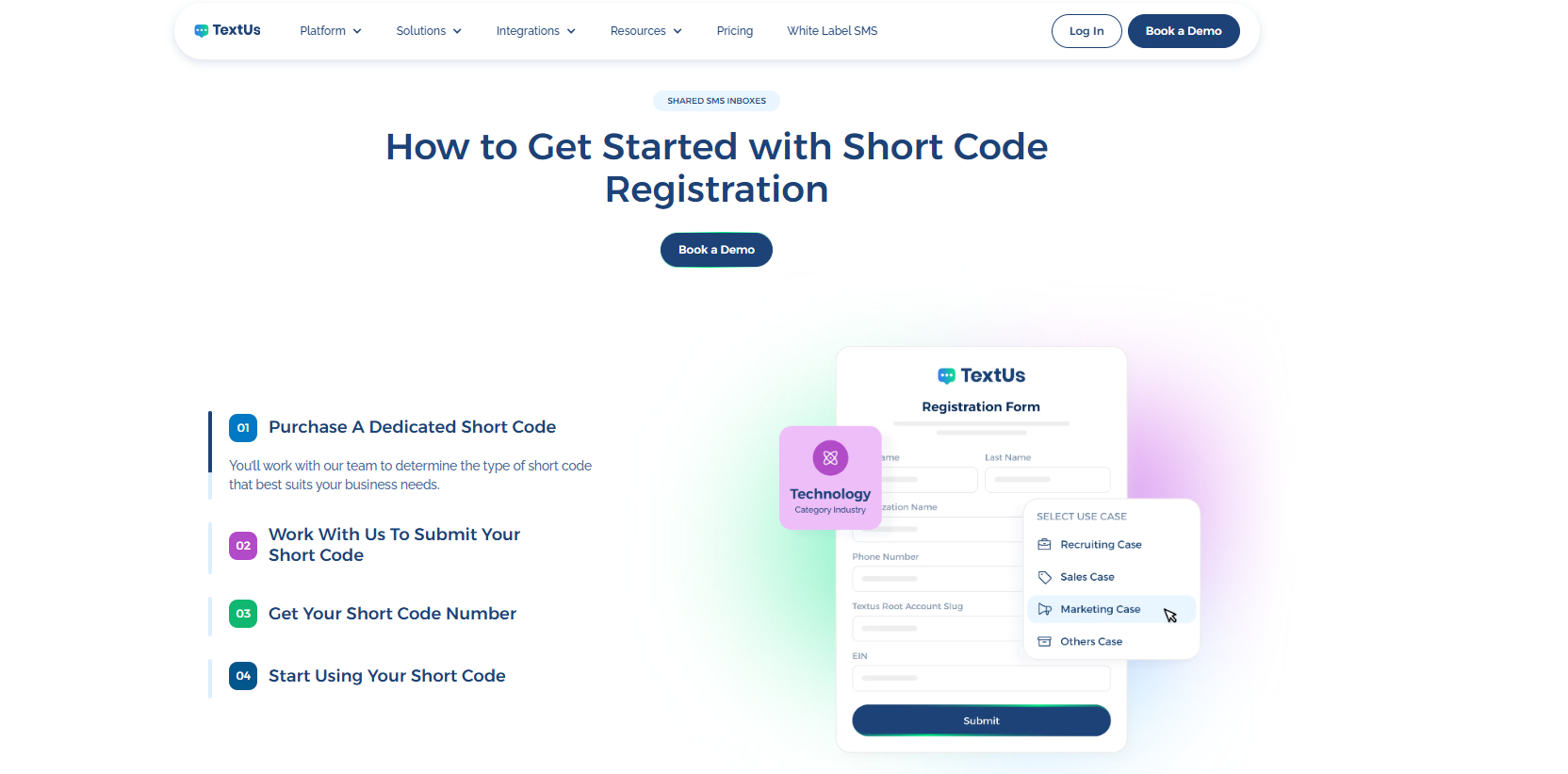
It also assists when mobile carriers request updates or additional information. That support makes short code setup easier to manage and creates a smoother path from registration to campaign launch.
Book a demo with TextUs today and see how it takes the complexity out of short code registration and ongoing campaign management!
High-Volume Messaging Capacity
Message capacity deserves close attention if you expect large subscriber lists, urgent notifications, or bulk SMS campaigns.
Ask how much traffic the platform handles, what throughput is available, and whether sending capacity changes based on campaign type or carrier requirements.
A short code service also needs the infrastructure to manage spikes without forcing every SMS message through the same sending limits.
Two-Way Texting
A service that lets you receive messages creates room for replies, keyword responses, support conversations, recruiting interactions, and other exchanges after the initial send.
The platform experience matters here as much as the number itself. Shared inbox access, message history, notifications, and automated messages make it easier for staff to manage conversations.
Keywords and Text-to-Join Campaigns
Keyword tools can turn a short code text message into a subscriber acquisition channel.
People may text a chosen word to join a campaign, request information, enter a marketing promotion, or trigger a preset response.
Good subscriber management makes consent information from the opt-in process, campaign activity, and customer data easier to track as the contact list grows.
Campaign Automation and Scheduled Messages
A capable short code service goes beyond sending a single SMS campaign to a contact list.
Scheduling, automated follow-ups, triggered responses, audience segments, and recurring sequences reduce manual work across larger messaging programs.
These features are worth comparing across SMS services because automation options vary from basic scheduled sends to more advanced workflows.
Compliance Tools
The requirements for obtaining a short code are designed to protect consumers from spam and other forms of messaging abuse.
SMS compliance tools need to support the way you collect consent, process opt-outs, identify the sender, and manage marketing message content.
A provider may also offer controls that flag risky message patterns, monitor opt-out activity, or stop sends when campaign behavior creates added carrier risk.
SMS software doesn't replace the company’s responsibility to follow applicable laws and carrier requirements. It can, however, make SMS short code compliance easier to manage.
Analytics and Reporting
A provider needs to show more than the number of messages sent.
Delivery results, failed sends, responses, opt-ins, opt-outs, link activity, and conversation data offer a better view of how campaigns perform.
Reporting also helps you spot changes that may require attention, such as rising opt-outs or declining response rates.
Integrations and API Access
Short code conversations are more valuable when they connect with the systems you already use.
CRM, ATS, marketing, and customer service integrations keep contact records and messaging activity tied to existing workflows instead of splitting information across separate tools.
SMS API access lets you build custom workflows or add messaging inside your own software, especially when you have several departments or systems.
How Much Does an SMS Short Code Service Cost?
Your total SMS short code cost depends on the number type, lease term, messaging volume, and the services included by the provider.
In the U.S., the Common Short Code Administration (CSCA) manages the Short Code Registry on behalf of participating wireless carriers.
A random short code tends to cost less because the number is assigned, while a vanity short code comes at a higher price because you select an available five- or six-digit number.
A dedicated short code lease often ranges from about $500 to $1,500, depending on the number and service arrangement.
Your provider may then charge for software access, onboarding, campaign setup, messaging usage, carrier fees, integrations, and ongoing support.
Some providers bundle these services into a broader plan, while others price them separately. Therefore, comparing the lease rate alone doesn't show the full cost of the service.
TextUs offers short-code access through its Enterprise plan, with pricing based on messaging volume, campaign scope, and setup requirements.
Book a demo with TextUs to discuss the service options and short code pricing that fit your messaging program.
How to Choose the Best SMS Short Code Service
The best service isn’t always the one with the longest feature list. Here are a few decision points that can help you evaluate your options:
Match the Service to Your Messaging Needs
Your short code texting goals should shape the type of service you choose.
If you rely on large marketing campaigns, you'll have different needs from a business that uses SMS short codes for transactional messages, appointment reminders, or two-factor authentication.
Some campaigns only require standard text messages, while others may benefit from MMS messages for images, graphics, or richer content.
A provider needs to support the message types and campaign volume your program requires.
Decide How Important Number Choice Is
Some businesses prioritize getting started with an available random code, yet others want a vanity code that customers can remember.
A memorable number strengthens brand recognition when it appears across your advertising, signage, digital campaigns, and recurring promotions.
Your decision should reflect how much the number itself contributes to the campaign rather than treating every short code as interchangeable.
There are also other types of SMS codes for business texting, such as long codes (10DLC) or toll-free numbers. For a detailed comparison, check out this article:
Know the Difference: Short Codes vs Long Codes vs Toll-free Numbers
Estimate Your Expected Messaging Volume
Your expected send volume can narrow the field of providers fast.
A service built for smaller campaigns may not have the capacity required for mass text messaging or frequent sends to a large subscriber base.
Look at both current and future volume instead of choosing around the first campaign alone. Growth in subscribers, campaign frequency, or departments can change the level of capacity you need within a few months.
Compare the Full Cost of the Service
The number lease is only part of the total expense. Provider pricing may also include software access, message usage, onboarding, support, campaign services, and a one-time setup fee.
A cheaper starting price doesn't always mean a lower overall cost. Compare what each plan includes, which charges increase with usage, and whether any services require separate contracts or added fees.
Check the Contract and Number Ownership Terms
The agreement should explain who controls the short code lease and what happens if you decide to change platforms later.
Knowing these terms helps avoid issues once the same short code is established across ongoing campaigns.
Ask whether you can move your own short code to another provider and what steps are required to transfer it. A service that gives you more control over the number makes future changes less disruptive.
Review the Provider’s Experience With Your Use Case
An SMS provider may have short code experience without having much background in the type of text marketing you plan to run.
Industry knowledge is valuable when your campaign includes complex workflows, large audiences, or specific messaging requirements.
You can ask for examples of similar programs and how the provider handled setup, launch, and ongoing changes.
The goal is to find a service that understands the practical demands behind your use case, not just the technical process of activating a number.
Why Choose TextUs as Your SMS Short Code Service
A short code is only as valuable as the SMS marketing platform and support behind it.
TextUs combines short code expertise with campaign tools, two-way messaging, automation, and hands-on support. Here are the main reasons why you should choose this service provider for short code texting:
Short Code Expertise From Registration to Launch
TextUs works with you throughout the short code process instead of leaving your staff to navigate carrier requirements alone.
The platform can determine the appropriate short code, gather information about campaign use and consent, assist with filling out a registration form, and complete setup after carrier approval.
The review by wireless carriers typically takes six to eight weeks. Having a provider familiar with the process can make it easier to understand what information is needed and what to expect before launch.
More Than Bulk Message Delivery
TextUs isn't limited to sending high-volume text messages.
It combines high-throughput sending with SMS keywords, MMS, drip campaigns, automated follow-ups, reporting, and other campaign tools designed to make the short code more useful after it goes live.
Two-way short code texting also allows contacts to respond instead of treating every campaign as a one-way broadcast.
Built for Fast, Large-Scale Communication
Short codes are designed for high-volume campaigns and faster throughput than standard business texting numbers.
TextUs lets you reach larger audiences through promotions, alerts, recruiting outreach, customer updates, and other time-sensitive messages.
That sending capacity is more useful when paired with campaign management tools. You can use automated follow-ups, drip sequences, and reporting rather than relying on a short code solely as a delivery channel.
Simplify Short Code Messaging From Setup to Launch With TextUs
Sophisticated messaging features have less value if the platform is difficult to adopt.
The right SMS short code service should support faster campaign launches, stronger customer engagement, and a smoother way to manage communication from one platform.
TextUs pairs its short code capabilities with a user-friendly platform, training resources, and customer support designed to help staff get comfortable with the service and make better use of its features.
That makes TextUs more than a provider that connects a number and leaves the rest to you.
If you want a short code service that supports both launch and long-term campaign management, TextUs is built to help you get more from every message. Book a demo today!
FAQs About SMS Short Code Services
How do I find out who owns an SMS short code?
Short codes are leased rather than owned. You can search the U.S. Short Code Registry to see whether a US short code is available or already registered.
However, the public lookup doesn't identify the current leaseholder.
What is a short code SMS service?
A short code SMS service allows one business or organization to send and receive text messages through a five- or six-digit number. Shared codes once allowed multiple businesses to use the same code to save money, but major U.S. carriers ended support for shared codes in 2022.
Short codes work across participating mobile networks and allow people to interact from their mobile phones through alerts, flash sales, loyalty programs, and other SMS use cases.
How much does an SMS short code cost?
The U.S. Short Code Registry lists random short codes at $500 per month and Select, or vanity, short codes at $1,000 per month. Short-code leases run for fixed terms ranging from three to 12 months.
Your messaging provider may charge additional setup and delivery fees beyond that monthly fee for the short code lease.
How to get an SMS short code?
You need to create an account, lease a number, define your campaign, and work with a messaging partner to submit the service approval form.
The application process may take several weeks, while the Short Code Registry states that provisioning after leasing can take about two to four weeks.
Continue Reading



Frequently Asked Questions
Business Texting
Built for Results
Create and convert pipeline at scale through industry leading SMS software