
15 Ways to Use Text Messaging for Staffing Agencies
Slow candidate replies delay placements. Text messaging for staffing agencies can speed up outreach and scheduling. Explore 15 practical ways to use it.

Written by
Adam Hamdan
Published
October 28, 2026

Staffing success depends on more than finding people who match an open role. You also need quick responses and a way to reach candidates without getting stuck in voicemail or long email threads.
Text messaging lets you stay in touch with candidates on a channel they already use throughout the day.
When you match outreach to their communication preferences, you improve the chances of faster replies and create a smoother path from first contact to placement.
In this article, you will learn how text messaging for staffing agencies can support sourcing, screening, interview coordination, onboarding, placement, and ongoing candidate communication.
TL;DR
- Job seekers instantly respond to texts, so consistent team adoption and timely follow-up can support stronger candidate engagement and fewer missed opportunities.
- Text messaging supports staffing from sourcing existing candidates, referrals, job promotion, and text-to-apply through screening, interview scheduling, reminders, status updates, offers, onboarding, shift coverage, schedule changes, payroll reminders, and re-engagement of past or seasonal workers.
- TextUs helps you coordinate candidate communication with targeted campaigns, two-way texting, automation, ATS integrations, shared recruiter visibility, and performance reporting.
Why Candidate Communication Matters in Staffing
Candidates consider several opportunities at the same time. Long gaps between recruiter updates may push them toward another role before your process moves forward.
Staffing also depends on quick decisions. Client requests, start dates, and worker availability can shift within a short period, so you need responses at every stage of the process.
Regular contact keeps candidates informed during sourcing, screening, interview scheduling, and placement. Even a short update confirms the next step and prevents candidates from wondering whether the role is still active.
Your existing talent pool also holds more value when relationships stay active. Past applicants, previous placements, and seasonal workers already match new openings and require less effort to reconnect with.
Text marketing offers a direct way to reach candidates with job opportunities, questions, reminders, and updates. It keeps conversations active without relying on missed calls or long email threads.
Book a demo with TextUs today and bring faster candidate communication into your staffing process!
15 Ways to Use Text Messaging in the Recruitment Process
Texting fits into more than one part of staffing, from early outreach to communication after someone starts an assignment.
Here are the 15 ways you can implement text messaging at each stage of the candidate journey.
1. Find Candidates Through Existing Talent Pool
Instead of relying on costly job boards for every opening, you can return to the people already in your database. It's easier to identify qualified candidates based on skills, availability, work history, and past recruiter conversations.
The value of re-engaging past candidates also comes from the conversation that follows.
SMS recruiting lets you ask about availability, job preferences, or interest in a new role without asking someone to schedule a call first.
These past candidates may include former applicants, previous placements, referrals, and workers whose assignments have ended.
Email may suit longer updates, while texting supports shorter exchanges in real time. Candidates who failed to answer emails or return phone calls may still reply to a message they can read and answer in seconds.
2. Generate More Candidate Referrals
A referral program takes time to build, so many agencies promote it in one large push and leave it inactive for months. Texting lets you set up a recurring campaign once and keep the program visible throughout the year.
Mass texting campaigns can reach candidates and placed workers based on role, location, assignment history, or recent activity. This keeps recruiting text messages more relevant than a broad referral request sent to everyone in your database.
SMS for staffing agencies also makes the referral request feel less awkward. Even when someone isn’t interested in a role, you can send a referral link and let that person share it without putting them on the spot during a call.
3. Promote Jobs to Relevant Candidate Segments
When you segment your talent database by role, location, experience, availability, or shift preference, your promotional messages stay focused on job openings that fit each group.
Details from your job postings also help shape each audience. If you're hiring for a warehouse role, you may focus on commute range and shift availability. For healthcare job openings, it's ideal to filter by credentials, licenses, or recent experience.
This approach supports personalized outreach without requiring a custom message for every person. If you include the role, location, pay range, schedule, and start date, candidates can decide faster whether the opportunity fits.
4. Support Text-to-Apply and Candidate Sourcing
If you're promoting roles through career pages, social posts, hiring events, QR codes, or printed ads, text-to-apply turns candidate interest into an immediate next step.
Candidates can enter the recruiting workflow by texting a keyword or scanning a code instead of searching for the application page later.
This approach also supports opt-in collection at the point of interest. The sign-up language should identify your agency and set expectations before texting candidates about roles or next steps.
A recruiter introduction, role reference, and one next action are usually enough to move the conversation forward without overwhelming the candidate.
5. Respond to New Applicants Faster
Fast-moving roles require immediate communication after an application. A short confirmation text lets applicants know their submission was received and what to expect next.
85% of candidates responded after the first text, while 70% of responses arrived within the first two hours.
That response window allows you to confirm interest, ask about availability, or move applicants toward screening while the opportunity is still fresh.
But not every candidate will answer the first message. A second or third follow-up brings someone back into the conversation, while candidates who already replied can be removed from later outreach to avoid repeat messages.
A faster response process also supports recruiter productivity. They spend less time chasing applicants through separate channels and more time moving active candidates forward.
6. Pre-Screen Potential Candidates
Questions about schedule, location, start date, credentials, recent experience, and shift preference are usually simple enough to handle through a short exchange.
A targeted pre-screen also keeps your recruiting process organized. You can ask one or two qualifying questions, review the response, and decide whether the candidate should move to the next stage.
Once the basic requirements are confirmed, your recruiter can move the candidate into an interview, request additional information, or close the loop with a status update.
7. Schedule Interviews and Recruiter Calls
Back-and-forth emails and missed calls can slow down interview scheduling. Text messaging lets you share available time slots, confirm appointments, or send a scheduling link.
A candidate replies with a preferred time or requests another option from the same message thread. For your recruiters, that reduces time spent coordinating calendars and checking separate email conversations.
Appointment details may include the date, time, interview format, recruiter name, location, or video meeting link. A confirmation message also makes the next step easy to reference before the interview.
For high-volume hiring, scheduled texts help you coordinate several interviews while keeping each candidate informed about where and when the conversation will take place.
8. Send Interview Reminders and Rescheduling Options
Interview no-shows happen when candidates forget the appointment, miss an email, or run into a schedule conflict.
Automated interview reminders let you confirm the date, time, location, and interview format before the meeting.
An automated reminder may also include an easy response such as “YES” to confirm or a link to choose another time. Candidates who need to reschedule can address the conflict before the original interview slot passes.
Your reminder sequence can include an initial message the day before and another closer to the appointment when appropriate. That extra touch keeps the interview visible without requiring your recruiters to contact every candidate one by one.
Rescheduling options also protect the candidate experience. If they cannot attend the original time, they still have a direct path to stay in the process instead of dropping out completely.
9. Keep Candidates Updated Between Hiring Stages
Hiring decisions don't always happen right after an interview. Client reviews, approvals, background checks, and internal decisions create gaps in the recruitment process.
Silence during those periods may leave candidates unsure about their status. Text updates help you maintain consistent communication even when there is no final decision to share.
A quick message confirms that the role is still active, explains the next step, or ensures the candidate knows when another update is expected.
Status updates also reduce the need for candidates to contact your recruiters just to ask what is happening. Your agency stays present throughout the process without sending long messages or repeating information already covered in an interview.
10. Follow Up on Job Offers
Once you extend an offer, texting keeps the conversation active while the candidate reviews the details. A check-in text helps confirm receipt and allows candidates to raise questions about the role, schedule, or start date.
You can send follow-up messages that remind candidates about acceptance deadlines, direct them to the formal offer, or confirm what happens after they accept.
This also keeps the transition from selection to placement organized. Questions about availability, location, or start timing can be addressed before onboarding begins.
11. Send Onboarding and Document Reminders
Once a candidate accepts the role, text reminders keep onboarding tasks on track before the start date.
You may use them for background checks, tax forms, identification, training, credential uploads, or orientation details.
Short automated text messages work well for deadlines and incomplete requirements that do not need a recruiter conversation. Each message should identify the task, explain when it is due, and direct the candidate to the correct secure portal.
Texting also helps you catch missing documents before they delay placement. Timely reminders keep candidates aware and lessen the risk of an incomplete step pushing back the start date.
12. Fill Open Shifts Faster
Open shifts require a response within hours, especially in high-volume staffing operations where availability changes throughout the day.
Texting lets you contact a relevant group of workers at once instead of calling candidates individually. Staffing coordinators can then review responses and confirm the best match without waiting through multiple voicemail callbacks.
Targeted shift alerts also help you reduce time to fill when a worker cancels, or a client adds coverage at short notice.
SMS segmentation based on location, credentials, availability, and prior assignments keeps each alert focused on people who are eligible for the shift.
13. Communicate Schedule Changes and Worker Callouts
Schedule changes need to reach workers before they affect the assignment. Texting lets you share updated start times, locations, shift lengths, site closures, or reporting instructions.
Worker callouts also need fast coordination between staffing teams. When someone reports an absence by text, you can acknowledge the message and begin contacting an available replacement.
A shared team inbox is valuable when multiple recruiters manage the same account or branch. The full conversation history stays visible, so another team member can step in when the assigned recruiter is unavailable.
For urgent changes, you can text candidates with the updated details and a shift confirmation request. Your team can see who received the update, who replied, and which assignments still need attention.
14. Send Timecard and Payroll Reminders
Timecard deadlines affect whether payroll stays on schedule. Text reminders keep due dates visible and point workers to the correct timekeeping system before the cutoff.
Your messages may cover missing hours, approval deadlines, holiday payroll schedules, or incomplete submissions. A quick reminder with the deadline and portal link keeps the next step easy to understand.
For staffing professionals, these reminders also create a more consistent process. A recorded message history provides an audit trail showing when the reminder was sent and whether the worker responded.
Remember, payroll details and sensitive financial information belong in secure systems. SMS should direct workers to the approved platform for any action that involves private account information.
15. Re-engage Past and Seasonal Candidates
Previous applicants and seasonal workers already have some familiarity with your agency, which makes them valuable sources for future roles.
Before peak hiring periods, you can reconnect with people whose skills, location, or availability match upcoming needs. Targeted job alerts bring former candidates back into the hiring process.
For seasonal hiring, outreach may start weeks before demand increases. Your texting platform organizes candidate groups so each campaign reaches a relevant audience.
How to Improve SMS Response Rates for Staffing Agencies
Two factors influence response rates: the type of message and the length of the message.
According to TextUs 2026 SMS Engagement + Benchmark Report, the average one-to-one SMS response rate is 34.7%, while top-quartile programs exceeded 56%.
Staffing teams also use conversational texts about half of the time, while other industries rely on conversational messaging closer to 70% of the time.
The type of message you send impacts your response rate. Conversational SMS marketing generates three times more responses than automated outreach.
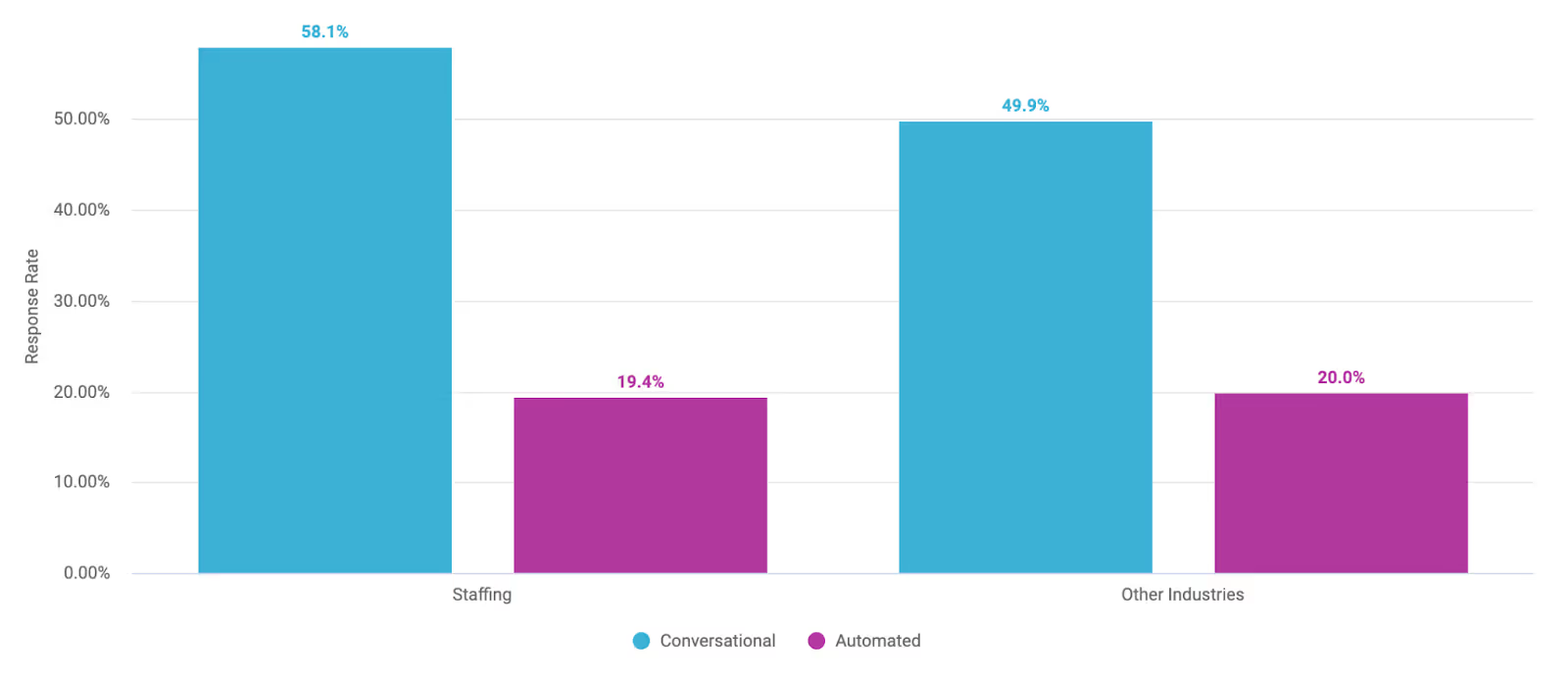
As the diagram above shows, staffing performs better than other industries when conversational texting is used. Staffing response rates reach close to 60%, compared with around 50% for other industries.
Automated texts, meanwhile, typically remain around a 20% response rate in multiple industries.
If you start with SMS automation, move the conversation to a real person once the candidate responds. A higher share of conversational texts can support stronger engagement and more natural recruiter-candidate interactions.
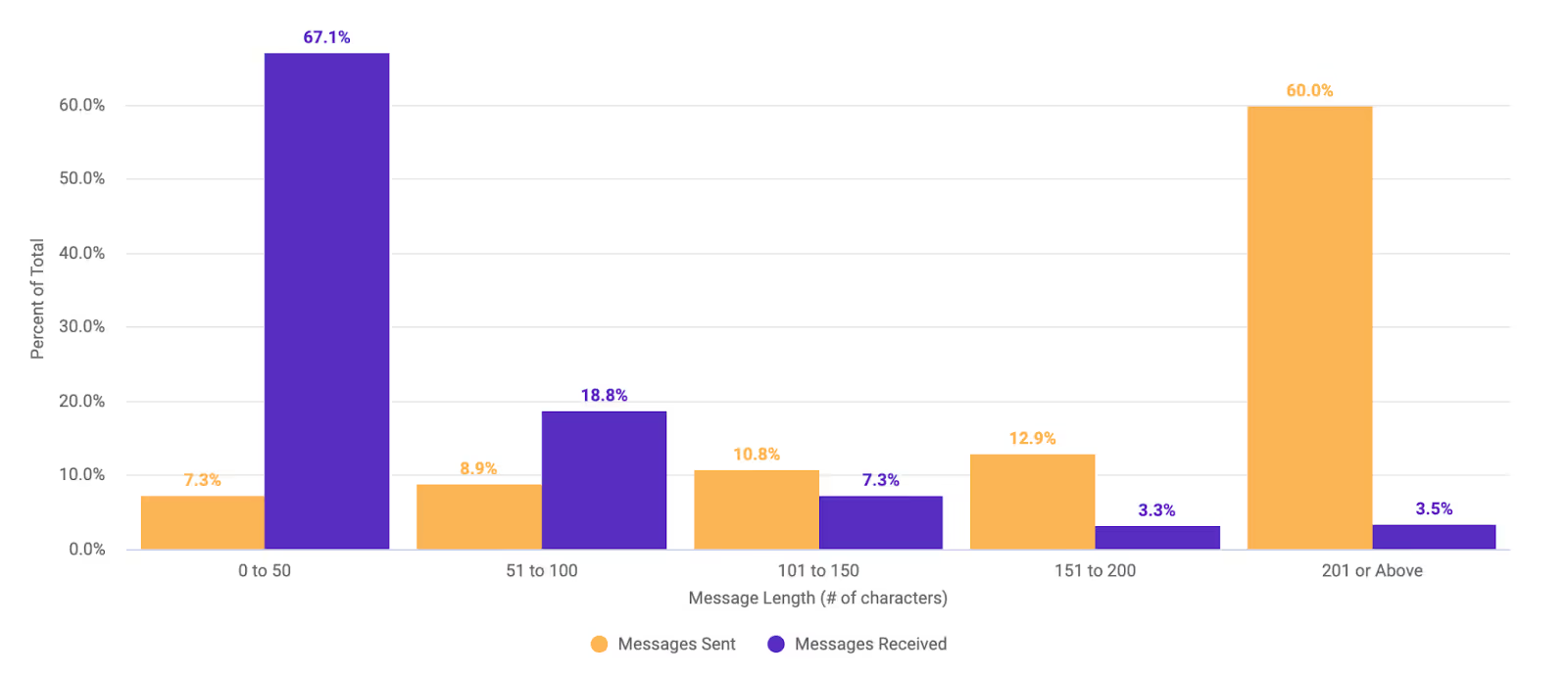
Message length also influences engagement. Two-thirds of candidate messages are 50 characters or fewer, while more than 60% of staffing agencies send messages that are 200 characters or longer.
Shorter texts can generate up to five times more replies, so concise messages tend to perform better.
TextUs Supports Text Messaging for Modern Staffing Firms
SMS text messaging can be challenging as candidate volume, recruiter count, branches, and placements grow.
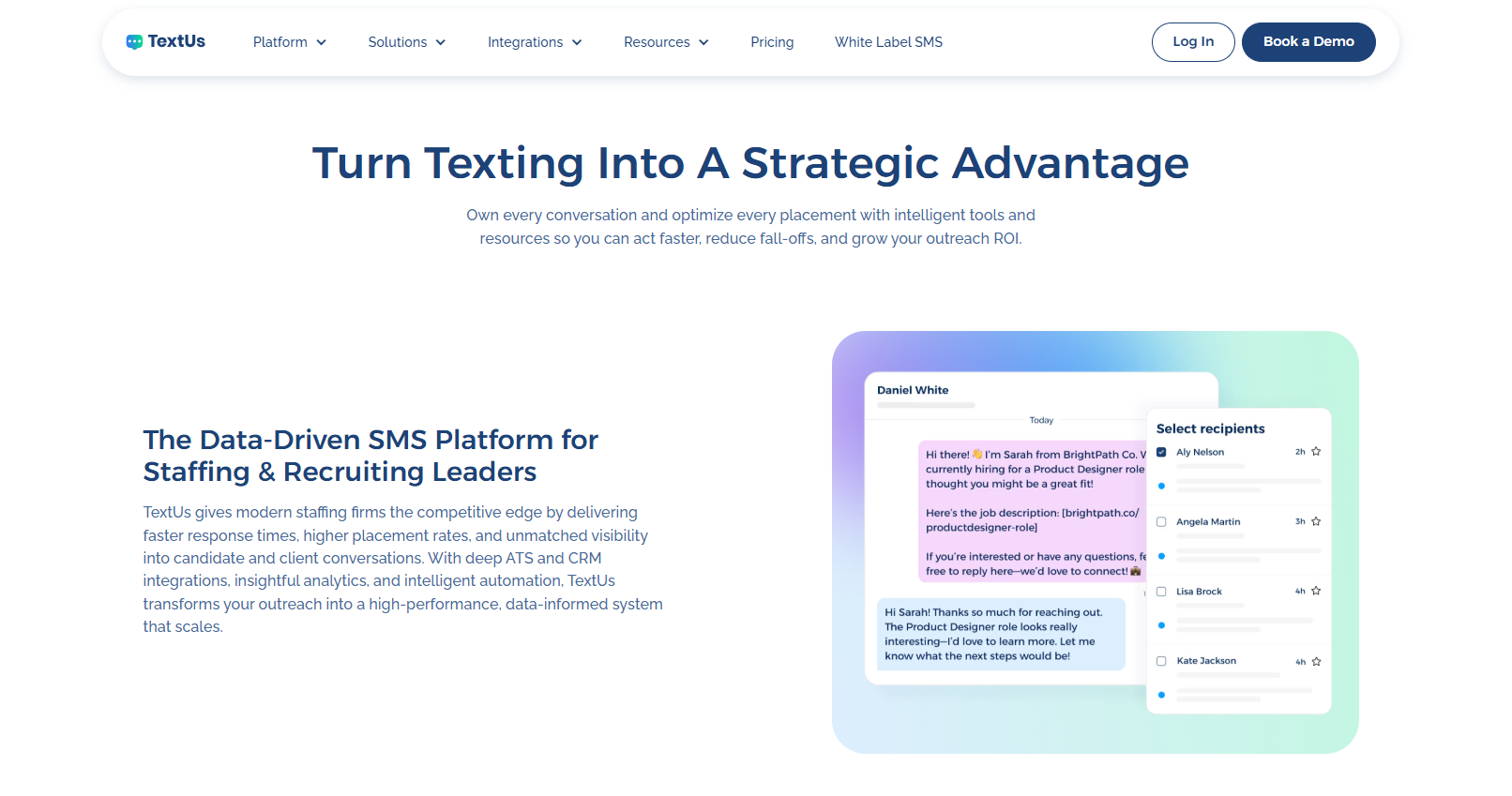
TextUs provides a business texting solution built for staffing firms that need a faster communication channel throughout sourcing, screening, scheduling, onboarding, and placement.
Here’s why you should add TextUs to your recruiting operation:
- ATS integrations: Connect with platforms such as Bullhorn, Greenhouse, Workday, JobDiva, LaborEdge, Tracker, Oracle, and SAP SuccessFactors to stay close to candidate records and existing workflows
- High-volume recruiting campaigns: Reach segmented candidate groups based on role, location, availability, skills, or previous engagement
- One-to-one recruiter conversations: Engage directly with candidates after they respond to broader outreach
- Automated sequences: Schedule interview reminders, follow-ups, re-engagement messages, and recurring candidate outreach
- Shared recruiter visibility: Keep candidate conversations accessible to the recruiting team instead of tying them to one recruiter or device
- Conversation assignments: Route replies to the right recruiter and keep ownership organized for active candidates
- Web, mobile, and Chrome access: Conveniently text from the web app, mobile app, or Chrome extension while working inside supported recruiting systems
- Custom keywords and QR codes: Create simple entry points for text-to-apply campaigns, hiring events, referrals, and candidate interest
- Templates and personalization: Standardize common recruiting messages while adding candidate details such as role, location, recruiter, or interview information
- Campaign and response reporting: Track deliveries, replies, clicks, response times, and engagement within recruiting campaigns
TextUs combines high-volume messaging with real-time, two-way conversations. You stay on top of every candidate interaction with tools that help you act sooner, protect placements, and increase outreach value.
Reach, Engage, and Place Candidates Faster With TextUs
Every missed reply can slow down an interview, delay a placement, or push a strong candidate toward another opportunity.
Candidate text messaging supports the full workflow, from first outreach through interviews and placement. It gives recruiters a direct channel for engaging candidates at every stage.
With TextUs, you get a recruiting-focused texting tool for scheduled messages, one-to-one conversations, ATS integrations, shared visibility, and reporting.
You can also send automated text messages for reminders and follow-ups, then move the conversation to a recruiter once a candidate responds. After placement, the same platform supports ongoing worker communication and employee engagement.
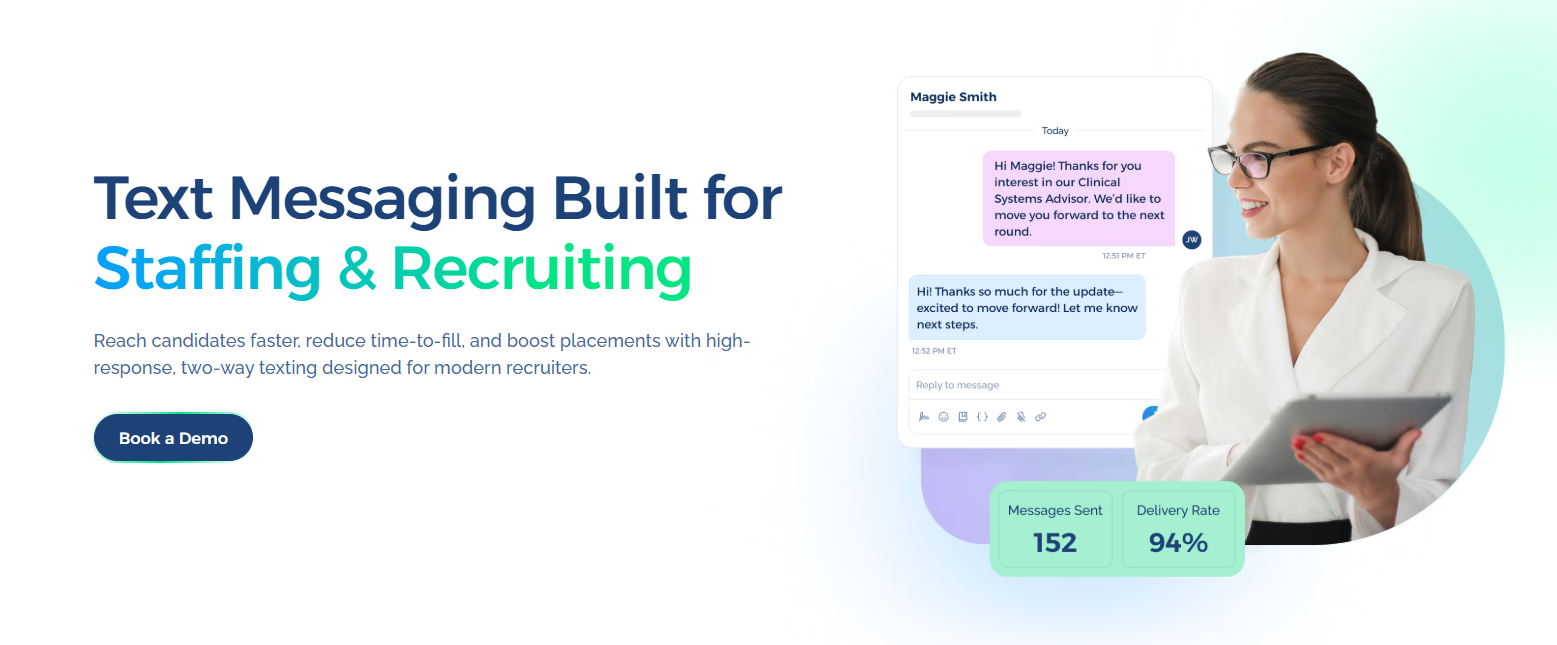
Book a demo with TextUs today to see how it supports your staffing pipeline while making recruiting communication easier to manage!
FAQs About Text Messaging for Staffing Agencies
What is a good message to send to a recruitment agency?
A good message includes your name, preferred job title, location, availability, and relevant experience. Keep it short and mention the specific role or type of work you want.
For example: “Hi, I’m Jordan. I’m looking for warehouse associate roles in Dallas and have two years of distribution experience. I’m available to start next week. Do you have any openings that may be a fit?”
How to get clients for your staffing agency?
Client growth often comes from referrals, outbound sales, networking, industry specialization, and consistent follow-up with sales prospects.
Texting also supports a longer sales cycle by keeping communication active between meetings, proposals, and hiring needs.
Do recruiters reach out via text messages?
Yes. Many recruiters use text for interview coordination, reminders, job updates, and candidate follow-up because it fits naturally into day-to-day recruiting workflows.
A dedicated SMS marketing platform keeps messages visible across the team, preserves records, supports handoffs, and manages opt-out requests without relying on personal phones.
What is the best texting app for recruiting?
The best option depends on your hiring volume, ATS, recruiter workflow, and compliance issues.
Staffing agencies need a platform that supports two-way texting, shared inboxes, templates, automation, reporting, candidate history, and ATS integrations.
TextUs includes these capabilities and integrates with recruiting systems such as Bullhorn, Greenhouse, Workday, JobDiva, LaborEdge, and others.
Continue Reading



Frequently Asked Questions
Business Texting
Built for Results
Create and convert pipeline at scale through industry leading SMS software