
10 Best White-Label SMS Software Options in 2026
10 Best White-Label SMS Software in 2026: 1. TextUs 2. Sinch 3. Infobip 4, Karis 5. Twixor 6. Messangi 7. SMSGlobal 8. Sendo 9. SmsTools 10. Kudosity.

Written by
Adam Hamdan
Published
October 16, 2026

SMS has moved from a nice-to-have feature to a core communication channel for many modern businesses.
The bigger challenge is adding strong SMS capabilities without building carrier infrastructure, compliance systems, and messaging workflows from scratch.
White-label SMS software offers a different path. Instead of building the full messaging stack, you can add text messaging under your brand while the provider manages the infrastructure.
In this guide, we'll explore the main benefits of branded SMS messaging, compare the best white-label SMS software, and explain what to evaluate before choosing a platform.
TL;DR
Here are the ten best white-label SMS software options worth considering in 2026:
- TextUs
- Sinch
- Infobip
- Karis
- Twixor
- Messangi
- SMSGlobal
- Sendo
- SmsTools
- Kudosity
The Rise of Branded SMS Messaging
Brand recognition has become more important as consumers grow more cautious about the communications they receive.
Edelman’s 2026 Trust Barometer found that 88% of consumers consider trust in a brand an important or critical factor when deciding what to buy.
That trust carries into SMS marketing. When a text is disconnected from the company a customer already knows, the experience can feel less credible.
White-label SMS marketing keeps messaging tied to your product identity, customer relationship, and existing experience rather than making another provider the visible point of contact.
You can extend your brand into campaigns, customer conversations, notifications, and other messaging workflows.
However, branding is only the customer-facing part of the equation. The platform behind it determines how well you can manage deliverability, compliance, integrations, and automation.
That makes the technology behind the branded experience just as important as the branding itself.
10 Best White-Label SMS Software Solutions in 2026
The white-label SMS market spans more than basic reseller dashboards.
Below are the 10 best providers that offer white-label capabilities for SaaS companies, telecom operators, resellers, and other businesses:
1. TextUs
Building branded SMS into your product means months of engineering work, carrier vetting, 10DLC registration, compliance review, and ongoing maintenance.
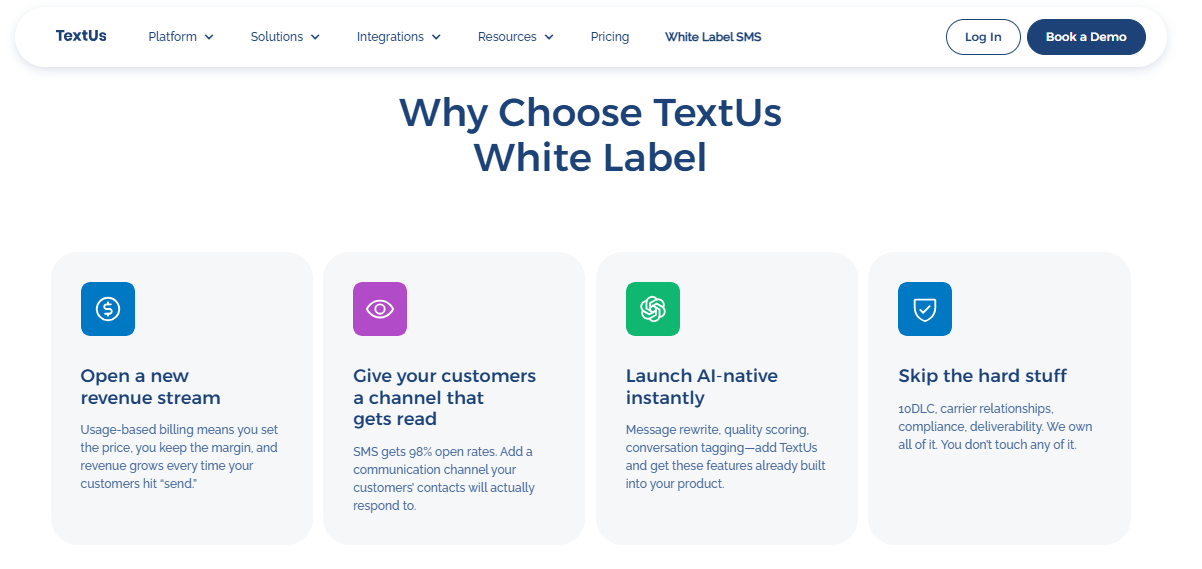
TextUs is your trusted partner for white-label SMS marketing. It removes much of that burden by giving you an AI-powered SMS product with the infrastructure already in place.
Launch SMS Marketing Your Way
TextUs gives you three deployment options based on how SMS fits into your product. That flexibility suits many businesses, whether you operate a SaaS platform, software company, or agency.
The full platform creates a standalone experience with your logo, brand colors, and custom domain. Embedded Messenger places SMS inside your existing interface through an iframe, with conversations tied to customer records.
The API connects your product directly to TextUs messaging infrastructure without adding another customer-facing interface.
Manage One-to-One Conversations and Campaigns
Your customers don't need separate products for individual conversations and bulk messaging. TextUs combines one-to-one conversations and high-volume outreach within the same platform.
Shared inboxes support routing and assignments, while templates and scheduling simplify day-to-day communication.
Campaign management tools include personalization tokens, A/B testing, MMS, short links, and click tracking.
Add AI and Automation Without Expanding Development
TextUs includes workflow and artificial intelligence (AI) features within its white-label offering. Drip campaigns support follow-ups, while keyword opt-ins and auto-replies automate common interactions.
QR codes also create direct paths into inbound conversations. AI in texting supports message refinement before outreach begins.
TextUs categorizes conversations as hot, warm, or cold based on response behavior and timing. These tools save time without requiring another workflow layer.
Keep Carrier and Compliance Work Off Your Plate
TextUs manages carrier relationships, throughput, routing, 10DLC registration, and changes to carrier requirements for white-label partners.
SMS compliance and delivery safeguards include opt-out monitoring, contact validation, message pacing, and pre-send content checks. The Message Quality Indicator also provides risk scoring before outreach goes out.
These controls address filtering and compliance risks before they become another ongoing responsibility for your engineering resources.
Set Your Pricing and Protect Your Margins
TextUs uses partner-based pricing without a revenue-share model. You determine what customers pay and retain the margin built into your pricing structure.
Usage-based billing also ties revenue to customer message volume. You may package SMS around existing product tiers, usage levels, or customer segments instead of following a fixed retail model.
The pricing structure also removes the unpredictable engineering costs associated with maintaining SMS infrastructure in-house.
Connect SMS With Your Existing Systems
TextUs integrates with Salesforce, HubSpot, Bullhorn, Workday, Greenhouse, Zapier, and other business systems.
Contact profiles, custom fields, lifecycle stages, lists, segmentation, CSV imports, and bulk updates keep customer information organized. Real-time synchronization keeps records aligned.
SMS messaging remains connected to the CRM, ATS, or other workflows your customers already use.
Get Dedicated Support Behind Your White-Label Offering
Finally, white-label partners receive a dedicated account manager and access to a support team for customer needs.
TextUs handles tier-three technical support, so complex infrastructure issues stay outside your product and engineering workload.
You retain ownership of the customer experience while the platform manages the deeper technical layer behind the service.
If you want to bring SMS into your product without creating another major development project, book a demo with TextUs today!
2. Sinch
Sinch offers a white-label reseller program if you want to include messaging within your own solutions.
This SMS service supports mass messaging, two-way conversations, automated text reminders, campaign workflows, templates, and real-time analytics. It also provides access to a shared inbox.
Sinch supports integrations with Salesforce, HubSpot, NetSuite, Shopify, BigCommerce, Microsoft Dynamics, and Zoho.
For software providers, Sinch Engage provides API access for SMS and MMS through its Messages API. Developers may schedule messages, receive replies, retrieve delivery reports, and use webhooks for message events.
Subaccounts provide another layer of control for larger organizations and partner environments. Each subaccount has its own administrators and users without access to other subaccount activity.
Parent administrators retain visibility into those accounts, which supports separate departments, business units, or customer environments.
3. Infobip
Infobip’s CPaaS X adds a multi-tenant layer to the platform, so you can manage SMS and other communication channels within separate customer environments.
Instead of giving every customer access to one shared environment, the platform separates messaging traffic, resources, and reporting by customer, brand, or business unit.
Partners may create customer entities through the interface or API and assign phone numbers, SMS sender IDs, and other communication resources to each environment.
CPaaS X also supports virtual long numbers, short codes, toll-free numbers, and alphanumeric SMS sender IDs, subject to the requirements of each market.
This white-label service includes API access for customer onboarding, resource provisioning, messaging, and reporting. Scoped API keys restrict access by application, entity, endpoint, or communication channel.
Webhook subscriptions also operate at the entity level. Delivery reports, inbound messages, and other events from one customer do not appear in another customer's event stream.
Infobip also provides customer-level consumption reporting for billing and cost allocation. For larger international deployments, it reports more than 800 direct carrier connections and offices in more than 80 locations.
4. Karix
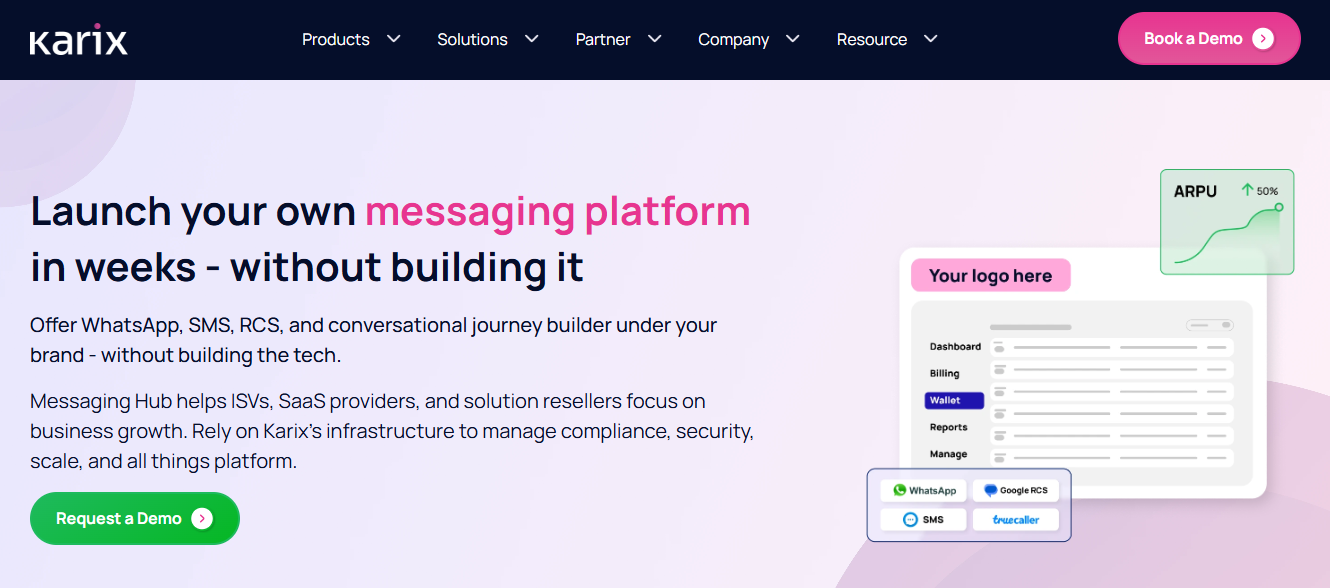
Karix has a white-label application called Messaging Hub designed for ISVs, SaaS providers, aggregators, and solution resellers.
A central administration dashboard supports hundreds of client accounts with separate access rules, usage limits, campaign needs, and pricing structures.
Karix also includes KYC and approval workflows for enterprise onboarding. Role-based permissions, two-factor authentication, and audit logs provide account-level controls for larger partner environments.
You'll have detailed commercial controls within Messaging Hub. They may define their own pricing by customer, channel, and geography.
For SMS, Karix supports bulk campaigns, two-way communication, virtual mobile numbers, short codes, keywords, auto-replies, and API forwarding.
Its SMS products also include real-time delivery reports, webhooks, operator failover routing, and configurable retry rules. It gives partners access to SMS APIs and newer messaging channels through its platform partnership model.
5. Twixor
Twixor provides a white-label CPaaS for telecom operators, aggregators, system integrators, and enterprise communication partners.
Its white-label setup supports custom branding for logos, colors, dashboards, interface elements, and customer-facing workflows. SMS sits alongside WhatsApp, RCS, voice, live chat, and other supported channels.
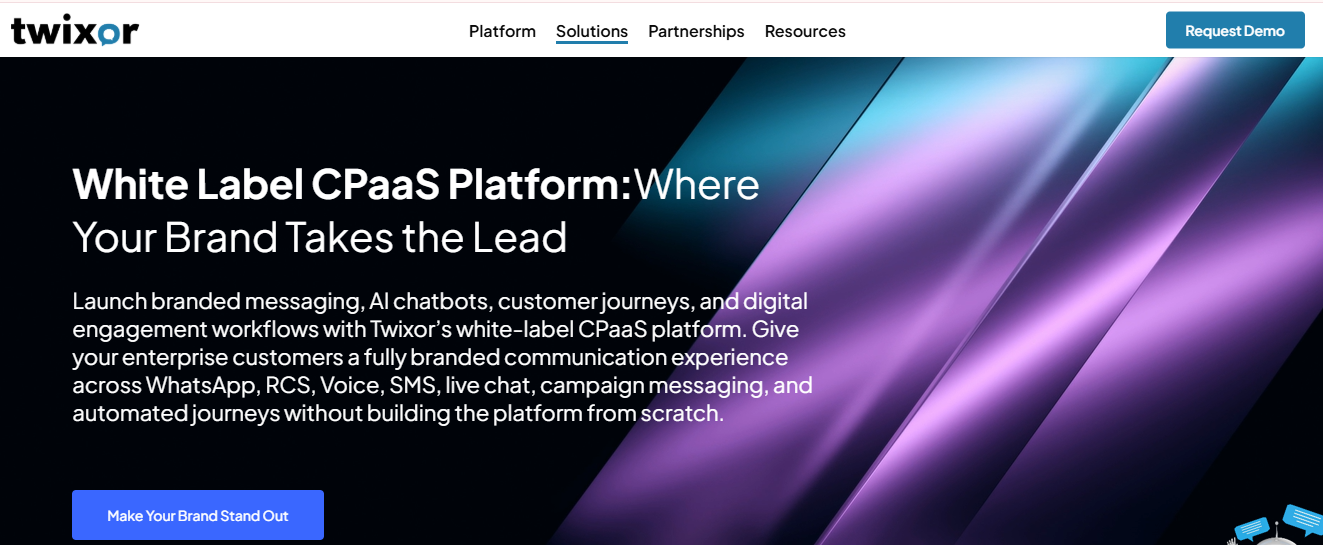
A multi-tier account structure separates the platform owner, enterprise customers, and other partner levels. Twixor combines this structure with built-in pricing, billing, and wallet management.
Campaign and workflow tools extend beyond basic SMS sending. Twixor includes audience segmentation, messaging templates, campaign scheduling, and a Journey Builder for multi-step communication flows.
The platform also supports connections with CRM, ERP, contact center, billing, and customer engagement systems through APIs. These integrations allow SMS activity to connect with customer records, backend processes, live-agent handoffs, and other business workflows.
Its white-label program also includes campaign management, chatbot automation, live chat, analytics, messaging templates, and journey orchestration.
6. Messangi
Messangi provides SMS aggregators and telecom operators with a white-label messaging environment.
Its Bring-Your-Own-Routes model lets you keep your current SMPP connections and carrier agreements while using Messangi for the customer-facing platform. You may also work through REST APIs or an SMPP proxy, depending on your existing infrastructure.
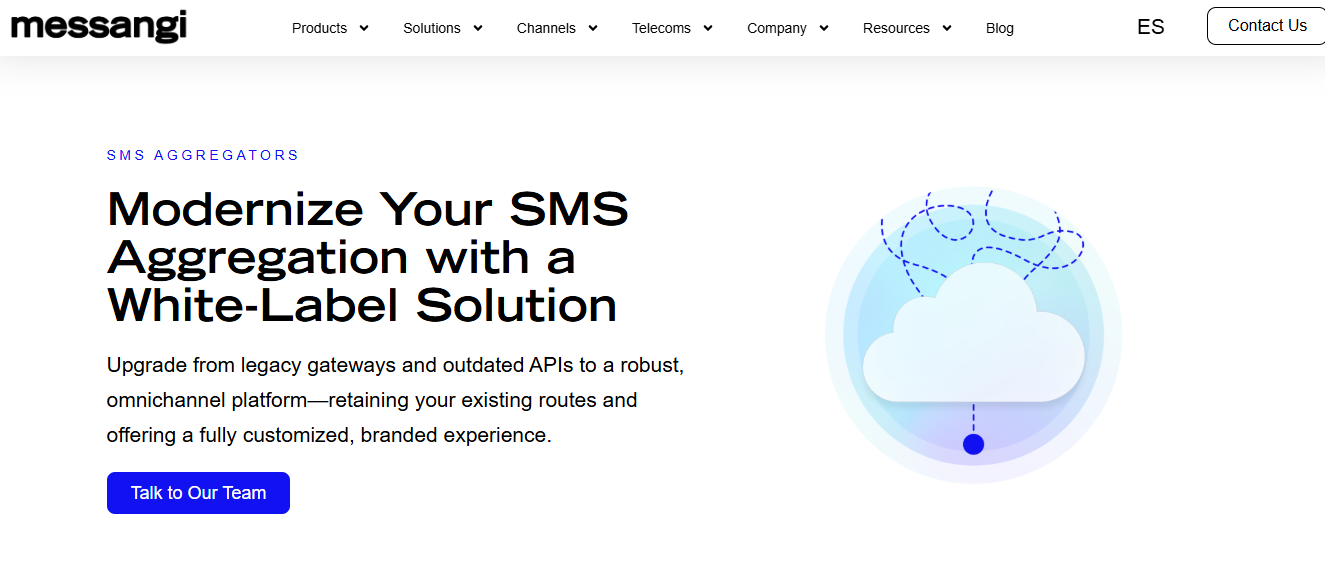
Branding options include custom domains, logos, and a branded user interface. Messangi's interface, domain, and support documentation can also be localized to match the operator’s identity.
Its SMS messaging services cover outbound messaging, inbound replies, delivery reports, and message logs through APIs. Messangi also supports broadcasts, scheduled campaigns, contact lists, audience segments, and automations.
Reporting includes message-level records for both outbound and inbound SMS traffic. You can filter records by recipient, campaign, sender, channel, or delivery status, then retrieve the data through JSON or export it as CSV.
Its expanded 2026 partnership with Liberty Latin America uses a fully branded platform with dedicated enterprise environments, independent service packaging, and flexible commercial configuration.
7. SMSGlobal
SMSGlobal’s white-label reseller program is built around its MXT messaging platform. It also provides marketing materials, including promotional templates for email and SMS campaigns.
The subaccount structure gives parent administrators complete control over credits, access permissions, billing history, and reporting for each customer or business unit.
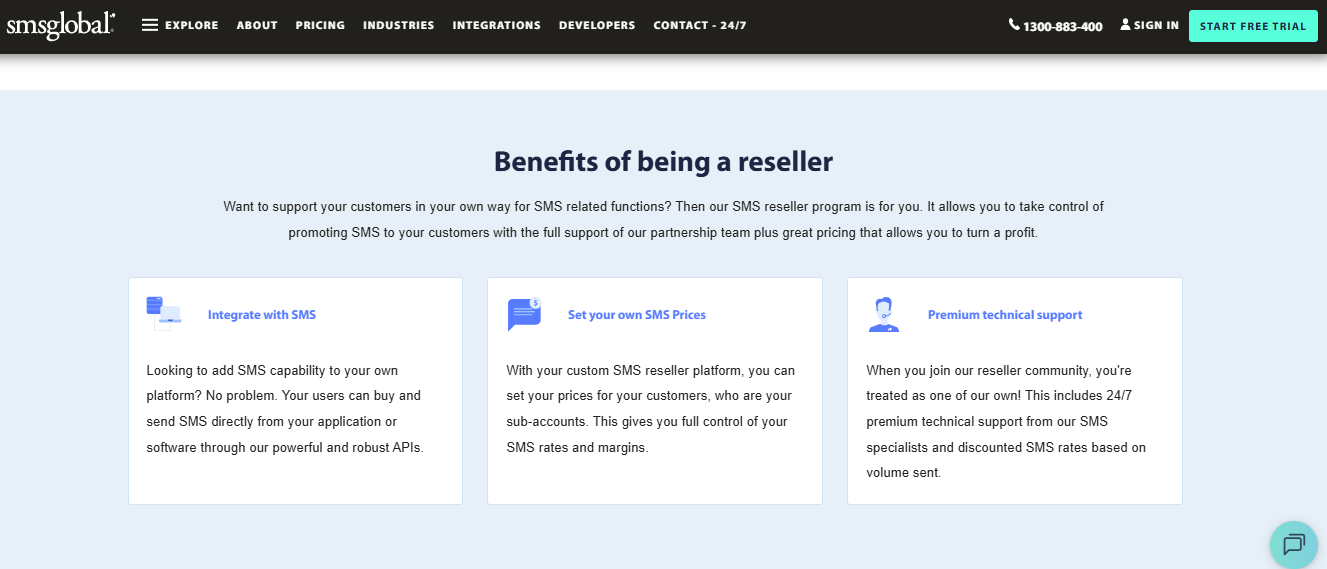
SMSGlobal also supports custom site branding for subaccounts, which extends the reseller setup beyond a single shared interface.
If you want to place SMS inside existing software, SMSGlobal provides REST, HTTP, SOAP, SMPP, MMS, and MNP APIs. Its REST API supports delivery receipts, message-status updates, and inbound-message postbacks.
The SMPP option supports throughput of up to 200 messages per second, TLS connections, short codes, and delivery reports for higher-volume deployments.
SMSGlobal also offers integrations with HubSpot, Salesforce, and Zapier. Its HubSpot integration supports contact synchronization, SMS from contact records, message history, and workflow automation.
8. Sendo
Sendo structures its white-label offer around organizations that manage communication for several customer brands.
Telecom operators may resell the platform under their own brand, while contact centers and BPOs can manage multiple customers through separate campaign and user environments.
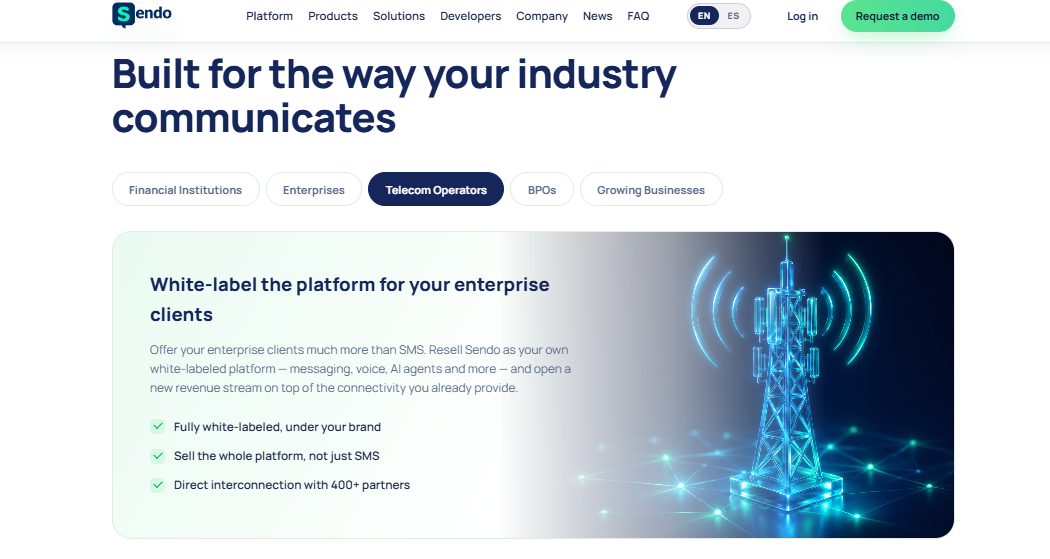
Sendo lists multi-tenant administration, per-client reporting, and capacity that can expand during seasonal campaign peaks among these controls.
For SMS, the platform supports both bulk and transactional traffic. Its web campaign manager includes audience management and message scheduling, while development teams can use REST APIs for programmatic messaging.
Delivery webhooks return message events, and centralized reporting tracks delivery times, read receipts, link activity, and other engagement data for traffic sent through the dashboard or APIs.
Sendo also provides reseller-specific controls for U.S. SMS registration. Approved reseller accounts can register customer brands, then create separate 10DLC or toll-free campaigns for each customer's messaging use case.
Its network connects with more than 400 partners and reaches more than 180 countries through the wider BTS Group infrastructure. Sendo also lists enterprise SLAs, 24/7 support, smart routing, and centralized analytics.
9. SmsTools
SmsTools allows you to run its SMS software on your own domain or subdomain, with your logo and brand colors throughout the customer interface.
The setup supports unlimited customer accounts, which may also be used to separate departments, subsidiaries, or regional teams within a larger organization.
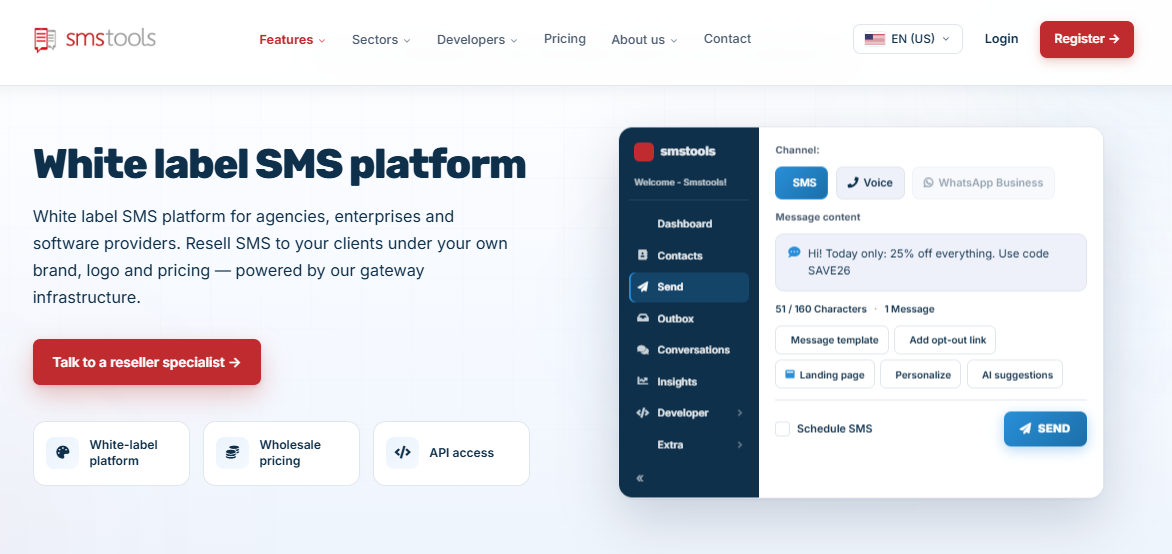
Account administration includes individual SMS rates, balances, reporting, and access for each customer or division. Existing SMS resellers may also ask the platform to route traffic through carrier connections they already own instead of relying only on the company's gateway routes.
Development teams can manage more of the reseller environment through SmsTools' REST API. Available endpoints cover account creation, account management, balance management, and single sign-on.
The company also provides webhooks for delivery and reply events, plus SDKs for PHP, Python, Node.js, .NET, Ruby, and PowerShell within its developer resources. Its SMS API supports both outbound and inbound messaging.
Billing is built into the reseller setup through an optional Stripe integration. Customers may purchase credits from the branded portal, while automatic top-ups replenish balances after they fall below a chosen threshold.
10. Kudosity
Kudosity’s white-label SMS setup also allows you to rebrand its web messaging platform with your own logo, brand colors, and custom URLs.
Partners may adjust SMS margins, set separate margins on virtual mobile numbers, and charge recurring fees for individual keywords.
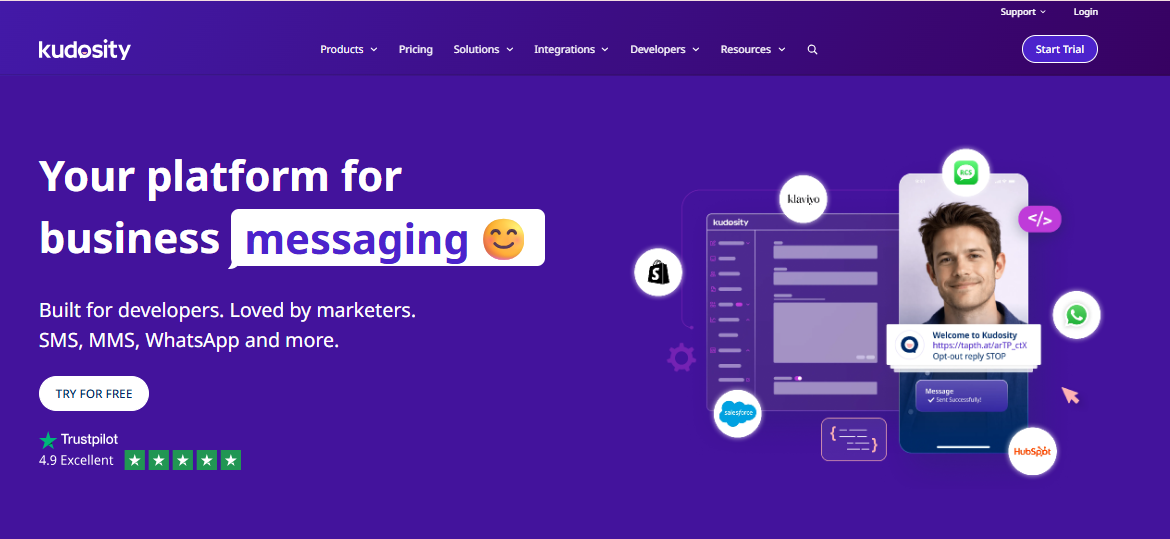
Kudosity also supports automated invoicing and multiple customer payment gateway methods. This gives you a way to manage profit margins without maintaining a separate billing process.
Account administration includes access to customer environments for troubleshooting and live training. You may also set custom trial periods, determine the number of trial credits, and apply daily top-up limits to reduce unexpected usage charges.
The SMS platform itself includes bulk campaigns, two-way messaging, scheduling, contact lists, keywords, auto-responders, tracked links, and reporting.
Developers may also work through Kudosity’s REST API, which supports outbound SMS and MMS, inbound replies, virtual numbers, unsubscribe actions, and real-time delivery reports.
How to Choose the Right White-Label SMS Software
The right platform depends on how you plan to offer messaging, who will use it, and how much control you need. Here are the main areas to compare before choosing the right provider for your product.
Match the Platform to Your Use Case
Start with the role SMS will play in your product or service offerings.
If you're a SaaS platform, you'll need embedded messaging. If you're a telecom provider, you'll need separate customer environments.
Think about who will use the platform, the expected message volume, and whether SMS supports recruiting, support, marketing, or operations.
Your SMS use case will narrow down the features that deserve the most attention.
Review the White-Label Experience
White-label options range from basic logo changes to a fully branded experience. Your evaluation should cover:
- Domains
- Dashboards
- Login screens
- Reports
- Notifications
A deeper setup gives you full control over how customers experience messaging under your brand. Any visible third-party branding should also factor into your decision.
Compare Messaging and Automation Features
These key features should reflect how customers communicate day to day.
Common requirements include one-to-one conversations, campaigns, MMS, templates, scheduling, keywords, routing, and shared inboxes.
Automation becomes more important when customers depend on appointment reminders, nurture sequences, alerts, or recurring workflows. A broader feature set reduces the need for separate tools as those use cases expand.
Check Integration and Developer Options
Strong connectivity keeps messaging tied to the systems customers already use. Native integrations with CRM, ATS, ERP, and customer engagement platforms reduce disconnected workflows.
Custom implementations may also require APIs, webhooks, authentication controls, documentation, and data synchronization.
Review Compliance and Deliverability Controls
SMS compliance requires more than a basic opt-out function. Sender registration, consent management, contact validation, message pacing, and content checks all affect how messaging programs operate.
Carrier relationships and routing also influence delivery performance when customers send messages at higher volumes. The provider should make these controls visible enough for you to understand how risks are managed.
Understand Pricing and Revenue Structure
The advertised monthly subscription rarely represents the full cost of a white-label deployment.
Message usage, phone numbers, carrier fees, registration, implementation, and premium functionality may all affect your total spend.
Your revenue model deserves equal attention. A platform that gives you control over customer pricing leaves more room to maintain healthy margins as adoption and usage increase.
Evaluate Reporting and Analytics
Reporting should cover both messaging performance and customer usage. Delivery, response, engagement, campaign, and conversation data provide a fuller picture of how customers use the platform.
Customer-level dashboards and exportable reports are also valuable when several accounts sit under the same parent environment.
Look at Security and Platform Controls
Enterprise deployments require stronger controls around data, users, and account access.
Role-based permissions, authentication, tenant separation, audit logs, encryption, and security certifications all deserve consideration.
The importance of these safeguards grows as more customers and employees gain access to the platform.
Launch a Branded SMS Experience Faster With TextUs
A white-label SMS rollout may take more than a year before customers can start using it.
Carrier approval, registration, compliance work, routing, and deliverability requirements all add cost and development time.
TextUs removes much of that groundwork because the core telecom infrastructure is already established.
You also get all the features for conversations, campaigns, MMS, A/B testing, automation, AI rewriting, and message quality scoring.
You can customize the experience around your brand while TextUs supports the telecom layer behind it. Less money is spent building and maintaining SMS infrastructure internally.
Book a demo with TextUs today and see how this white-label SMS platform brings branded messaging into your product!
FAQs About White-Label SMS Software
What is the best software for SMS marketing?
The best platform depends on your branding needs, customer volume, integrations, compliance requirements, and the ability to scale.
A strong option should also offer automation, reporting, and two-way communication that lets you enhance customer engagement within your existing product.
Can I buy a white-label app?
Yes, a white-label tool may operate as a standalone branded product or an add-on within your existing software.
The available setup depends on whether the provider offers a full platform, embedded interface, API, or several deployment options.
Does white-label SMS software support two-way texting?
Many white-label platforms support two-way conversations for customer service, recruiting, sales follow-ups, and other direct communication.
Those conversations also support sales by keeping prospects and customers engaged in the same messaging experience.
Continue Reading



Frequently Asked Questions
Business Texting
Built for Results
Create and convert pipeline at scale through industry leading SMS software